
China quotes Cat7 cable at a fraction of European pricing, and the first ten suppliers an importer contacts will all claim to be the factory. Most are not: they are wholesalers who buy from extrusion plants and resell with a margin, a mark-up on freight and sometimes an invented specification. The commercial risk is not the cable, it is paying factory-direct prices for a trading margin and taking factory-level accountability without factory-level traceability. This comparison separates the five wholesaler types that genuinely exist, and shows what each one costs you in MOQ, lead time and verification effort.
Quick answer: The strongest route for most importers is a Guangdong wholesaler in the Shenzhen-Dongguan cluster that owns its extrusion lines and exports directly, because S/FTP capacity, test equipment and export paperwork sit in one place. Order 3,000-10,000 m to get past sample pricing. Caveat: treat the word factory as a claim to be tested, not a description, and never place a container order without a 600 MHz DSX report on the exact construction you are buying.
Top 5 Cat7 Cable Wholesalers in China
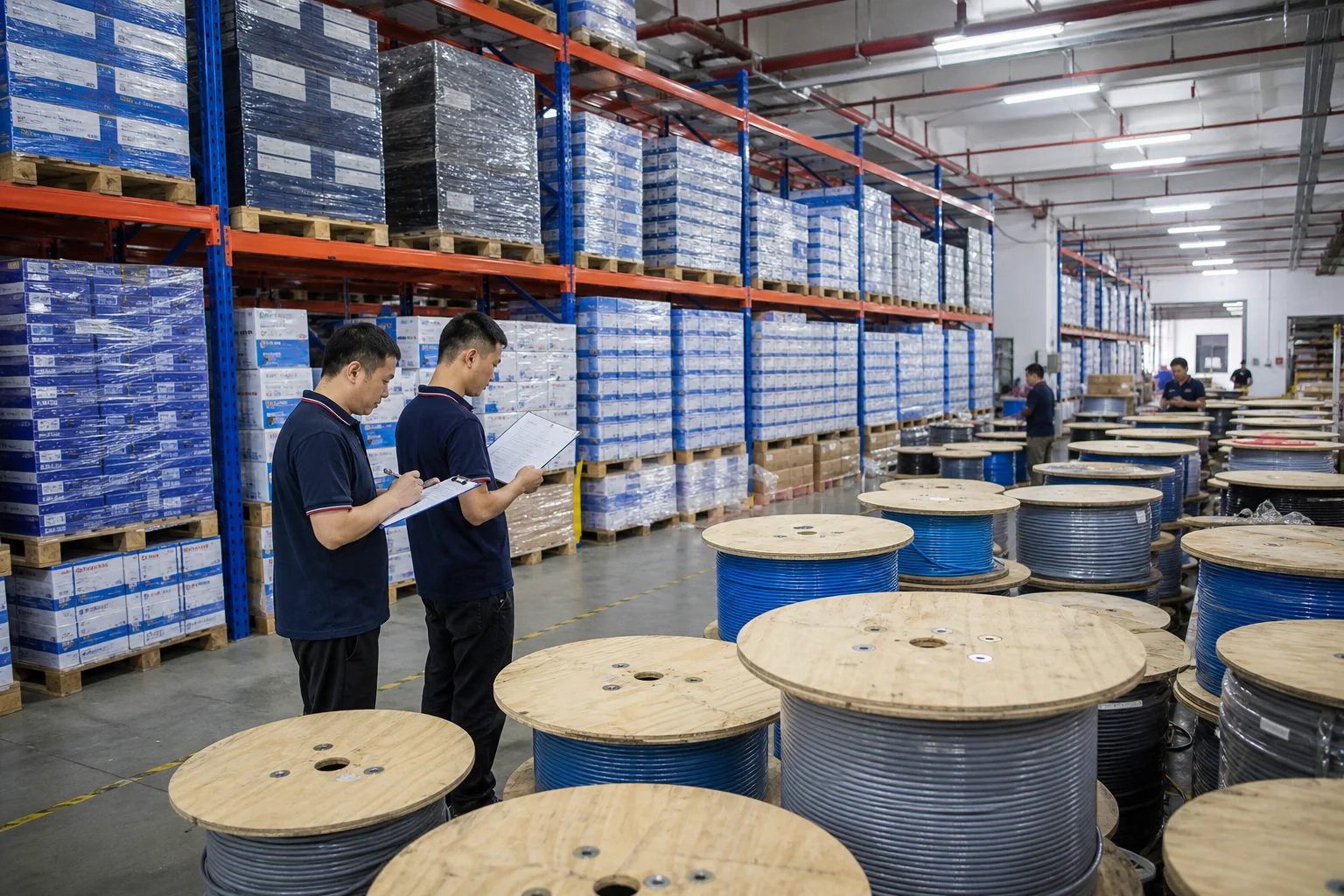
This ranking describes wholesaler types, not named companies. Naming individual firms would be a list of whoever paid for placement, and it would tell you nothing about the two things that decide a Cat7 import: whether the seller controls extrusion, and whether the paperwork survives a 600 MHz test. Ranked by how well each type serves an importer buying Class F cable in commercial volume, here are the five that matter.
Where Cat7 Wholesale Supply in China Actually Comes From
Cat7 is an ISO/IEC 11801 Class F construction at 600 MHz, S/FTP with PiMF pair shielding, usually 23 AWG solid copper. Chinese plants build it to that international definition because their export market is Europe, the Middle East and Asia-Pacific, not North America, where TIA stops at Cat6A. Wholesale therefore clusters where extrusion capacity and export logistics already exist.
Guangdong, Shenzhen and Dongguan. The densest structured-cabling cluster in China. Extrusion, braiding, jacketing, assembly and testing sit within a few kilometres of each other, and export forwarders are on the same industrial estate. Best range of shielded constructions, fastest sampling, highest competition on price.
Zhejiang, Ningbo and Cixi. Strong in cable assemblies, patch cords and connector moulding, with trading houses that consolidate multi-SKU orders. Good for mixed containers, weaker on pure 600 MHz bulk cable engineering.
Jiangsu, Suzhou and Wuxi. Higher-end plants serving structured-cabling brands, with better process control, cleaner documentation and less appetite for small orders.
Anhui, Hebei and inland volume plants. Lower labour cost, high output of standard constructions, thinnest documentation and the widest quality spread per pallet.
Online verified wholesale channels. Alibaba.com verified suppliers, Made-in-China storefronts and Canton Fair exhibitors. Useful for discovery and sample ordering, dangerous as the only due-diligence step, because a storefront badge is an account status rather than a factory audit.
The Five Wholesaler Types Compared
| Wholesaler type | Main cluster | Typical MOQ | Lead time | Certification and testing |
|---|---|---|---|---|
| 1. Factory-direct exporter with own extrusion | Shenzhen and Dongguan, Guangdong | 3,000-10,000 m for custom construction; 100-500 m stocked reels | 3-7 days ex-stock; 15-30 days production | ISO 9001 and 14001; in-house Fluke DSX-8000; RoHS and REACH; 600 MHz sweep |
| 2. Assembly and patch-cord wholesaler | Ningbo and Cixi, Zhejiang | 1,000-5,000 pcs patch cords; 500-2,000 m bulk cable resale | 7-15 days for standard lengths; 20-30 days custom | ISO 9001; patch-cord test reports per cord; component certificates from upstream plants |
| 3. Structured-cabling specialist | Suzhou and Wuxi, Jiangsu | 5,000-10,000 m per type; submittal samples from 100 m | 20-30 days production; samples in 5-10 days | ISO 9001; third-party lab reports; full datasheet with frequency sweep; traceable lots |
| 4. Volume extruder, inland | Anhui, Hebei and inland provinces | 10,000 m and above; container-load pricing | 15-25 days production | ISO 9001 where held; factory test certificate; third-party testing usually buyer-funded |
| 5. Verified online wholesaler or trading house | Guangdong and Zhejiang, multi-plant sourcing | 500-3,000 m trial orders; container consolidation | 10-20 days sourcing and consolidation | Depends on the plant behind the order; platform verification is not a product test |
Which Wholesaler Type Fits Which Buyer?
Type 1, factory-direct exporter. The default choice for an importer who wants Class F and intends to keep buying it. You get one accountable party for extrusion, testing and export documents, and you can audit the line. The trade-off is narrower product range: these plants make cable, not full cabling systems, so patch panels and outlets come from elsewhere. Expect them to quote 5-15 percent above inland plants and to justify it with test data. For custom print and packaging see Cat7 OEM from China.
Type 2, assembly and patch-cord wholesaler. The right partner when your volume is in cords, not reels. Buy the bulk cable from a Type 1 plant and have the cords made where moulding and testing are the core competence. Do not let an assembly shop choose your bulk cable without a construction specification, because the cheapest reel is the default.
Type 3, structured-cabling specialist. Built for buyers who must submit documentation to a consultant: data centres, hospitals, campuses. Highest price of the five, cleanest file, and the least negotiation room. Worth it when a submittal review is the real gate.
Type 4, inland volume extruder. Pure price play at container scale. Only sensible with your own inspection regime on site, a retained third-party lab, and a tolerance for rework conversations. Margin is real; so is variance.
Type 5, verified online wholesaler. A sourcing layer, not a manufacturer. Efficient for trial orders and mixed containers, and a reasonable way to compare ten plants without ten factory visits. It becomes a liability when the purchase order, the test report and the shipping documents point at three different entities.
What Do Chinese Cat7 Wholesalers Charge?
Indicative FOB ranges for Cat7 S/FTP 4-pair, 23 AWG solid, 305 m reel: roughly USD 0.55-1.10 per metre in commercial volume. Below 3,000 m expect the top of the band or above it, because set-up and testing cost is spread over less cable. Above 10,000 m and on repeated orders, the low end becomes reachable. LSZH jacket, 22 AWG conductor, Cat7A at 1,000 MHz and printed private-label jackets all sit above the band. Every figure is indicative: copper, jacket compound and freight move, and a quotation without a copper basis and a 7-15 day validity is not comparable to the next one.
The most expensive mistake in this market is not a high price, it is a low price on a construction that fails on site. A reel that fails a 600 MHz permanent link test costs you the cable, the freight, the installation labour and the recabling programme. Price the test report into the deal. See Cat7 bulk price bands for volume breakpoints.
How to Verify a Chinese Cat7 Wholesaler
- Map the entities. Get the business licence, the plant address and the export licence, and confirm they match. A wholesaler invoicing from one entity while the cable ships from another has no product accountability.
- Ask for the extrusion line, not the catalogue. Request a video walk-through of drawing, insulation, pair shielding, braiding and jacketing, filmed in one continuous take with the plant name visible.
- Validate ISO 9001 properly. Check the issuing body, certificate number, expiry and scope. A certificate for trading services does not cover cable manufacture.
- Demand a 600 MHz test report per construction. A Fluke DSX-8000 Channel or Permanent Link report with date, operator, cable ID and 90 m link results. Headroom matters more than a pass mark.
- Order two sample reels from separate lots. Weigh the copper, check shield coverage, read the jacket print, then terminate and test 90 m yourself or through a local lab.
- Book a factory audit or third-party inspection. Especially for Type 4 suppliers. Confirm the extruder count, the braiding capacity and the test bench exist in the building that will make your order.
- Lock the specification into the contract. AWG, shield construction, jacket compound, reel length, print text, lot numbering and the test standard all belong in the purchase order, not the chat history.
- Run pre-shipment inspection before the container is sealed. Agree an AQL plan, reel length verification and a pull test on a sample. Retain the inspection report with the shipping documents.
Three Buyer Scenarios and the Wholesaler That Fits
- An EU importer replacing a European brand with a private label. Target cost is 40 percent below current landed cost and the client base expects a full datasheet. Route: Type 1 Guangdong factory-direct with printed jacket at 5-10 km, first-article approval, then repeat orders. Keep a Type 3 quote in reserve as a documentation benchmark.
- A distributor testing China for the first time. No history, no inspection partner, and a limited budget for mistakes. Route: Type 5 verified wholesaler for a 1,000 m trial plus a Type 1 sample reel, tested locally at 600 MHz before any container commitment. Judge the test report, not the price list.
- A contractor needing 20,000 m of patch cords and 15 km of bulk cable. Two different manufacturing competences. Route: bulk cable from Type 1, cords from Type 2, both consolidated by one forwarder, with pre-shipment inspection at both plants. Compare this with European supply through Cat7 wholesale in Europe before you commit the year’s volume.
FAQ
1. Are Chinese Cat7 cable wholesalers the same as manufacturers?
Often not. Many wholesalers buy from extrusion plants and resell, adding margin and sometimes an inaccurate specification. Ask for the business licence, the plant address and the export licence, and confirm they refer to one entity. A wholesaler that controls extrusion can show you the line and the test bench.
2. What is the MOQ for Cat7 cable from China?
Stocked reels typically start at 100-500 m per SKU. Custom construction, jacket colour or non-standard length usually starts at 3,000-10,000 m, and OEM jacket print with retail packaging needs 5-10 km. Trial orders of 500-3,000 m are common through trading wholesalers.
3. How long does Cat7 production and shipping take from China?
Production runs 15-30 days for a custom construction, and 3-7 days for stocked reels. Sea freight adds 25-40 days to the US West Coast, 30-45 days to Europe and 18-30 days to Gulf ports. Allow 6-10 weeks door to door for a first order.
4. Is Chinese Cat7 cable good quality?
It can be, and the spread is wide. Plants in Guangdong and Jiangsu that test to 600 MHz with Fluke DSX equipment deliver solid Class F cable. The risk sits in unnamed inland plants and trading intermediaries. Test two lots before you trust a container.
5. Which Chinese cluster is best for shielded Cat7?
Shenzhen and Dongguan in Guangdong, because extrusion, braiding and assembly capacity for shielded constructions sit together there, along with export forwarders. Suzhou and Wuxi in Jiangsu are the alternative when documentation quality matters more than price. Shipping from Shenzhen and Ningbo ports also shortens the export leg to Europe and the Gulf.