
Bulk buying is where Cat7 budgets are won or lost, and it is also where quotes become hardest to compare. One supplier prices a pallet of 305 m reels, another prices a 20-foot container of 1,000 m drums, and a third quotes an annual frame with quarterly releases. The per-meter numbers look like a single market, but each reply carries different packing, print, testing and payment assumptions. This guide maps indicative FOB bands to order sizes, shows which triggers actually move the price, and sets out the checks that stop a volume discount from turning into a quality discount.
Quick answer:
For Cat7 S/FTP with AWG 23 conductors, indicative FOB bulk bands run about USD 0.55 – 1.45 per meter on 300 – 1,500 m orders, USD 0.45 – 1.20 per meter at 6 – 20 km, and USD 0.40 – 1.10 per meter on container loads or annual frames. The caveat is that most of the saving is triggered by packaging and scheduling, not by volume alone, so confirm reel length, print and testing before comparing tiers.
How Much Does Cat7 Cable Cost in Bulk?
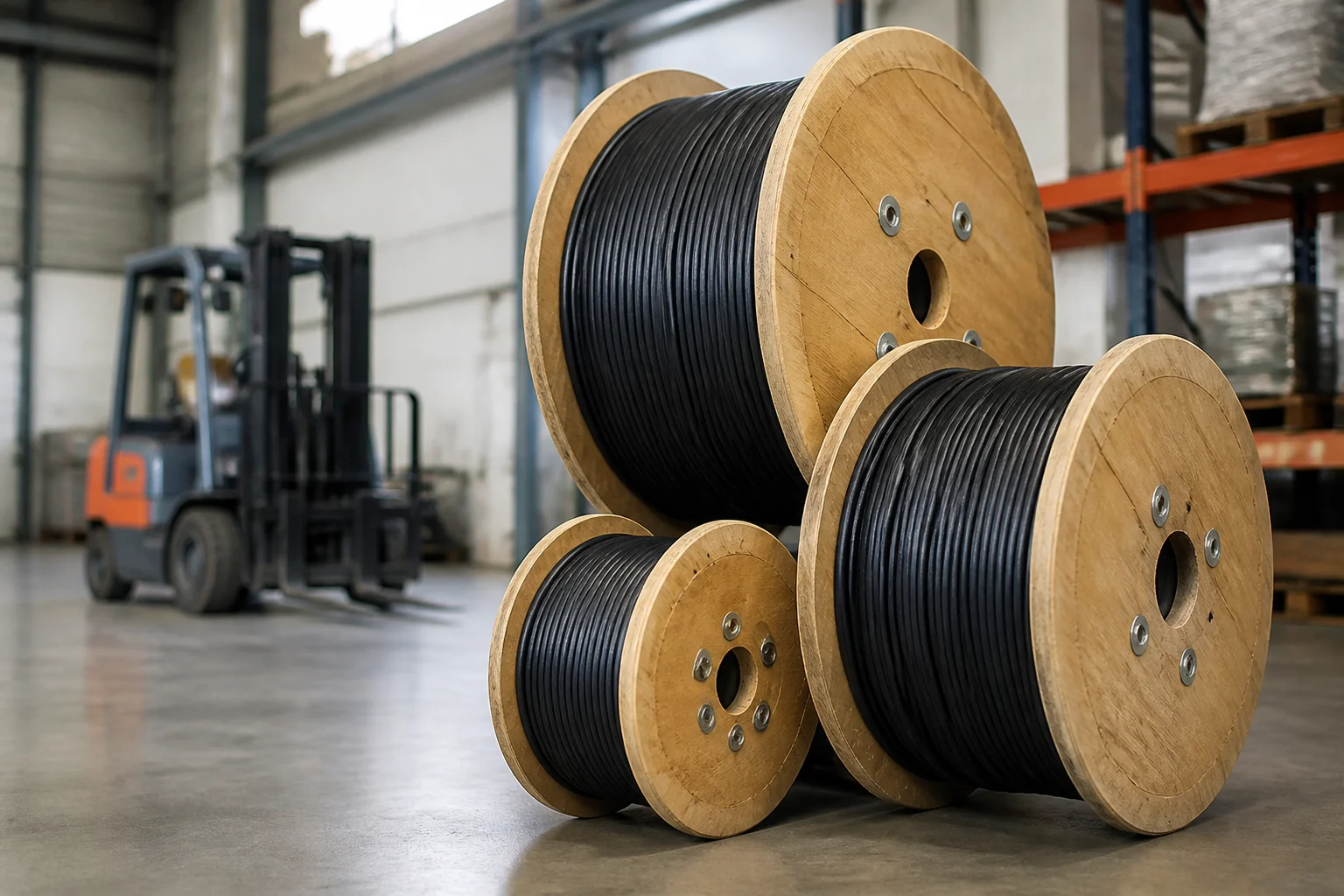
Bulk price bands by order size
The table below sets out indicative FOB bands for Cat7 S/FTP with AWG 23 conductors, PVC or LSZH, in the order sizes that most buyers actually place. Bands are deliberately wide because they span jacket compound and conductor gauge. They exclude freight, insurance, duty and destination testing, and they assume a copper basis stated at the time of quotation.
| Order band | Typical buying unit | Indicative FOB band (USD per meter) | Lead time | What the price assumes |
|---|---|---|---|---|
| 300 – 1,500 m | 305 m reels or mixed spools | 0.55 – 1.45 | 3 – 7 days if stocked | Standard print, no customisation, distributor or factory stock |
| 1,500 – 6,000 m | 500 m reels, some 1,000 m drums | 0.50 – 1.30 | 7 – 15 days | Limited colour and print choice, one construction |
| 6 – 20 km | 1,000 m drums | 0.45 – 1.20 | 15 – 30 days | Custom print, lot testing, mixed loading possible |
| 20 – 60 km | Full container of drums | 0.42 – 1.15 | 20 – 30 days plus 25 – 45 days sea | OEM packing, CPR or UL documentation, schedule agreed |
| 60 km and above | Annual frame with releases | 0.40 – 1.10 | Contracted release windows | Copper index clause, capacity reservation, audit access |
Read the bands as a shape rather than a promise. The difference between a 1,500 m order and a 20 km order is usually 10 – 20 percent, while the difference between a thin construction and a full one at the same order size can be 40 percent or more. Volume buys efficiency; it does not buy shield weight or copper.
What actually moves a bulk quote
Drum size and packing density. A container holds far more meters as 1,000 m drums than as 305 m reels, and the freight cost per meter falls with it. Buyers who fix a reel size for site convenience before costing freight often pay more in shipping than they save in unit price.
Single construction versus mixed. A factory running one construction for 20 km gets a clean extrusion schedule. Five constructions of 4 km each means five set-ups, five test lots and five sets of labels, and the per-meter price reflects it. Consolidate to two constructions where the design allows.
Jacket compound and CPR class. LSZH material costs more than PVC, and a cable claiming a CPR class needs the compound and the test evidence to support it. If your project needs Cca or B2ca, expect the upper half of each band and ask for the classification report rather than a statement on the datasheet.
Print, packing and private label. Custom jacket print, branded cartons and retail-ready spools add tooling and handling. These are one-off costs, so their effect per meter collapses at volume and is painful on a single pallet. If you need private label, plan to buy it at the 5 km level or above.
Payment and scheduling. A firm 12-month schedule with quarterly releases earns better pricing than a single spot order, because the factory can buy copper and plan capacity. Deposits, letters of credit and retention terms all price risk into the number.
Copper basis. Every bulk quote should state the reference date and the adjustment mechanism. Without it, a difference of a few percent between two suppliers may simply be two different copper dates. For a per-meter view before you scale up, see Cat7 price per meter.
How to verify a bulk quote
- Ask for the price build: construction, gauge, jacket, drum size, print, packing and copper basis, each on its own line.
- Request the frequency sweep datasheet to 600 MHz and confirm the quoted construction matches the datasheet, not a sibling product.
- Ask which lot the Fluke DSX-8000 permanent link report came from, and require one report per production lot on the order.
- Verify ISO 9001 and ISO 14001 certificates with the issuing body, and check that the scope covers extrusion and not only trade.
- Order one drum as a pre-production sample, weigh the copper and measure conductor diameter against the datasheet.
- Book pre-shipment inspection on the first container, and require drum labels with lot numbers that match the test reports before releasing balance payment.
- Record the copper basis date in the contract so that later price discussions are about movement, not about memory.
Three bulk buyer scenarios
- A distributor adding Cat7 to a stocked catalogue. Start with 3 – 6 km split across two constructions and two drum sizes, not with a container. That volume is enough to establish the factory’s lot consistency and to learn which lengths your installers actually pull, and it keeps working capital low while the copper basis is proven.
- A contractor with a 40 km campus package. One container plus a second release four weeks later is usually better than a single 40 km order, because site storage is the constraint and because a single bad lot would hit the whole project. Split the award across two qualified factories and keep both on the same datasheet so handover tests are comparable.
- An importer supplying several regional wholesalers. An annual frame with quarterly releases is the right structure, with a copper index clause and an agreed audit window. Negotiate the print and packing once, then let each release vary only in length and jacket, which keeps set-up costs out of every shipment.
Is a full container always the cheapest way to buy Cat7?
Only if the meters are going to be used within a reasonable time and stored properly. A container of drums is cheaper per meter, but drums are heavy, awkward to store and vulnerable to jacket damage if they sit on a damp yard through a winter. Add warehousing, insurance, handling and the cost of capital tied up for six months, and a 20 km container can lose to two 8 km shipments. The break-even depends on your storage and your cash cycle, not only on the FOB number. Buyers who are new to bulk should also check the practical limits of drum handling on site, covered in our guide to reel sizes and drum lengths.
Buying through trading companies or direct
For orders under roughly 5 km, a trading company in Shenzhen or Dongguan often beats a direct factory enquiry once sample handling, consolidation and export paperwork are counted. Above 10 km, direct discussion with the extrusion plant usually pays, provided you can audit it and agree a test protocol. The commercial risk to watch is the middle layer that neither owns the line nor holds stock. Our overview of Cat7 wholesalers in China explains how to tell the two apart before you send a deposit, and why a factory audit is worth more than an extra two percent on the per-meter price.
Planning the first bulk shipment
A first bulk order should be sized to the interval between two shipments, not to the annual forecast. Work out the realistic monthly consumption of the construction you are buying, multiply by the shipping window plus two weeks of safety stock, and round up to the nearest drum size the factory runs. That arithmetic usually lands between 6 and 15 km for a mid-sized distributor, which is also the range where custom print becomes possible and where lead time still fits inside a quarter. Ordering a full container before the sell-through rate is known is the most common way bulk buying turns into dead stock, and no per-meter saving survives six months of warehousing.
FAQ
1. What is the minimum order for a bulk Cat7 price?
Stocked reels usually start at 100 – 500 m per SKU, but the bulk tiers begin around 1,500 – 3,000 m, where drum size and packing start to work in your favour. A meaningful step down normally appears at 6 – 20 km, and another at full container volume.
2. How much cheaper is Cat7 by the container?
Indicative FOB bands suggest roughly 10 – 25 percent below a pallet-level price for the same construction, most of it from freight per meter, packing density and a cleaner production schedule. The saving is smaller than most first-time buyers expect, and it disappears if the meters sit in storage.
3. Does bulk pricing include custom jacket printing?
It can, but print usually carries a one-off cost and a minimum run, commonly 5 – 10 km for a fully custom print and packing programme. At pallet volume, expect standard print or a premium. Ask for the print cost as a separate line so you can judge it per meter.
4. How is the copper price handled in a bulk contract?
Serious suppliers quote with a copper basis: a reference date, an index and an adjustment rule if copper moves beyond an agreed threshold. This protects both sides. A bulk quote that holds a fixed number for months without a clause is either cushioned or will be reopened.
5. What lead time should I plan for a bulk Cat7 order?
Stocked reels ship in 3 – 7 days, production of 6 – 20 km typically takes 15 – 30 days, and sea freight adds 25 – 45 days to Europe or 25 – 40 days to the United States. Add inspection and inland delivery, and a container order is realistically a two-month project.