
Europe is the region where Cat7 is a normal specification rather than a curiosity, and that makes its wholesale market both mature and awkward. Reels are stocked, but mostly in a handful of constructions; CPR classes decide what can be sold into which building; and the price you are quoted depends on whether the wholesaler owns the stock or is brokering it. Buyers who treat Cat7 wholesale as a simple per-metre comparison end up with a cable that meets the datasheet but not the project’s declaration of performance. This guide covers where wholesale volume actually comes from and how to buy it safely.
Quick answer: Buy wholesale Cat7 in Europe from a national distributor with bonded or owned stock in Germany, Poland, the Netherlands or Italy, and specify the CPR class before you discuss price. Intra-EU stock delivers in 3-10 days; production runs take 15-30 days. Caveat: much wholesale Cat7 is private label made in Asia or Eastern Europe, so the brand on the reel says little about who tested it.
Where Do European Buyers Source Cat7 Cable Wholesale?
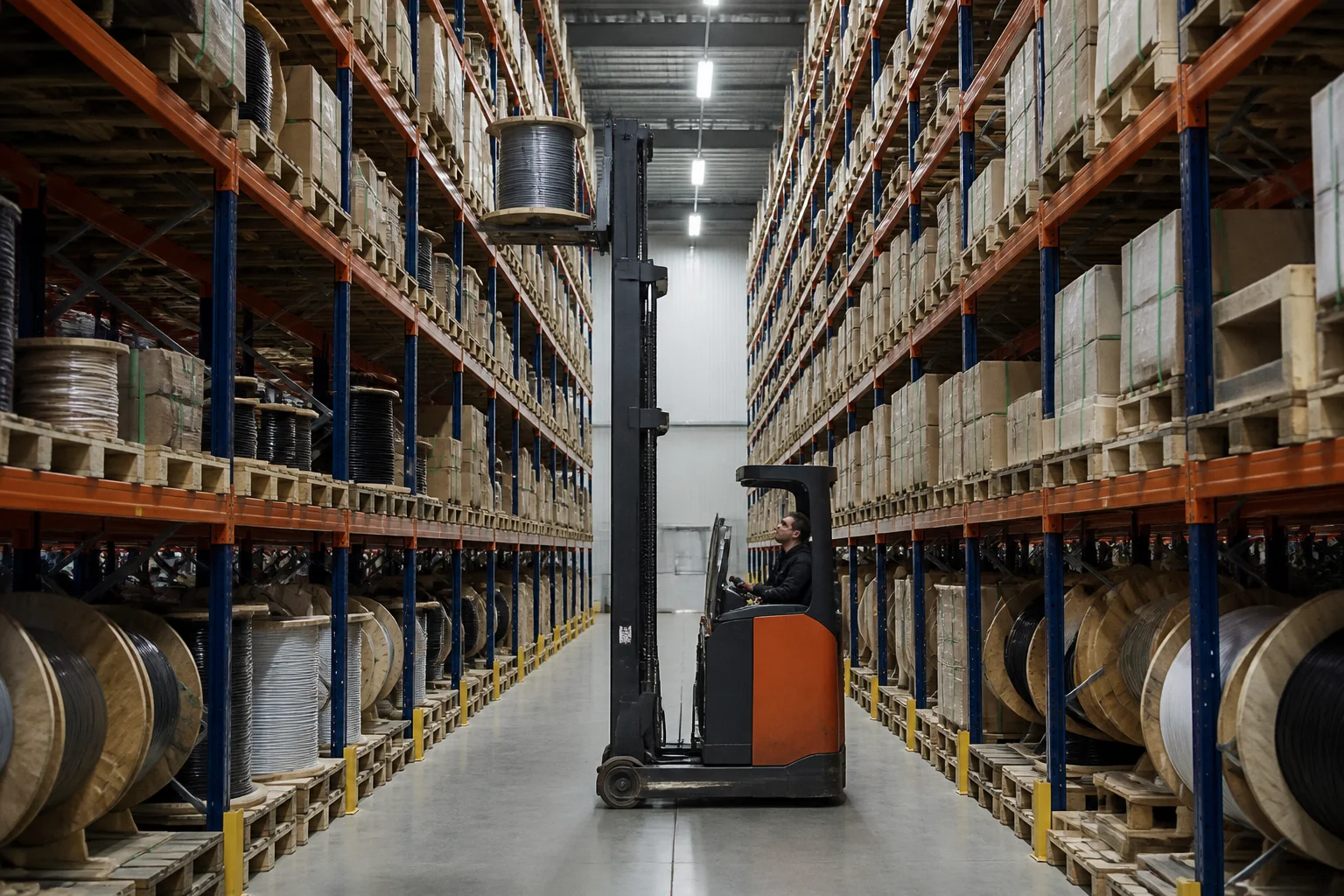
Cat7 is a European and Asian specification far more than an American one. Because TIA standards stop at Cat6A, European projects specify Class F under ISO/IEC 11801 and buy the cable as a construction product with a declaration of performance attached. That single fact reorganises the wholesale market: the reel is not just copper and foil, it is a declared product with a fire class, a CE marking route and a paper trail that a distributor has to keep. Buyers who understand that get better prices and far fewer site failures.
Where European Wholesale Cat7 Volume Actually Comes From
Wholesale stock concentrates where the project density is. Germany carries the deepest range, with distributors around Bavaria and North Rhine-Westphalia holding both domestic and imported Class F reels. Poland has become the volume and logistics hub for Central Europe, with warehouses near Wroclaw, Poznan and Lodz feeding German, Czech and Baltic projects. The Netherlands, especially around Rotterdam and Venlo, holds bonded and transit stock that can be released duty-paid on short notice. Italy’s Lombardy cluster and northern Spain serve southern Europe, and Czech and Slovak warehouses cover the eastern edge.
Behind the geography sits an ownership pattern. Some distributors own the brand and buy private label from Asian or Eastern European plants. Some are national agents for a manufacturer and hold authorised stock. Some are pure wholesalers buying container loads and selling pallets. Buying groups and electrical wholesale consortia pool demand and hold framework stock. Each answers a different question: brand-backed stock answers specification risk, private label answers price, and bonded transit stock answers availability. For a comparison of factory-side capability, see our guide to Cat7 manufacturing in Germany.
European Wholesale Channels Compared
Ranges are indicative and vary with copper, CPR class, jacket compound and volume. Prices move with the copper reference on the day of quotation, so treat any fixed figure as a snapshot.
| Channel and location | Role in the supply chain | MOQ range | Lead time range | Certification and documentation |
|---|---|---|---|---|
| Germany – national distributor stock | Authorised brand stock, specification support, project quantities | 500-2,000 m per SKU | 3-10 days intra-EU | CPR declaration of performance, CE marking, DSX channel reports |
| Poland – central European warehouse | Volume pallets, private label and own-brand reels | 1,000-5,000 m | 3-7 days regional; 15-30 days production | CPR class on request; RoHS and REACH; thinner lab data on own brands |
| Netherlands – bonded transit stock | Duty and VAT deferral, fast release, mixed origins | 500-2,000 m release lots | 2-5 days after release | Origin documents; CPR class must be confirmed per lot |
| Italy and northern Spain – regional distributors | Project supply for local contractors, some pre-termination | 500-1,000 m | 5-12 days | CPR declaration, brand datasheet with frequency sweep |
| Buying group or wholesale consortium | Framework stock across members, one contract many depots | Framework volume 10-50 km per year | 3-10 days per call-off | Group-level compliance pack, CPR classes per SKU |
| Asia factory direct – baseline | Private label Class F and Class FA, full construction control | 5-10 km for OEM print | 15-30 days plus 30-45 days sea freight | Factory test data; CPR testing arranged by importer |
MOQ, Lead Time and the CPR Question
Wholesale MOQ in Europe is friendly by factory standards: 500-2,000 m per SKU from a distributor, 1,000-5,000 m for a pallet programme, and 10-50 km a year for a framework agreement. Lead time is the real advantage. Stocked reels move in 3-10 days inside the EU, and a bonded release in Rotterdam or Venlo can be quicker still. Production runs of 15-30 days appear when you need a specific colour, an LSZH compound outside the standard range, or a print change, and import from Asia adds 30-45 days of sea freight on top.
CPR is where wholesale buying in Europe differs from buying anywhere else. Under EN 50575, cable for permanent installation in buildings carries a reaction-to-fire class, commonly Dca, Cca or B2ca, declared in a declaration of performance. A wholesaler quoting Cat7 without a class is either selling cable outside the construction-products route or has not checked. Ask for the class per SKU and confirm it matches the project specification, because a Dca reel cannot be substituted for a B2ca requirement without a variation, and swapping after delivery is expensive. Buyers building a cost model should read Cat7 bulk price drivers before negotiating, since the fire class often explains more of the price gap than the copper does.
Why Is European Cat7 Wholesale Priced So Differently?
Four things drive the spread. First, CPR class: a Cca or B2ca construction with a filled LSZH compound costs materially more than a Dca PVC equivalent. Second, brand: authorised stock carries a premium that a private label does not, and that premium buys specification support and warranty clarity rather than better copper. Third, copper basis: European quotations are usually tied to a published copper reference and adjusted at delivery, so a quotation held for 60 days is either hedged or it is not a quotation. Fourth, volume shape: a container of one construction is cheap per metre, a mixed pallet of five constructions is not.
The practical consequence is that comparing a German distributor’s authorised reel with a Polish own-brand reel on price alone is meaningless unless the CPR class, jacket compound and copper weight match. Once those match, a spread of a few percent is normal and worth paying for documentation and delivery reliability. A spread of thirty percent on identical declared specifications usually means one of the two reels is not what its label says.
How to Verify a European Cat7 Wholesaler
- Confirm the legal entity and VAT registration, and check whether the warehouse you will collect from is the one on the delivery note.
- Request the declaration of performance and CE documentation for the exact SKU, and check the CPR class against the project specification.
- Verify who manufactures the reel behind the brand, and whether the wholesaler holds authorised status or buys on the open market.
- Ask for a 600 MHz permanent-link report at 90 m with a lot number, and confirm it belongs to the delivered lot rather than a type test.
- Check RoHS and REACH declarations and, where relevant, the halogen content of the LSZH compound.
- Inspect reel labels for lot traceability, metre marking and the manufacturer’s plant code before accepting delivery.
- For bonded stock, confirm the customs status and who pays duty and VAT on release, then put it in the contract.
- Agree a copper basis clause and a validity window, and test the first call-off with an independent laboratory before scaling volume.
The audit method in our guide to verifying a Cat7 manufacturer applies just as well to a wholesaler’s own-brand programme, where the distributor stands between you and the plant.
Three Buyer Scenarios
- German installer buying for a school refurbishment, 2,500 m Cca. Buy from a national distributor with authorised stock and a declaration of performance for the exact SKU. Pay the brand premium, because the Cca class and the warranty matter more than a few percent on the reel price.
- Polish wholesaler building a private-label range, 20 km per year. Use an own-brand programme with a fixed construction and CPR testing on the first lots, keep a second source in Asia for price tension, and hold a copper basis clause in every contract.
- Dutch trading house serving UK and Scandinavian projects, mixed volumes. Use bonded stock in Rotterdam or Venlo for availability, but confirm the CPR class per lot and check post-Brexit documentation requirements before promising a UK delivery date.
Contracts, Currency and Call-Off Discipline
European wholesale Cat7 is usually bought on a framework with call-offs rather than a single shipment. That structure is where the money is made or lost. Put the CPR class, construction, copper basis, validity window, delivery tolerance and test obligations into the framework, then keep call-offs short so the copper reference cannot drift far from the quoted price. If the wholesaler invoices in a currency other than yours, agree which side carries the exchange movement. Finally, keep one reel from each call-off for twelve months: if a link fails on site six months later, that reel is the only evidence that ties the failure to the delivered lot.
FAQ
1. Where do European buyers buy Cat7 cable wholesale?
Mostly from national distributors and wholesalers in Germany, Poland, the Netherlands and Italy, plus buying groups that pool demand across members. Stocked reels deliver in 3-10 days inside the EU. Direct factory import is used for private label, with 5-10 km OEM thresholds and 30-45 days of sea freight.
2. What CPR class should Cat7 cable have in Europe?
It depends on the building and the national rule set. Common declared classes are Dca, Cca and B2ca under EN 50575, and the project specification decides which applies. Always request the declaration of performance for the exact SKU, because a class declared on one construction does not transfer to another.
3. What is a typical MOQ for Cat7 wholesale in Europe?
Distributors usually sell from 500-2,000 m per SKU, pallet programmes start around 1,000-5,000 m, and framework agreements are written for 10-50 km a year. Custom colours, niche LSZH compounds and print changes push buyers toward a production run of 15-30 days.
4. Why is Cat7 wholesale cheaper in Poland than in Germany?
Lower warehouse and labour costs, more own-brand product and less specification support explain most of the gap. Part of it can also come from a lower CPR class or a thinner jacket compound. Compare declared class, copper weight and jacket material before treating the difference as a saving.
5. Can I import Cat7 direct from Asia and still sell it in the EU?
Yes, but the importer becomes the manufacturer for compliance purposes. That means holding the CPR test data, issuing the declaration of performance and CE documentation, and taking responsibility for RoHS and REACH. Budget for testing on the first lots and for repeat testing if the construction changes.