
German Cat7 is the reference product most European consultants write into a specification, and the reason is paperwork as much as copper. A German plant sells a declaration of performance with a fire class on it, a frequency sweep to 600 MHz, and a traceable lot number that survives an inspector’s visit. That package costs 40 to 90 percent more than Asian supply, and whether the premium is worth paying depends on what your project contract actually requires. The sourcing problem is knowing which German and neighbouring plants genuinely extrude Class F, what minimum order they will accept, and which documents to insist on before a purchase order.
Quick answer: Start with manufacturers in Bavaria, North Rhine-Westphalia and Baden-Wurttemberg, where the German cable industry concentrates, and cross-check plants in the Netherlands, Poland and the Czech Republic that quote to German specification at 15-30 percent lower cost. Expect 1,000-5,000 m per type as a realistic minimum. Caveat: confirm the CPR class you need (Dca, Cca or B2ca) before requesting quotes, because it changes the compound and the price.
Where Can You Find a Cat7 Cable Manufacturer in Germany?
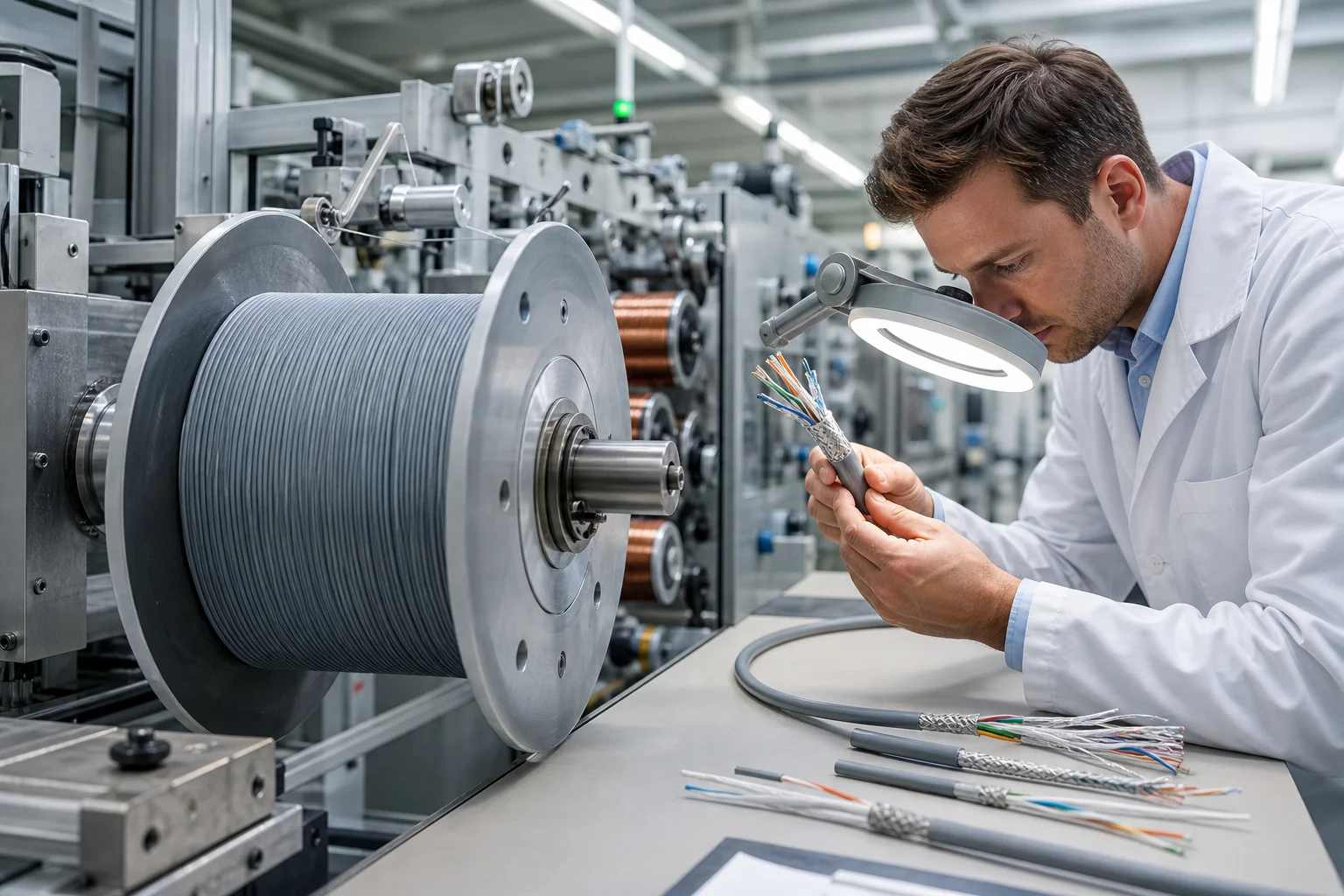
Germany is one of the few places where Cat7 is a catalogue product rather than a special order. Cat7 is an ISO/IEC 11801 Class F construction at 600 MHz, S/FTP with PiMF pair shielding, and the European specification culture treats it as the normal choice for new commercial buildings, unlike the United States where TIA stops at Cat6A. The sourcing decision therefore moves from whether Class F exists to which manufacturing cluster, which CPR class and which minimum order you can live with.
Where German Cat7 Manufacturing Actually Sits
The German cable industry is regional and specialised rather than evenly spread. Five supply routes serve buyers who need Class F with German or EU documentation.
Bavaria, around Nuremberg and Erlangen. A dense cluster of cable and connectivity manufacturing with strong automation, heavy investment in shielding and jacketing equipment, and short runs of high-specification constructions. Expect excellent process control and limited appetite for orders under a few kilometres.
North Rhine-Westphalia, the Cologne and Dortmund belt. Larger industrial plants with high output, deep experience in halogen-free compounds for public buildings, and the widest catalogue of shielded data cable. This is where most German Class F volume originates.
Baden-Wurttemberg and the southwest. Precision-oriented plants serving machine-building, automotive and laboratory customers, often with tight tolerance requirements and small custom runs at a premium.
German master distributors and system brands. Not manufacturers, but the practical channel for buyers below factory minimums. They hold EU-made stock, publish datasheets with CPR classes, and sell in 305 m boxes or cut lengths. You pay a distribution margin of roughly 20-45 percent over factory pricing.
Neighbouring EU plants quoting to German specification. The Netherlands, Poland, the Czech Republic and Italy host modern extrusion capacity that meets EN 50575 and ISO/IEC 11801 Class F, typically at 15-30 percent below German factory pricing. For a buyer whose contract says Class F with a named CPR class rather than a named country of origin, this is the strongest value route in Europe.
German and EU Cat7 Supply Routes Compared
| Route | Region and role | Typical MOQ | Lead time | Certification and documentation |
|---|---|---|---|---|
| German manufacturer, direct | Bavaria, NRW and Baden-Wurttemberg plants | 1,000-5,000 m per type; 5-10 km for OEM print | 2-4 weeks ex-stock; 4-8 weeks production | EN 50575 declaration of performance with Dca/Cca/B2ca; ISO 9001 and 14001; 600 MHz sweep; REACH and RoHS |
| German master distributor | National logistics hubs serving installers and wholesalers | 100-500 m reels and 305 m boxes; cut lengths from 50 m | 1-5 days domestic; 3-8 days intra-EU | Manufacturer datasheet and DoP; lot labels; CPR class stated per SKU |
| EU plant in a lower-cost member state | Poland, Czech Republic, Netherlands, Italy | 3,000-10,000 m per type | 3-6 weeks production; 5-15 days road freight | EN 50575 DoP; ISO 9001; third-party 600 MHz test reports; CE marking |
| EU assembly and pre-terminated specialist | Germany and Benelux, cutting and terminating EU cable | 500-2,000 pcs assemblies; 100 m sample reels | 2-4 weeks standard; 5-8 weeks for project schedules | Per-assembly test reports; system warranty documentation; CPR class inherited from cable |
| Asian plant with EU conformity file | Guangdong and Vietnam, exporting to EU specification | 3,000-10,000 m; 5-10 km for OEM print | 15-30 days production; 30-45 days sea to Hamburg or Rotterdam | ISO 9001; CE and DoP where genuinely held; third-party Fluke reports; RoHS and REACH |
What Does German Cat7 Cost, and Is the Premium Justified?
Indicative FOB-equivalent ranges for Cat7 S/FTP 4-pair, 23 AWG solid, on 305 m or 500 m reels: roughly EUR 0.95-1.80 per metre from German plants, EUR 0.75-1.45 from neighbouring EU plants, and USD 0.55-1.10 from Asian plants, before freight and duty. Halogen-free LSZH jackets, 22 AWG conductors, Cat7A at 1,000 MHz and higher CPR classes all push toward the top of each band. Treat these as planning ranges only, because copper, compound prices and freight move them, and always quote with a copper basis and a 7-15 day validity.
The premium buys three things: a declaration of performance that a German building authority accepts, a documented 600 MHz sweep with run-level headroom, and a supplier who answers a warranty claim inside the EU legal framework. If your project is a German public building, a hospital, a laboratory or a data centre with a consultant-led submittal review, that package is usually cheaper than the delay caused by rejected material. If you are fitting out a private warehouse with no CPR requirement, the premium buys very little.
One comparison buyers forget: Class F at 600 MHz does not by itself deliver more Ethernet speed. 10GBASE-T runs on Cat6 or Cat6A at 100 m, and 25/40GBASE-T needs Cat8 at 30 m. Buying Cat7 for speed is a specification error; buying it for bandwidth headroom and a European standard is not. See Cat7 versus Cat6A from a supplier perspective.
How to Verify a German Cat7 Manufacturer
- Read the declaration of performance, not the brochure. It should name the product, the EN 50575 class (Dca, Cca or B2ca), the notified body and the AVCP system applied. A DoP without a class is a marketing document.
- Check the certificate register yourself. ISO 9001 and 14001 certificates carry an issuer, a number and an expiry date. Look them up in the issuer’s public register rather than trusting a PDF.
- Confirm where the cable is extruded. German brands sometimes own the specification and outsource production to another EU country. That is legitimate, but it changes lead time, MOQ and who signs the test report.
- Request a 600 MHz test report with headroom figures. A Fluke DSX-8000 Channel or Permanent Link report on a 90 m link, with date, operator and cable ID. Marginal pass results predict field failures.
- Ask for the frequency sweep datasheet. Insertion loss, NEXT, ACR-F and return loss plotted to 600 MHz, not a table that stops at 500 MHz with a footnote.
- Take a sample and test it in your own environment. Terminate with the connector system the vendor specifies, bond the shield properly, and test. Class F fails at the termination far more often than in the cable.
- Inspect the reel label and lot system. Lot number, metre marking, plant code and date should allow you to retrieve the production record months later.
- Book pre-shipment inspection on any import. For non-EU supply especially, verify reel length, jacket print and packing before the container leaves.
Three Buyer Scenarios and the Route That Fits
- A German electrical wholesaler adding Class F to its range. Customers ask for CPR classes by name and expect next-day availability. Route: master distributor supply first to establish demand, then a direct contract with an EU plant at 3,000-10,000 m per type once annual volume is visible. Keep the DoP on file per SKU, not per brand.
- A contractor fitting out a Frankfurt data hall to a Cca specification. The fire class drives the compound choice and the price, and the client’s consultant reviews submittals. Route: German manufacturer direct, 5,000-10,000 m, submittal pack submitted before production release, and pre-terminated assemblies from an EU specialist to protect the test results. Check Cat7 reel sizes to plan handling and site storage.
- An international buyer wanting EU-origin Class F without German pricing. Origin matters for the tender narrative, price matters for the margin. Route: a Polish or Czech plant quoting to EN 50575 with a Cca or Dca class, verified by a third-party test report, shipped by road in 5-15 days. This is the value option in Europe and it satisfies most EU specifications. Compare with Cat7 factories in Vietnam if your volume justifies an ocean leg.
FAQ
1. Is Cat7 cable still manufactured in Germany?
Yes. German plants in Bavaria, North Rhine-Westphalia and Baden-Wurttemberg list Class F as a catalogue construction for European projects. Some German brands specify the product and outsource extrusion to another EU country, so confirm where the cable is actually made before you rely on origin.
2. What CPR class should I specify for Cat7 in Germany?
It depends on the building and the route of the cable. Dca is common for general commercial areas, Cca for higher-risk spaces and B2ca for escape routes and demanding public buildings. Confirm the class with the consultant or authority before requesting quotes, because it changes the compound and the price significantly.
3. What is the minimum order from a German Cat7 manufacturer?
Direct factory orders typically start at 1,000-5,000 m per type, and printed private-label jackets usually need 5-10 km. Below those volumes, German master distributors supply 100-500 m reels, 305 m boxes and cut lengths from about 50 m at a distribution margin.
4. How long is the lead time for German Cat7 cable?
Stocked items ship in 2-4 weeks from a German plant or 1-5 days from a distributor. Custom production runs 4-8 weeks. Neighbouring EU plants typically need 3-6 weeks plus 5-15 days of road freight, and Asian supply needs 15-30 days production plus 30-45 days at sea.
5. Why is German Cat7 more expensive than Asian cable?
Higher labour and energy costs, halogen-free compound prices, notified-body testing, CPR documentation and smaller production runs. German pricing typically sits 40-90 percent above Asian FOB levels. The premium pays for a declaration of performance and traceability that European public projects accept.