
Two suppliers quote for the same project: one offers Cat7 S/FTP at USD 0.70 per meter, the other Cat6A U/UTP at USD 0.45. Both claim to support the same network. The purchasing decision is not which cable is faster, because both carry 10GBASE-T over 100 m, but which specification your region recognises, which connector ecosystem you can actually terminate on site, and which supplier can evidence the claim. This comparison sets out the commercial differences and the audit steps that make a supplier’s specification believable.
Quick answer:
Buy Cat6A where TIA standards govern, that is the United States and most North American projects, because Cat7 is not a TIA category and local test equipment and acceptance criteria are built around Class EA. Buy Cat7 S/FTP for EU and APAC projects that specify ISO/IEC Class F and accept GG45 or TERA termination. The caveat: a Cat7 cable with unshielded RJ45 plugs will fail Class F testing, so the connector and the grounding plan are part of the purchase.
Cat7 vs Cat6a: Which Supplier Spec Should You Buy?
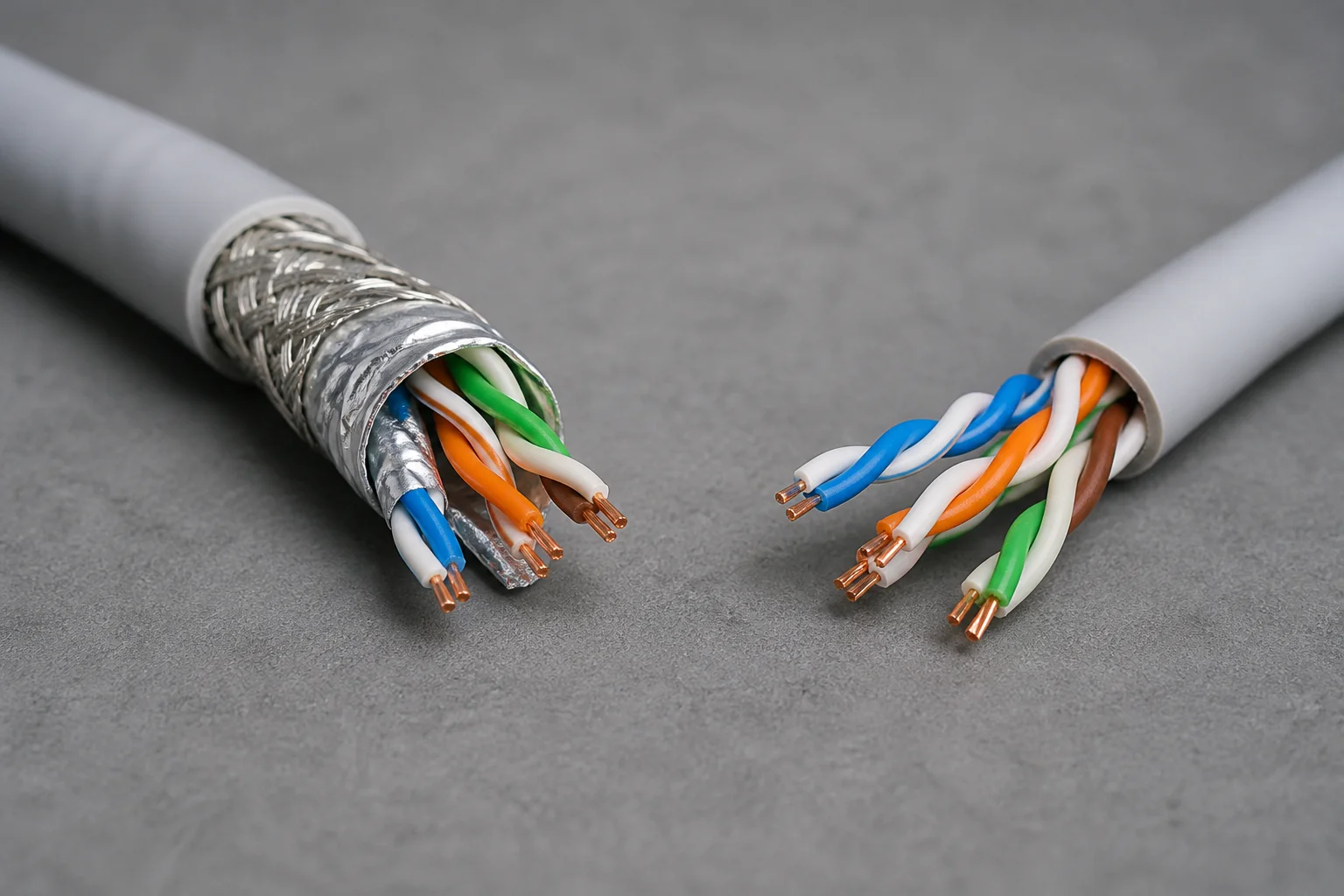
The specification decision in one table
The table below compares the options a buyer will be offered in a tender, using standard classes rather than marketing claims. Cat7 is ISO/IEC 11801 Class F at 600 MHz; Cat6A is Class EA at 500 MHz and is also the highest category recognised by TIA. Prices are indicative FOB bands for bulk reels and move with copper, jacket and volume.
| Option | Standard and bandwidth | Termination | Indicative FOB band (USD per meter) | Typical stocked MOQ | Where it is specified |
|---|---|---|---|---|---|
| Cat6A U/UTP | TIA 568 and ISO/IEC Class EA, 500 MHz | Unshielded 8P8C (RJ45) | 0.30 – 0.75 | 100 – 500 m | North America, general commercial LAN |
| Cat6A F/UTP | Class EA, 500 MHz | Shielded 8P8C with grounding | 0.40 – 0.95 | 100 – 500 m | EU commercial, healthcare and education |
| Cat7 S/FTP | ISO/IEC Class F, 600 MHz | GG45 or TERA, or 8P8C per vendor | 0.45 – 1.45 | 100 – 500 m | EU and APAC projects, industrial sites |
| Cat7A S/FTP | ISO/IEC Class FA, 1000 MHz | TERA or GG45 | 1.00 – 1.95 | 500 – 2,000 m | Specialist and data centre designs |
| Cat8.1 or Cat8.2 | Class I or II, 2000 MHz, 30 m channel | 8P8C for 8.1, GG45 or TERA for 8.2 | 2.00 – 4.50 | 500 – 2,000 m | Switch-to-server runs for 25 and 40GBASE-T |
Two conclusions follow. First, Cat7 and Cat6A overlap almost entirely in capability for a 100 m channel: both support 10GBASE-T, and neither supports 25 or 40GBASE-T beyond 30 m without moving to Cat8. Second, the cost difference is not mainly in the copper; it is in the shield, the connector and the testing class, and those are exactly the elements a cheap quote tends to trim.
What changes the number
Regional standard. In the United States, TIA stops at Cat6A, so Cat7 sits outside the standard the installer, the tester and the acceptance certificate are built around. Specifying Cat7 there often means arguing about test limits at handover. In the EU and much of APAC, Class F is a recognised design choice and Cat7 is quoted without friction.
Connector ecosystem. Cat7 termination is the hidden cost. GG45 and TERA outlets cost more than RJ45, are stocked by fewer distributors, and require trained installers. Vendors that offer Cat7 on 8P8C plugs exist, but the link only passes Class F if the plug, the outlet and the bonding are engineered as a system. Budget the connector line before comparing cable prices.
Shield construction. S/FTP means foil on each pair plus an overall braid, which is more material and more extrusion work than U/UTP. The premium is real but it buys shielding effectiveness, not bandwidth. If the environment is a normal office, the premium buys nothing the network can use.
Test class and documentation. A Class F claim needs a tester configured for Class F limits and a report that shows it. Suppliers who test to Cat6A limits and label the product Cat7 are common, and the gap surfaces at acceptance, not at delivery.
Volume and gauge. AWG 23 is standard for both categories; AWG 22 adds copper and attenuation margin at a premium. MOQ follows the same logic in both cases: 100 – 500 m on stocked reels, 3,000 – 10,000 m for a custom jacket or colour.
Spare capacity. Buyers sometimes choose Cat7 for future headroom. That is a legitimate design argument, but the headroom only pays if the rest of the channel, including patch cords and outlets, is rated the same. For the underlying electrical comparison, see Cat6 vs Cat6A.
How to verify a supplier’s spec claim
- Ask which standard the cable is tested to, and require a report showing the test limit, the tester model and the frequency range used.
- Confirm the shield construction in writing: S/FTP, F/FTP or U/UTP, with braid coverage stated, and check it against a cut sample.
- Request the connector datasheet for the exact plug or outlet offered, and confirm it is rated for the same class as the cable.
- Verify ISO 9001 and ISO 14001 certificates with the issuing body, and check that the scope covers extrusion.
- Ask for a recent Fluke DSX-8000 Channel test on a link built with the supplier’s own components, not a cable-only laboratory result.
- Compare one sample reel of each option in your own test setup before committing to a project quantity, then keep the report as the acceptance baseline.
Three buyer scenarios
- A US healthcare group fitting out three sites. Specify Cat6A F/UTP where EMI from imaging equipment is a concern and Cat6A U/UTP elsewhere, and keep Cat7 out of the tender. The purchaser gains standard acceptance criteria, local test equipment and a wider supplier base, and avoids a debate about a category the local standard does not define. The shielding premium over U/UTP is modest.
- A German public building with a Class F design brief. Buy Cat7 S/FTP with LSZH jacket and CPR class documentation, and buy the outlets and patch cords from the same supplier family. Confirm GG45 or TERA availability before the cable order, because a cable that arrives before its connectors delays the whole floor. Expect the upper band and a 305 – 1,000 m MOQ.
- A Middle East data centre contractor. Use Cat8.1 or Cat8.2 for the 25 and 40GBASE-T top-of-rack runs at 30 m, and Cat6A for the rest. Cat7 adds cost without adding reach here. Award the copper package to a supplier who can evidence Class I or II testing, and hold a drum from each lot for independent verification.
Do I need Cat7 if the network only runs 10GBASE-T?
No. 10GBASE-T runs on Cat6 and Cat6A over a 100 m channel, and Cat7 does not change that. The reason to buy Cat7 is a specification requirement, a shielding requirement in an electromagnetically noisy environment, or a regional design standard that names Class F. If none of those applies, Cat6A F/UTP delivers the shielding benefit at a lower price and with a termination ecosystem your installer already knows. Buyers who want the regional view of supplier capability can start with Cat7 manufacturing in Germany for EU-facing projects.
Mixing suppliers on one project
It is common to buy cable from one supplier and outlets from another to hit a budget. It is also the most frequent cause of a failed channel test, because the class rating is a system property. If you mix, require both suppliers to confirm in writing that their component is rated for the class and that the combination has been tested, and run one verification link on site before the full installation. The audit method is set out in verifying a Cat7 manufacturer.
Specification wording that prevents disputes
Most Cat7 versus Cat6A arguments are settled by the words in the purchase order, not by the cable. Write the standard class and the frequency range, not only the category name, so that Class F at 600 MHz cannot be read as Class EA. Name the shield construction, the conductor gauge and the jacket compound, and state which standard the acceptance test will follow. Add the connector and outlet as separate line items with the same class requirement, and require one test report per lot with the tester model and the limit configuration shown. A purchase order written this way costs an extra ten minutes and removes the two most common causes of rejected deliveries: a construction that differs from the sample, and a test certificate that was never run to the class the project requires.
FAQ
1. Is Cat7 better than Cat6A for a new office network?
Not automatically. Both support 10GBASE-T over 100 m. Cat7 adds shielding and a 600 MHz Class F rating, which matters in noisy environments or where the local standard names Class F. In North America, Cat6A is the recognised top category and is easier to test and accept.
2. Why is Cat7 not common in the United States?
TIA standards stop at Cat6A, Class EA at 500 MHz. Cat7 belongs to ISO/IEC Class F, so US projects often have no acceptance criteria for it and testers are configured for Cat6A limits. Buyers there generally specify Cat6A instead, and the supply base reflects that.
3. Does Cat7 need special connectors?
It can be terminated on GG45 or TERA, or on 8P8C plugs where the vendor rates the assembly for Class F. The termination must preserve the shield and bond it to ground at both ends. A shielded cable with ordinary unshielded plugs will not pass Class F testing.
4. How much more does Cat7 cost than Cat6A?
Indicative bands put Cat7 S/FTP roughly 20 – 60 percent above Cat6A U/UTP of similar gauge and jacket, and closer to Cat6A F/UTP. Add the connector premium: GG45 and TERA outlets cost more than RJ45 and are stocked by fewer distributors.
5. Which specification has a lower MOQ?
Stocked MOQ is similar for both, typically 100 – 500 m per SKU. Cat7 custom builds, such as a specific LSZH colour with printed branding, usually start at 3,000 – 10,000 m, and connectorised Cat7 assemblies often have a piece-based minimum instead.