
Per-meter pricing for shielded Cat6 looks simple until two quotes differ by a quarter and nobody can explain why. The answer is usually conductor gauge, shield type, jacket compound or reel length rather than margin. This guide gives indicative FOB bands for the main STP Cat6 constructions, shows what freight and duty add to a landed meter, explains how volume tiers change the number, and lists the checks that make two offers genuinely comparable before a purchase order is raised.
Quick answer: Indicative FOB prices for STP Cat6 run from about 0.28 to 0.65 USD per meter on 305 m reels, with F/UTP PVC at the bottom of the band and SF/UTP outdoor PE at the top. At 5 km and above, expect 10 to 20 percent below those figures. Landed cost adds freight and duty: roughly 0.03 to 0.08 USD per meter by sea to Europe or the US. Copper price, shield type, jacket and reel length move the number more than supplier choice does.
How Much Does STP Cat6 Cable Cost per Meter?
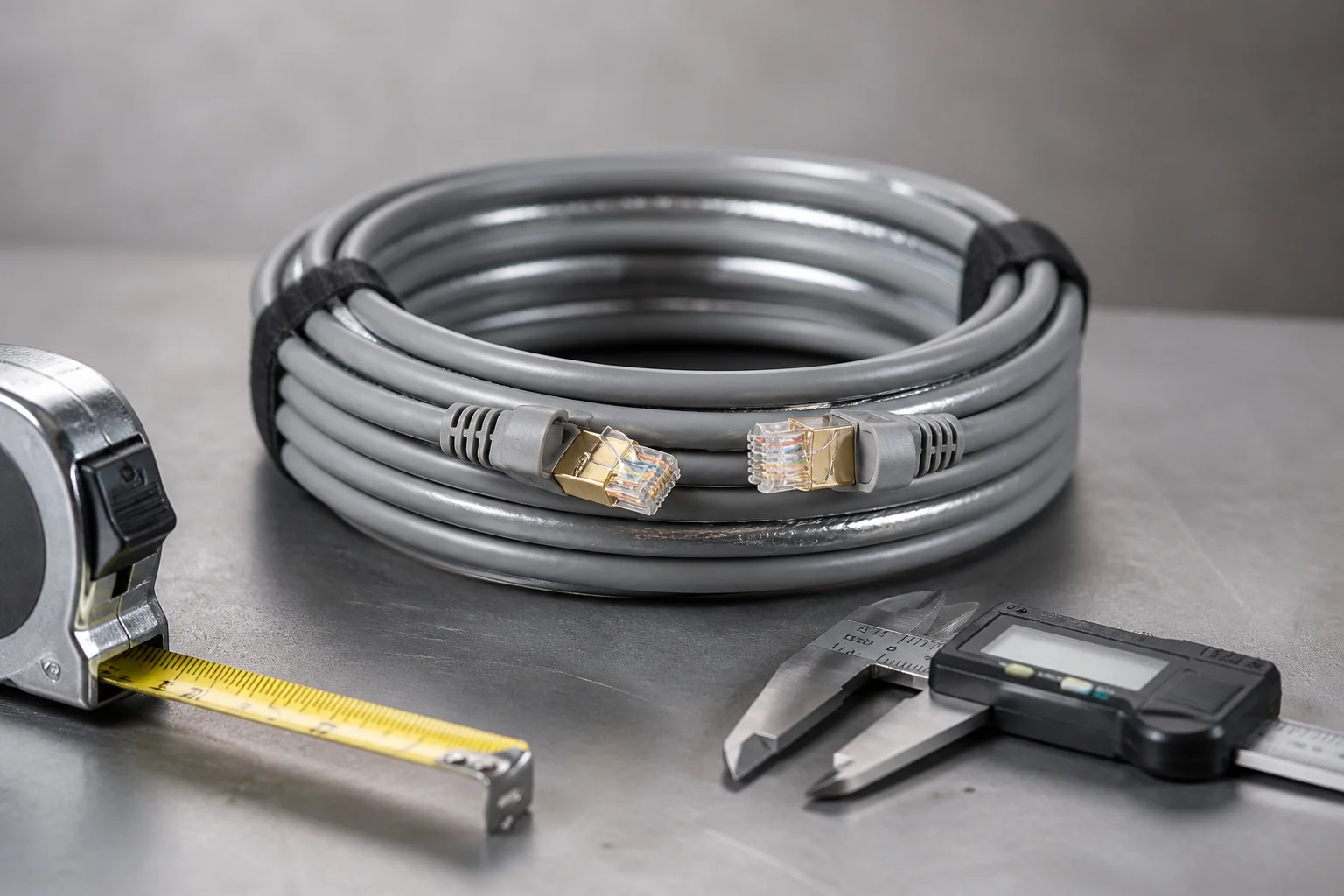
Indicative FOB prices for STP Cat6 run from about 0.28 to 0.65 USD per meter on 305 m reels, with F/UTP PVC at the bottom of the band and SF/UTP outdoor PE at the top. At 5 km and above, expect 10 to 20 percent below those figures. Landed cost adds freight and duty: roughly 0.03 to 0.08 USD per meter by sea to Europe or the US. Copper price, shield type, jacket and reel length move the number more than supplier choice does.
What a Per-Meter Price Actually Contains
A quoted per-meter figure bundles four things: copper, shielding, jacket compound and processing. Copper dominates. A 23 AWG solid bare copper pair set weighs a predictable amount per kilometer, so when the copper price moves, the cable price follows within weeks. That is why a quote dated six weeks ago is not a price, it is a historical record, and why serious buyers ask for a copper basis clause on large orders.
Shielding comes second. Foil-only F/UTP uses an aluminium-polyester tape, a drain wire and a taping operation. S/FTP adds pair-level foil plus an overall braid, which means more material and a slower line speed. The braid also increases outer diameter, which changes packaging, drum capacity and conduit fill – costs that appear outside the cable line but still reach your project budget.
Jacket compound and reel length finish the job. PVC is cheapest, LSZH compounds cost more and extrude slower, and outdoor PE adds UV and moisture performance. On length, a 305 m reel carries more handling cost per meter than a 500 m drum, so the same cable can legitimately quote differently at different reel sizes.
Indicative Price Bands by Construction
Bands below are FOB China, per meter, excluding freight and duty. They are planning ranges, not quotations, and shift with copper and volume.
| Construction | Jacket | 305 m reels (USD/m) | 5 km and above (USD/m) | Main cost driver |
|---|---|---|---|---|
| F/UTP Cat6, 23 AWG | PVC | 0.28 – 0.42 | 0.24 – 0.36 | Copper weight |
| F/UTP Cat6, 23 AWG | LSZH | 0.33 – 0.48 | 0.28 – 0.41 | Jacket compound |
| S/FTP Cat6, 23 AWG | LSZH | 0.38 – 0.58 | 0.32 – 0.50 | Braid coverage |
| SF/UTP Cat6, 22-23 AWG | PE outdoor | 0.42 – 0.65 | 0.36 – 0.56 | Copper plus jacket |
Read the two price columns as the volume effect rather than a discount. Moving from a 305 m reel to a 5 km order removes reel handling, reduces per-unit packaging and lets the factory run a longer campaign, which is where the 10 to 20 percent comes from. It is not a negotiating trick.
Landed Cost: Where the Meter Price Grows
The FOB number is roughly half the story for an imported reel. Freight on cable is volume-heavy rather than weight-heavy, so container utilisation matters as much as the rate per container.
- Sea freight and insurance: roughly 0.03 – 0.08 USD per meter to Europe or the US on a full container, higher on LCL.
- Duty and taxes: destination-specific, and worth confirming with a customs broker before the tender closes.
- Inland delivery and unloading: drums need forklift capacity; a 500 m drum is not a one-person lift.
- Testing and inspection: third-party pre-shipment inspection and channel certification add a fixed cost that is negligible at 10 km and significant at 300 m.
Comparing a distributor’s delivered price with a factory FOB price without these lines produces the wrong decision roughly half the time. Our note on STP Cat6 reel sizes explains how packaging choices change both freight and handling cost.
Why STP Costs More Than UTP
Buyers often ask why a shielded reel quotes 20 to 40 percent above an unshielded reel of the same copper weight. The difference is material and process: foil tape, drain wire, braid where specified, a taping or braiding pass, and a larger jacket to contain the shield. Testing also costs more, because shielded certification needs shielded adapters and a longer setup.
That premium only pays back in the right environment. STP is specified for high-EMI areas – industrial drives and VFDs, imaging rooms, broadcast facilities, machine halls, routes adjacent to power trunks – where unshielded error rates rise. It does not make the cable faster: both constructions run 250 MHz, and 10GBASE-T over 100 m is a Cat6A question. If your route is a clean office ceiling, the premium buys nothing; the comparison in STP versus UTP sets out the decision.
How Volume, MOQ and Lead Time Affect Price
Suppliers price in tiers, and the tiers are shaped by setup cost rather than by generosity.
- 100 – 500 m: stock or short-run pricing, the top of the band, 3 to 7 days.
- 3,000 – 10,000 m: production pricing with custom jacket or print, 15 to 30 days.
- 5 – 10 km: OEM programme pricing, 20 to 30 days, often with call-off delivery.
- Container volume: best per-meter figure, but freight and storage become the constraint.
A useful tactic is to buy the trial volume at stock pricing and negotiate the balance as a single production run, with the same construction and lot family. You pay slightly more on the first few hundred meters and materially less on the rest, while keeping one traceable lot.
Checking That a Low Price Is Really the Same Cable
Price differences of 25 percent between two quotes usually mean two different products, not two different margins. Run these checks before you chase the cheaper number.
- Compare conductor gauge and material: 23 AWG bare copper is not 24 AWG CCA, and the price gap between them is large.
- Confirm the shield type and braid coverage in writing, because “shielded” alone covers F/UTP, S/FTP and SF/UTP alike.
- Check the jacket compound against the specification; PVC quoted as LSZH is the most common substitution.
- Verify reel length; a nominal 305 m reel with a short count is a hidden price increase.
- Request the datasheet frequency sweep to 250 MHz and compare margins, not pass or fail claims.
- Test drain-wire continuity and certify one mock channel with a Fluke DSX and shielded adapters.
- Match jacket print and lot number to the factory packing list before accepting delivery.
Two quotes that survive all seven checks are genuinely comparable, and then price becomes a fair basis for the award.
Questions Buyers Ask About Cable Pricing
Is the price fixed for the project duration? Rarely. Ask for a copper basis and a validity period, typically 7 to 15 days for small orders and longer with a copper clause for large ones.
Why did the price rise between quotation and order? Usually copper, sometimes freight. Ask for the copper reference date and compare it with the LME trend before accepting the explanation.
Does a higher price mean better shielding? Not automatically. Price tracks material, not workmanship. Braid coverage and drain-wire bonding are verified by test, not by the invoice.
Three Buyer Scenarios
- Single production line, 600 m of F/UTP LSZH: buys from stock at the top of the band and accepts it, because the engineering cost of a volume order exceeds the saving.
- Plant-wide rollout, 18 km of S/FTP: runs a tender at container volume, locks a copper basis, and splits delivery across two shipments.
- Distributor stocking programme, 60 km annual: negotiates tiered pricing with call-offs, holding two constructions and taking the balance in quarterly releases.
Building a Realistic Budget Line
Take the midpoint of the band for your construction, add freight and duty, add 10 percent for termination waste and shield damage, and add the fixed cost of testing. That total is defensible in a project meeting; a single per-meter figure pulled from a marketplace listing is not. Buyers comparing suppliers on that basis should also read the China wholesaler comparison for how the wholesale models map onto these price bands.
FAQ
1. What is the average price of STP Cat6 per meter?
There is no single average, but indicative FOB bands run from about 0.28 to 0.65 USD per meter on 305 m reels: F/UTP with PVC at the lower end, S/FTP and outdoor SF/UTP at the top. Landed cost adds roughly 0.03 to 0.08 USD per meter for sea freight plus duty.
2. Why is shielded Cat6 more expensive than UTP?
The shield adds foil tape, a drain wire, sometimes a braid, an extra production pass and a larger jacket, plus slower shielded testing. That typically produces a 20 to 40 percent premium over unshielded cable of similar copper weight. The premium only pays back in high-EMI environments.
3. Does buying more cable reduce the price per meter?
Yes, by roughly 10 to 20 percent when moving from 305 m reels to 5 km or more, because reel handling and packaging costs fall and the factory runs a longer campaign. Container volume improves it further, but freight and storage then become the limiting factors.
4. How often do STP Cat6 prices change?
Quotes usually hold for 7 to 15 days on small orders because copper moves quickly. Large orders are better handled with a copper basis clause and a stated reference date. Ask each supplier for its validity period and copper reference so that later increases can be checked rather than accepted.
5. How do I compare two quotes that differ by 25 percent?
Check conductor gauge and material, shield type and braid coverage, jacket compound, and actual reel length. Then request the frequency sweep to 250 MHz and a shielded channel test report. Two quotes that match on all of these are comparable; if they do not, the cheaper one is usually a different product.