
The STP versus UTP decision reaches every buyer twice: once as a technical question about interference, and again as a purchasing question about how many SKUs a warehouse can carry. Both cables are 250 MHz Cat6 constructions, so the difference is not speed. It is the shield, the drain wire, the jacks, the grounding, and a price premium that ranges from modest to painful depending on build. This article compares the two from the order desk rather than the lab bench, with FOB bands, termination cost implications and a rule for standardizing one specification across projects.
Quick answer:
Standardize on UTP Cat6 for general office, retail and residential work, and specify STP only where interference is measured or certain: drive cabinets, imaging rooms, broadcast floors, machine halls and trays running beside power feeders. Keep one STP build in stock as an exception SKU. The caveat is that shielded cable on unshielded jacks delivers no shielding benefit and still costs 30 to 60 percent more, so the spec and the termination hardware must be decided together.
STP vs UTP Cat6: Which Spec Should Buyers Standardize On?
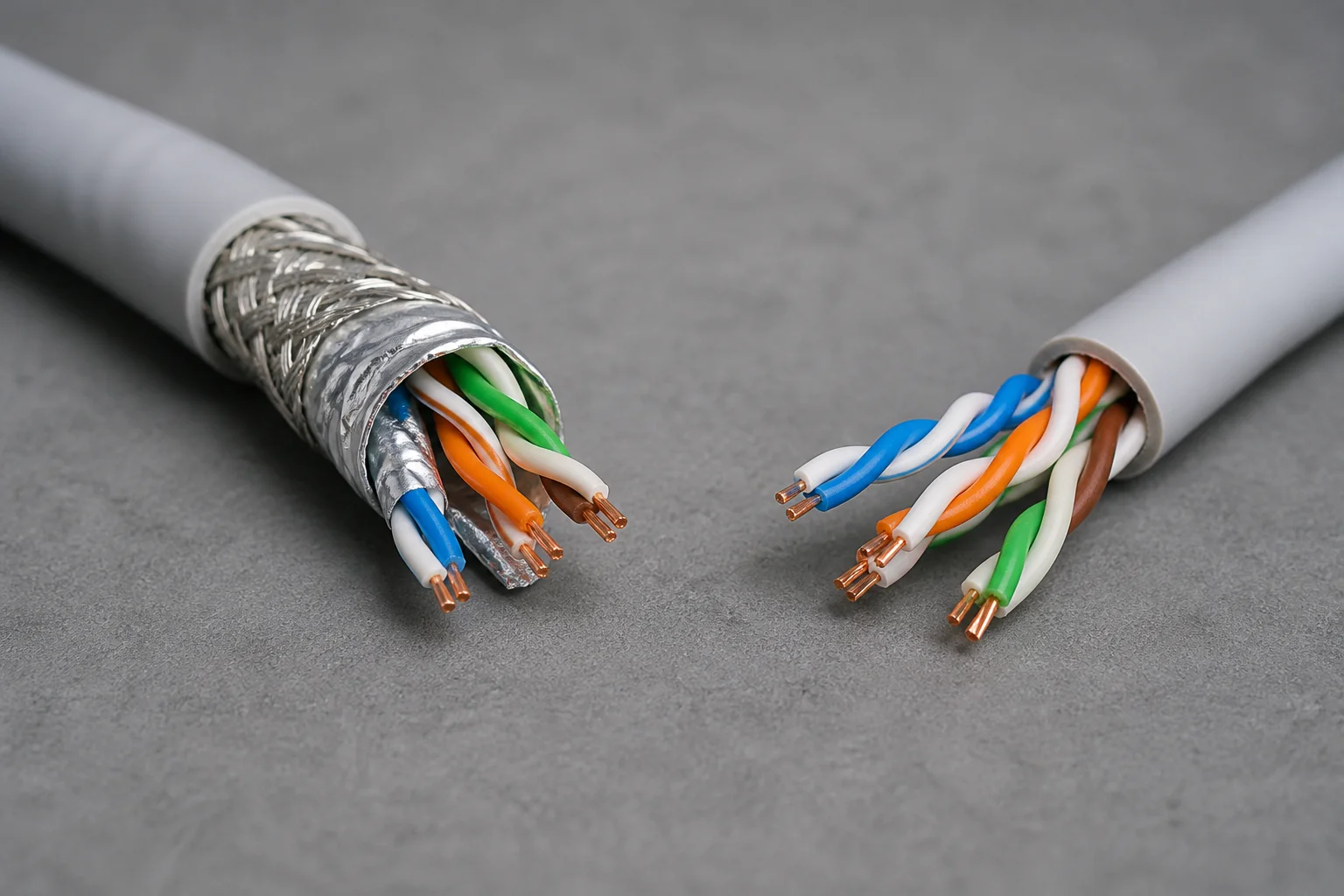
The Question Is Not Which Cable Is Better
Both UTP and STP Cat6 are four-pair 250 MHz cables qualified under TIA-568.2-D Cat6 and ISO Class E. Neither is faster in the standard sense. 10GBASE-T over Cat6 is limited to short distances by the standard itself, and moving to 10GBASE-T at 100 m is a Cat6A decision, not a shielding decision. A supplier who sells shielding as a speed upgrade is either uninformed or willing to overstate.
What the shield does is change the cable response to external electromagnetic energy. A foil or braid bonded at both ends intercepts interfering fields and carries the induced current to ground before it reaches the pairs. In a room with variable frequency drives, welding equipment, imaging systems or an adjacent power trunk, that difference shows up as a lower and more stable error rate rather than a higher nominal bandwidth. In a normal office with no significant source, it shows up only on the invoice.
For buyers, the practical question is therefore narrower: how often does your project mix include an environment where the shield is justified, and can your stock and your installers support two specifications without confusing them?
Side by Side: What Changes When You Add a Shield
Ranges below are indicative FOB bands for 4-pair Cat6 on 305 m to 500 m units. They move with copper price, conductor gauge, jacket compound and volume. The premium column is the part most spreadsheets miss, because it includes the jacks and panels that a shield forces you to buy.
| Attribute | UTP Cat6 | F/UTP Cat6 | S/FTP Cat6 |
|---|---|---|---|
| Shield build | None | Overall foil plus drain wire | Pair foils plus outer braid |
| Indicative FOB per metre | USD 0.14 – 0.28 | USD 0.20 – 0.40 | USD 0.30 – 0.60 |
| Typical conductor | 23 AWG solid | 23 AWG solid | 23 AWG solid |
| Outside diameter | Narrower, easier in dense tray | Moderate, foil adds bulk | Widest of the three |
| Termination hardware | Standard jacks and panels | Shielded jacks, grounded panel | Shielded jacks, grounded panel |
| Install discipline | Standard practice | Drain wire bonded both ends | Braid clamp plus drain bonding |
| Best fit | Office, retail, residential | Machine halls, light industrial | Drive cabinets, imaging, broadcast |
The cable premium alone is typically 30 to 60 percent over UTP of the same copper weight. Add shielded jacks, which often cost two to three times their unshielded equivalents, plus a grounding bar and the labour to bond a drain wire at every outlet, and the installed premium on a large floor plate can exceed the cable cost itself. That is the number to put in front of a client, not the per-metre delta. Our STP Cat6 price per metre breakdown separates the cable component from the hardware component.
Where UTP Still Wins the Order
UTP wins wherever the electromagnetic environment is ordinary. General office floors, retail, hospitality, schools and residential installations have no dominant interference source, and the cable is usually installed in tray or conduit at a distance from power distribution. In those conditions a correctly installed UTP link passes the same field test as a shielded one, and the buyer keeps the difference.
UTP also wins on installation tolerance. It is narrower, which matters when a 100 mm basket tray is already full. It terminates faster because there is no foil to fold back and no drain wire to land. And it fails in a more forgiving way: a marginal UTP link usually shows up as a bad pair, while a marginal shielded link can pass the pair tests and still leak, because the shield path was never evaluated. For contractors working to a fixed labour rate, that difference in termination time is real money.
Finally, UTP wins on availability. Any distributor holds it, any factory quotes it in minutes, and stocked reels start at 100 m with no minimum. A shielded SKU with a specific jacket and CPR class can add two to three weeks to a schedule that had none.
Where the Shield Pays for Itself
The shield pays when interference is present and expensive. Machine halls with variable frequency drives are the classic case: unshielded links running near motor cables show intermittent errors that disappear when the drive is idle, which makes them hard to diagnose and expensive to revisit. Imaging rooms in healthcare buildings carry high field strengths during scans. Broadcast and post-production floors combine high data rates with dense equipment. Industrial automation cells with servo drives and welding robots belong in the same group.
In each of those cases the cost of a single intermittent fault, in downtime or in a repeat site visit, exceeds the entire premium on the cable run. That is the correct way to justify STP internally: not as a specification upgrade, but as fault avoidance with a calculable payback. Buyers sourcing for those environments should shortlist suppliers who routinely build shielded product rather than factories that add a foil on request. The industrial STP Cat6 supplier comparison covers what those factories look like.
The Hidden Cost of Standardizing on STP
Standardizing on one specification looks efficient and often is, but shielded cable exports its complexity to the installation. Four costs tend to appear after the decision is made.
- Hardware creep. Shielded jacks, shielded panels, grounding bars and bonding kits all enter the bill of materials, usually late, usually at short notice.
- Labour variance. Bonding a drain wire at 400 outlets is not free, and contractors price it as a separate line once they see the drawing.
- Test scope. Shielded links need channel adapters and a continuity check that unshielded links do not, which changes the commissioning budget.
- Stock duplication. Two specifications mean two reels, two SKUs, two reorder points, and a warehouse that eventually ships the wrong one to a site.
None of those costs are reasons to avoid STP. They are reasons to make the decision once, in writing, with the hardware and labour included.
Buyer Questions We Hear Most
Is STP Cat6 faster than UTP Cat6?
No. Both are 250 MHz Cat6 constructions and both support the same Ethernet rates at the same distances under the standard. Shielding changes immunity to external interference, not channel capacity. If your actual requirement is 10GBASE-T at 100 m, the correct answer is Cat6A, shielded or not. See Cat6 versus Cat6A for that comparison.
Can I mix STP and UTP in one installation?
You can, and many buildings do, but the boundary has to be deliberate. Shielded runs must be bonded at both ends into a grounded panel, and the transition point has to be documented. A mixed installation that nobody documented becomes a troubleshooting problem two years later, when the technician testing a link has no idea which segment is shielded.
Does shielded cable need a special patch cord?
Yes. The shield path runs through the jack, the patch panel and the cord. If the horizontal run is shielded and the cord is not, the bonding chain is broken at the equipment end. Buy shielded cords for shielded channels, and keep the cord length in the channel budget when you calculate margin.
Three Standardization Scenarios
- Contractor with a mixed project pipeline. Standardizes on UTP for the base specification and keeps 500 m of F/UTP in stock for the industrial jobs. The exception SKU is priced into tenders as a separate line item so it never eats the margin on an office fit-out.
- Manufacturer fitting out two plants. Standardizes on S/FTP across both sites because drive cabinets sit in every production hall. The buyer accepts a higher cable cost to remove a recurring maintenance complaint, and orders 10 km in one lot to hold the construction constant.
- Distributor building a catalogue. Carries UTP as the volume SKU and one F/UTP SKU as the shielded answer, both from the same factory so the datasheet formats and declarations match. Adding S/FTP only follows a named customer request.
Verification Checklist Before You Standardize
- Confirm the construction code in writing: F/UTP, S/FTP or SF/UTP, never the word shielded alone.
- Check the datasheet sweep reaches 250 MHz with insertion loss, return loss, NEXT and PS-NEXT curves.
- Request a construction diagram showing foil facing, braid coverage and drain wire gauge.
- Ask for shield continuity measurements on a finished assembly, drain wire to shell, both ends.
- Insist on Fluke DSX-8000 or DSX-5000 reports with shielded channel adapters named in the header.
- Verify jacket print includes category, AWG, shield code, compound and lot number.
- Collect RoHS and REACH declarations, plus CPR class evidence for EU-bound stock.
- Buy a 100 m to 305 m sample reel and terminate it with your own hardware before the first bulk order.
Writing the Spec So Suppliers Compete Fairly
Most price comparison failures start with a vague inquiry. If the request says Cat6 shielded, one factory quotes F/UTP on 250 m and another quotes S/FTP on 500 m, and the numbers cannot be compared. Write the specification as a short table: construction code, conductor AWG and metal, jacket compound, CPR class if applicable, reel length, print requirements, packaging, test evidence and delivery window. Send the same document to every supplier and require the quote to answer it line by line.
That single discipline does more for landed cost than any negotiation. It also settles the STP versus UTP question at the level where it belongs: a defined requirement with a defined cost, rather than a preference argued at the last minute.
FAQ
1. How much more does STP Cat6 cost than UTP Cat6?
The cable itself typically carries a 30 to 60 percent premium over UTP of the same copper weight, depending on whether the build is F/UTP or S/FTP. The installed premium is larger once shielded jacks, grounded panels and drain-wire labour are counted. Ask suppliers for both constructions at the same AWG and jacket before comparing.
2. Do I have to ground STP Cat6 at both ends?
Yes. The shield must be bonded at both ends through shielded jacks and a grounded panel. Bonding at one end only leaves the shield floating, which allows it to couple interference onto the pairs. An unbonded shield adds cost and can worsen emissions compared with plain UTP.
3. Can STP Cat6 fix a network that already has errors?
Only if the errors come from external interference. Shielded cable does nothing for duplex mismatch, bad patch cords, oversubscribed uplinks or damaged connectors. Diagnose the fault first. If the errors track a drive, a welder or an imaging system, shielding and proper bonding will help; otherwise it is an expensive guess.
4. What is the minimum order for shielded Cat6?
Stocked reels typically start at 100 to 500 m per SKU, which is enough for a pilot or a single machine hall. Custom jacket colour or print moves the minimum to roughly 3,000 to 10,000 m, and OEM packaging with your own label starts around 5 to 10 km. Plan the SKU count before committing to a custom run.
5. Should a distributor stock both UTP and STP Cat6?
Usually yes, but as one volume SKU and one exception SKU rather than two equal lines. UTP covers most projects, while a single F/UTP build in a common jacket answers industrial inquiries. Buying both from the same factory keeps datasheets, declarations and print formats consistent and simplifies staff training.