
Reel size looks like a packing detail until it changes your cost per meter, your scrap rate and your ability to deliver. Shielded Cat6 is heavier per meter than UTP, bulkier on the pallet and more sensitive to crush, so format choice has a real commercial effect on a wholesale order. This guide compares the formats that STP Cat6 wholesalers actually stock, from 100 m boxes to 1,000 m wooden drums, with indicative price bands, minimum quantities and the delivery checks that confirm you received the length you paid for.
Quick answer:
Most STP Cat6 wholesalers stock 305 m boxes and 500 m reels, with 100 m boxes for trade counters and 1,000 m drums on order. Price per meter drops roughly 8-15 percent from 305 m to 1,000 m. Caveat: drums are only cheaper if you can handle them, since fork access, upright storage and a de-reeling plan are all required before the first pull.
What Reel Sizes Do STP Cat6 Wholesalers Offer?
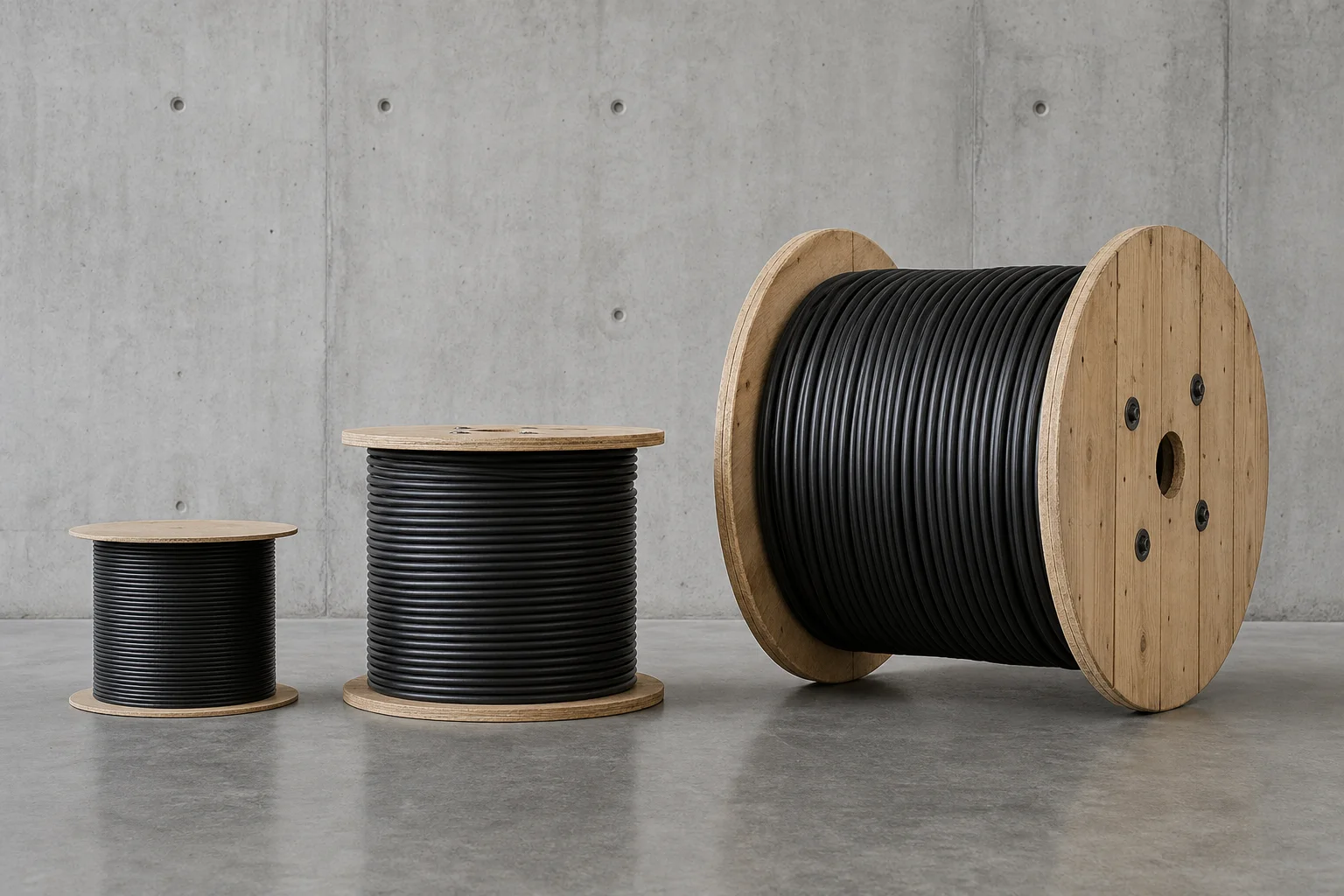
Buyers usually start a shielded Cat6 project by comparing price per meter, then discover that the cheapest quoted number assumed a 1,000 m drum they cannot unload. Reel format sits between specification and price: it determines how the cable is packed, what minimum quantity applies, how much handling damage risk you carry and whether the last hundred meters of a project become waste. The formats below are the ones wholesalers quote most often, with the commercial consequences of each.
Why Reel Format Is a Commercial Decision
Three costs move with format. Packing cost per meter falls as length rises, because the drum, the cardboard and the labour are spread over more cable. Handling cost per meter also falls, but only if you have a forklift and space, since a 1,000 m shielded drum weighs in the region of 40-50 kg of cable plus the drum itself. Scrap cost moves the other way: a short box that matches the run length wastes less than a drum that leaves 300 m unused at the end of a fit-out.
There is also a quality dimension that is easy to overlook. Shielded constructions carry foil, and foil creases under point load. A drum stored on its side, or a carton buried under heavier pallets, can produce return loss failures at commissioning that no factory test would have predicted. Format choice is therefore partly a damage-control decision, not only a price decision.
Reel and Box Formats Compared
The table gives indicative figures for F/UTP 23 AWG PVC. S/FTP and LSZH constructions follow the same format logic with a higher price band.
| Format | Typical net length | Packing | Typical MOQ per SKU | Indicative price band (USD per meter) | Best fit |
|---|---|---|---|---|---|
| Trade box | 100 m | Cardboard box, pull-out | 10-20 boxes | 0.55-0.95 | Service calls, small fit-outs, resale |
| Standard box | 305 m | Cardboard box, pull-out | 5-10 boxes | 0.40-0.70 | Commercial floors, riser work |
| Standard reel | 305 m | Wooden or plastic reel | 5-10 reels | 0.38-0.66 | Contractor sites with a stand |
| Project reel | 500 m | Wooden reel, palletised | 4-8 reels | 0.34-0.60 | Warehouse and industrial runs |
| Bulk drum | 1,000 m | Wooden drum, returnable | 2-5 drums | 0.30-0.55 | Wholesale stock, long horizontal pulls |
Two observations from the table matter commercially. First, the step from 305 m to 500 m often delivers most of the per-meter saving a buyer will ever see; the further step to 1,000 m adds a smaller increment and a large handling burden. Second, MOQ is usually expressed in units of the format, so a buyer who wants a custom jacket colour may face a 3,000-10,000 m minimum regardless of format, which is a different constraint entirely.
What Each Format Costs Per Meter
The price gradient between formats is not linear and it is not the same across suppliers. A wholesaler holding 305 m boxes in a Dubai or Rotterdam warehouse has already absorbed freight and handling, so the premium over a 1,000 m drum reflects service rather than packing. A factory quoting both formats will usually show a modest difference, because the cable itself costs the same and only the reel changes. When a factory quote shows a large gap, ask whether the drum price assumes a lower copper grade or a thinner jacket.
Copper remains the dominant variable. A 5 percent move in copper price shifts a 23 AWG construction by a visible amount per meter, and it shifts all formats by the same percentage, so the format gradient stays roughly stable while the absolute numbers move. Contracts that run longer than a quarter should carry a copper adjustment rather than a fixed number, particularly for drum quantities where the cash commitment is larger.
MOQ and Lead Time by Format
Stocked formats move in 3-7 days from a regional warehouse and 15-30 days from a factory. The distinction that catches buyers is customisation: printing your brand on the jacket, changing the jacket colour, or specifying a non-standard length converts a stocked item into a production order with a 3,000-10,000 m minimum. If you need 400 m in a custom colour, the practical route is to buy a standard format and accept the factory’s print, or to combine the requirement with other SKUs to reach the minimum.
Reel returns are another commercial detail. Wooden drums are sometimes returnable or carry a deposit, and the cost of returning an empty drum from Europe to Asia is almost never worth it, so treat the drum as consumable in your landed cost. Plastic reels are lighter and stack better but crack in cold weather, which matters for outdoor storage in northern Europe.
Three Buyer Scenarios
- Electrical wholesaler restocking a trade counter. A mix of 100 m boxes for walk-in sales and 305 m boxes for installer accounts covers most demand. Drums sit badly in a trade counter because they need floor space and a stand, and the per-meter saving is usually lost to slower turnover.
- Contractor on a 40,000 sq m distribution centre. Long horizontal runs across the warehouse floor favour 500 m or 1,000 m drums with a de-reeling stand, while the office block within the same project is better served by 305 m boxes. Ordering both formats on one purchase order keeps freight efficient.
- Importer building stock for resale. Bulk drums maximise margin per meter, provided the warehouse has racking rated for the weight and a plan for cutting down to 305 m boxes. Buyers who skip the cutting step end up selling drums to contractors who did not want them.
How to Verify Length and Shield Integrity on Delivery
Length disputes are common and almost always avoidable. Run these checks when the pallet is opened, before the delivery note is signed clean.
- Weigh one reel or box and compare against the nominal weight per meter from the datasheet; a short length shows up as a low weight before any counter is used.
- Check the reel label and carton print for net length, construction, gauge and lot number, and confirm they match the purchase order.
- Measure the counter reading on a sample pull against a measured 10 m length to confirm the meter wheel is calibrated.
- Inspect the outer wraps for crush damage, and reject any reel where the foil layer is visibly creased under the jacket.
- Test shield continuity on a sample from each lot, then run a Fluke DSX channel test with shielded adapters on one reel per pallet.
- Record reel count, format and lot numbers on the receiving document so a later claim can be traced to a specific drum.
Packing, Labelling and Shipping Considerations
Cable is heavy freight, and format affects what a container can carry. Boxes cube out before they weigh out, so a container of 305 m boxes carries less copper than the same container loaded with drums. That is why drum pricing can look aggressive on a per-meter basis while the freight per meter stays lower. On the receiving side, drums should travel upright on their flange edge with chocks, and boxes should be palletised in a way that does not put point load on the middle of a coil.
Labels deserve a clause in the purchase order. A reel label should carry the construction, gauge, length, lot number and factory identification, and it should match the test report for that lot. Buyers who accept generic labels find themselves unable to prove which production run failed a channel test, which usually means absorbing the cost. If you are comparing suppliers on format and price, our guide to STP Cat6 MOQ explains how minimums shift between stocked and custom orders, and STP Cat6 price per meter gives the bands by construction.
Choosing a Format Mix for a Warehouse
A practical stock mix for a mid-sized wholesaler is roughly 60 percent of volume in 305 m boxes, 30 percent in 500 m reels and 10 percent in 100 m boxes for counter sales, with drums bought only against a confirmed project. That mix keeps the fast-moving SKU available without tying cash in a format that turns slowly. Review it after two quarters against actual order sizes; most buyers discover their real average order is smaller than assumed, which argues for more boxes and fewer drums.
Whatever the mix, confirm the format in writing on every quotation. A supplier who quotes per meter without stating the format has not quoted a comparable number, and the cheapest per-meter figure in a tender pack is often a drum price against a box requirement. Buyers who want to compare delivered options across channels can start with STP Cat6 online purchasing, where format and length are usually stated per listing.
FAQ
1. What is the most common STP Cat6 reel size?
305 m is the most common wholesale format, supplied either as a pull-out box or on a reel. Trade counters also carry 100 m boxes, and project work increasingly uses 500 m reels. Drums of 1,000 m are available on order and are usually reserved for wholesale stock or long horizontal runs.
2. Is a 1000 m drum cheaper per meter than boxes?
Usually yes, by roughly 8-15 percent against 305 m boxes, but the saving only holds if you can unload, store and de-reel a drum safely. Add forklift time, floor space and the risk of leftover cable, and a drum can cost more than boxes for a project under 3 km.
3. What MOQ applies to custom STP Cat6 reels?
Standard stocked formats typically start at 5-10 units per SKU. A custom jacket colour or printed branding usually moves the order to production with a 3,000-10,000 m minimum, and OEM packaging commonly requires 5-10 km. Confirm which constraint applies before requesting a customised quote.
4. How do I check that a reel holds the length stated?
Weigh the reel and compare it with the nominal weight per meter on the datasheet, then measure a 10 m pull against the counter reading. Both checks take minutes and catch short lengths before installation. Record the reel label and lot number on the receiving document in case a claim is needed later.
5. Can shielded Cat6 be damaged in storage?
Yes. Foil layers crease under point load and tight bending, which can appear later as return loss failures. Store drums upright on their flange edge, avoid stacking boxes beyond the carton rating, and keep reels out of direct sun. Damaged outer wraps should be rejected at receiving rather than accepted with a note.