
Buying shielded Cat6 online looks simple until the reel lands in your warehouse and the drain wire turns out to be a foil tail with no continuity to the connector. This guide is written for buyers who already know they need a shielded construction and now have to choose a channel: a factory storefront on a verified B2B marketplace, a regional importer holding bonded stock, or a trading company reselling from a cluster. It covers what each channel really stocks, the FOB bands that separate F/UTP from S/FTP, and the paperwork and test evidence to demand before money moves.
Quick answer:
Buy STP Cat6 from a factory-operated storefront on a verified B2B marketplace, or from a regional importer that holds bonded stock in your market, and never from a consumer listing that hides the shield type. Insist on the construction code (F/UTP, S/FTP or SF/UTP), a 250 MHz sweep datasheet and a Fluke DSX report run with shielded adapters before payment. One caveat: the cheapest listing rarely ends up the cheapest cable once drain-wire failures, replacement freight and re-termination labour are counted.
Where to Buy STP Cat6 Cable Online Without Getting Burned
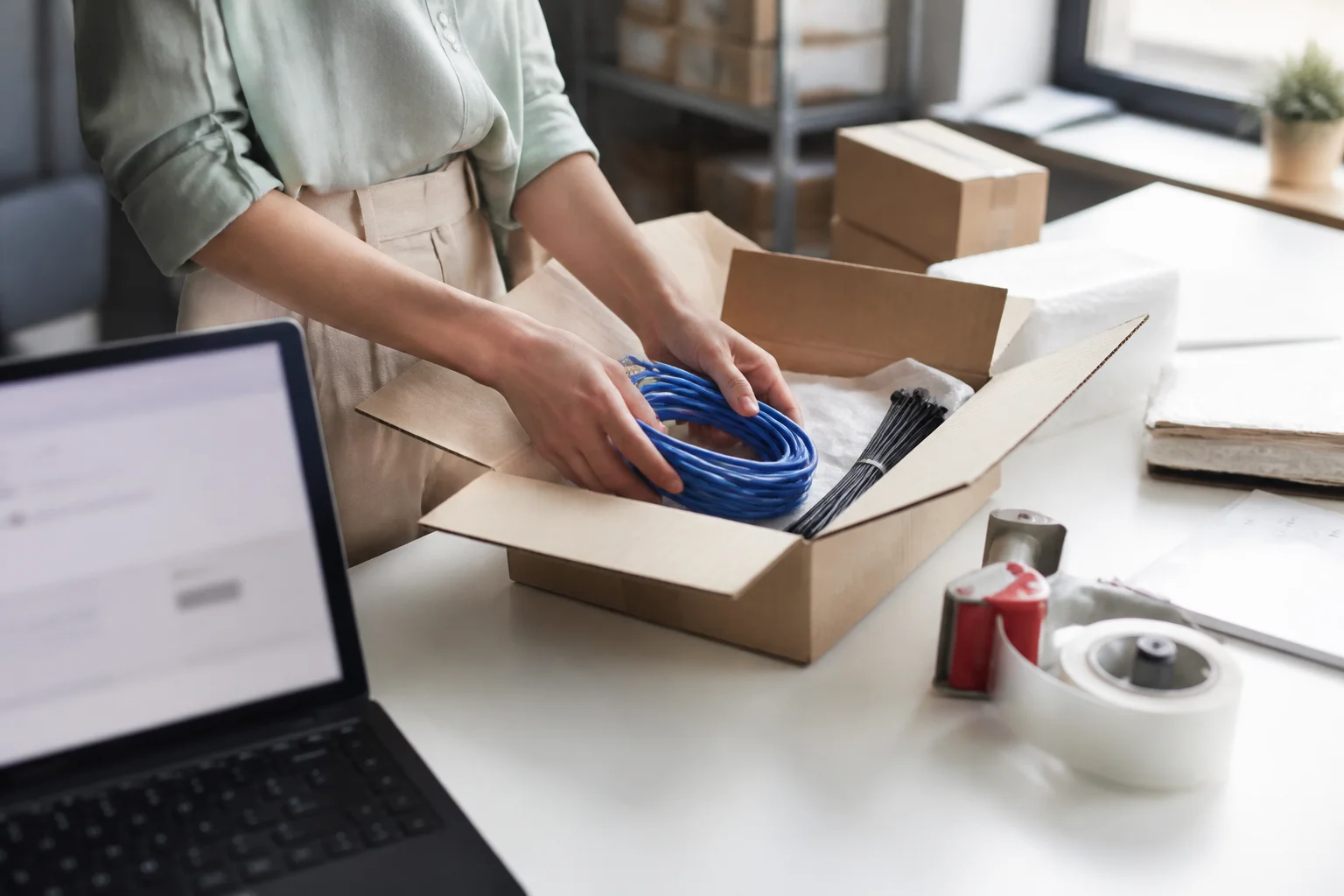
Online Is Now the Default Channel for Shielded Cat6
A decade ago a buyer in Rotterdam or Houston sourced shielded Cat6 through a distributor visit and a printed catalogue. Today the first contact is almost always a storefront: a verified marketplace listing, a factory site with an inquiry form, or a regional importer with a stocked SKU page. The channel changed; the failure modes did not. Three things still break an order, and all three are visible before you pay if you know where to look: the shield construction is not what the listing implied, the drain wire is not bonded through the supplied jacks and panels, and the delivered reel length is short of the label.
STP Cat6 is a shielded twisted pair construction rated to 250 MHz under TIA-568.2-D Cat6 and ISO Class E. It ships in three builds that buyers routinely confuse. F/UTP carries one overall foil with a drain wire. S/FTP places a foil around each pair and a braid over the assembly. SF/UTP uses a braid plus an overall foil. The builds differ in price by roughly a third and differ completely in how they must be terminated. An online purchase only works when the listing names the build before you compare numbers.
Construction and Price Bands You Should Expect
The table below reflects bands we see across factory-direct online channels for 4-pair Cat6. Read the figures as indicative FOB ranges, not quotations. Copper moves every week, a 22 AWG conductor instead of 23 AWG adds cost, and an LSZH or outdoor PE jacket shifts the number again.
| Construction | Shield build | Typical conductor | Indicative FOB per metre | Common online MOQ |
|---|---|---|---|---|
| F/UTP Cat6 | Overall foil plus drain wire | 23 AWG solid | USD 0.20 – 0.40 | 100 – 500 m per SKU |
| S/FTP Cat6 | Braid over pair foils | 23 AWG solid | USD 0.30 – 0.60 | 100 – 500 m per SKU |
| SF/UTP Cat6 | Braid plus overall foil | 23 AWG solid | USD 0.28 – 0.55 | 305 m box or 500 m reel |
| F/UTP Cat6 LSZH | Overall foil plus drain wire | 23 AWG solid | USD 0.28 – 0.52 | 500 m reels |
| UTP Cat6 (reference) | None | 23 AWG solid | USD 0.14 – 0.28 | 305 m box |
The spread between the cheapest F/UTP listing and the most expensive one of the same build is usually explained by four variables: copper weight, jacket compound, whether a third-party test was actually run on the lot, and reel length. Sellers quoting well under the band are typically shorting the copper, substituting a CCA conductor, or shipping 250 m on a reel labelled 305 m. None of those defects show up in a photo. They show up in a cut sample and a DSX report. For a deeper breakdown of how the per-metre number is assembled, see our guide to STP Cat6 price per metre.
Which Channel Fits Which Order
Verified marketplace storefronts run by the factory are the most common entry point for first orders between 300 m and 5 km. You get a public trading record, escrow-style payment protection and a documented dispute path. The weakness is that many storefronts are operated by trading companies that outsource production, so the listing says factory while the reel comes from a subcontractor. Ask for the production address and compare it with the business licence.
Regional importers and bonded warehouses are the fastest route when you need 3 to 7 days and can accept the SKU they stock. You pay a stock premium, often 15 to 30 percent above direct FOB, but you avoid sea freight of 30 to 45 days to Europe or 25 to 40 days to the US, and you get a local return address if a reel fails. For project work where a missed date costs more than the cable, this is usually the correct trade.
Trading-company storefronts without production assets sit in the middle. They are useful for mixed containers where you need shielded Cat6 alongside jacks, patch panels and trunking, because they consolidate. They are the wrong choice when you need lot traceability or a specific CPR class, because they cannot control which line ran your order. Cluster-based sellers in the Shenzhen and Dongguan cable belt can be excellent on flexibility and poor on documentation, so the paperwork must be specified in the inquiry rather than assumed.
Reading a Listing Before You Ask for a Quote
Most bad online orders are decided in the first ten minutes, before any message is sent. Screen the listing on these points:
- Shield type is stated in the title or first bullet. If the page says shielded but never names F/UTP, S/FTP or SF/UTP, the specification is not under control.
- Conductor is described as solid bare copper, with AWG. CCA, CCS or an unstated gauge is a rejection, not a negotiation.
- Bandwidth claim matches the category. Cat6 is 250 MHz. A listing promising 10GBASE-T over Cat6 at 100 m is overstating the standard, which is a Cat6A matter.
- Reel or box length is explicit. 305 m, 500 m and 1000 m are the normal options; a vague length usually means the short one.
- Jacket material and CPR class appear for EU-bound stock. PVC, LSZH and outdoor PE are different products, and Dca or Cca is a declaration, not a slogan.
- The storefront has a production address and a repeat-order history. Both are checkable in minutes.
Buyer Questions We Hear Most
Can I buy a single 305 m box of STP Cat6 online?
Yes, and it is the right way to start. Stocked reels typically begin at 100 to 500 m per SKU, and many factory storefronts will ship one box as a paid sample. Expect to pay sample freight plus a handling charge, and expect the sample to be pulled from standing stock rather than from the lot you will later order. Treat it as a construction check, not a lot approval.
Why is the online price lower than my distributor quote?
Sometimes it is genuine factory-direct pricing. Often it is a different build: F/UTP quoted against an S/FTP requirement, PVC against LSZH, 23 AWG against 22 AWG, or a 250 m reel described as 305 m. Ask for the construction code, the AWG and the reel length in writing, then compare again. The gap usually narrows to freight and duty, which is where it belongs.
Do I need shielded jacks to make the purchase worthwhile?
Yes. A shielded cable terminated on unshielded jacks loses the shielding benefit and keeps the cost. The foil or braid must be bonded at both ends through shielded jacks and a grounded panel, or the shield behaves as an antenna and can make emissions worse than plain UTP. Budget the jacks, panels and grounding bar as part of the same purchase decision.
Three Buying Scenarios
- Retail fit-out, 4 sites, 6 km total. A systems integrator standardizes on F/UTP Cat6 in LSZH, orders through one factory storefront to keep the lot consistent, and takes a 305 m sample reel first. The costs that matter are lot consistency and a single declaration pack, not the last two cents per metre.
- Machine hall retrofit, 1.2 km. A plant engineer buys S/FTP because VFD cabinets sit within a metre of the tray. The order is small, so freight per metre is high and the buyer consolidates with patch panels and shielded jacks to justify the shipment.
- Distributor adding a shielded SKU. A regional distributor orders 10 km of F/UTP in PVC with their own print, takes OEM packaging, and holds bonded stock. Their risk is inventory, not specification, so they buy the build that covers the widest range of local projects.
Verification Checklist Before You Release Payment
- Factory audit or a live video walk of the extrusion and braiding lines, booked before the deposit.
- Datasheet with an insertion loss and return loss sweep to 250 MHz, not a single-frequency claim.
- Shield construction diagram showing foil orientation, braid coverage percentage and drain wire gauge.
- Shield continuity test on a finished assembly: drain wire to connector shell, both ends, recorded in milliohms.
- Fluke DSX-8000 or DSX-5000 permanent link test using shielded channel adapters, with the report files supplied.
- Jacket print check: category, AWG, shield code, jacket compound, metre marking and lot number.
- RoHS and REACH declarations, plus a CPR class declaration where the stock is bound for the EU.
- Pre-shipment inspection with reel count, measured length on a sampling basis, and photos of pallet labels.
The DSX point deserves emphasis. A permanent link test run with unshielded adapters can pass a shielded cable that has no shield continuity at all, because the test never evaluates the shield path. Ask for the adapter model in the report header. For a wider view of how to screen a supplier before the first order, read how to verify an STP Cat6 manufacturer.
Freight, Reels and Landed Cost
Online prices are almost always FOB. The landed number adds sea freight, insurance, duty and inland delivery, and for shielded cable the pallet configuration matters as much as the rate. A 500 m reel of S/FTP is bulky and heavy, so a container fills on volume before it fills on weight. Ask for the pallet plan: reels per pallet, pallet dimensions, and gross weight. Orders under a full pallet are usually cheaper to move as LCL, but LCL adds handling and increases the chance of crushed reels. Buyers who order regularly should look at reel size options before fixing quantities, because 305 m boxes and 500 m reels rarely share an efficient pallet.
What a Clean Online Order Looks Like
A clean order has four documents before production starts: a specification sheet naming the construction and AWG, a signed sample approval, a test plan naming the instrument and adapters, and a packing list with reel lengths. It has one more document before shipment: the inspection report. Everything else, including the storefront design and the response speed of the sales contact, is noise. Buy the documents and the lot traceability, and the cable usually arrives as specified.
FAQ
1. Is it safe to buy STP Cat6 from an online marketplace storefront?
It is safe when you treat the storefront as a lead source rather than a guarantee. Verify the production address against the business licence, confirm the shield construction in writing, buy a sample reel first, and pay through a channel with a documented dispute process. Buyers who skip those four steps and rely on listing photos are the ones who receive unshielded or CCA cable.
2. What is a normal MOQ for an online STP Cat6 order?
Stocked reels usually start at 100 to 500 m per SKU, which covers most first orders and pilot projects. Custom jacket colour or print typically moves the minimum to 3,000 to 10,000 m, and full OEM packaging with your own label runs from 5 to 10 km. Ask which of the three tiers your order falls into before requesting a price.
3. How long does delivery take when I buy shielded Cat6 online?
Stocked items ship in 3 to 7 days. Made-to-order production runs 15 to 30 days depending on jacket compound and print changes. Add sea freight of 30 to 45 days from Asia to Europe, or 25 to 40 days to the US, plus customs clearance. Regional bonded stock is the only route that reliably delivers inside a week.
4. How can I tell F/UTP from S/FTP in a listing?
F/UTP has one overall foil around all four pairs plus a drain wire. S/FTP has a foil around each individual pair and a braid over the whole assembly. The listing should state the code, and the jacket print should repeat it. If neither does, request a cut sample and a construction diagram before ordering.
5. Do online sellers provide Fluke test reports?
Reputable factory storefronts provide DSX-8000 or DSX-5000 reports on request, usually for a sampled link rather than every reel. What matters is that the report header names shielded channel adapters and that the test was run on your lot. A report with unshielded adapters proves continuity of the pairs but says nothing about the shield.