
Almost no LAN cable is manufactured in the Gulf, so Middle East projects depend on distributors who hold stock, handle conformity paperwork and deliver to site. For shielded Cat6 that dependence is sharper, because only part of the distributor field stocks braided or foil-shielded constructions at all. This guide compares UAE, Saudi, Qatari, Omani and Kuwaiti sourcing practice, gives indicative landed price bands, and sets out the documentation and shield tests to require before a reel reaches a process area.
Quick answer: For most Gulf projects the practical recommendation is a distributor with stock in a UAE free zone plus a Saudi partner for in-Kingdom delivery: UAE hubs cover the Emirates, Qatar, Oman, Kuwait and Bahrain quickly, while Saudi work needs local conformity documentation. Expect landed prices around 0.40 to 0.85 USD per meter for F/UTP Cat6 depending on jacket and volume, stock delivery in 3 to 10 days, and 25 to 40 days if the reel has to be produced in Asia first.
Which STP Cat6 Distributor Is Recommended in the Middle East
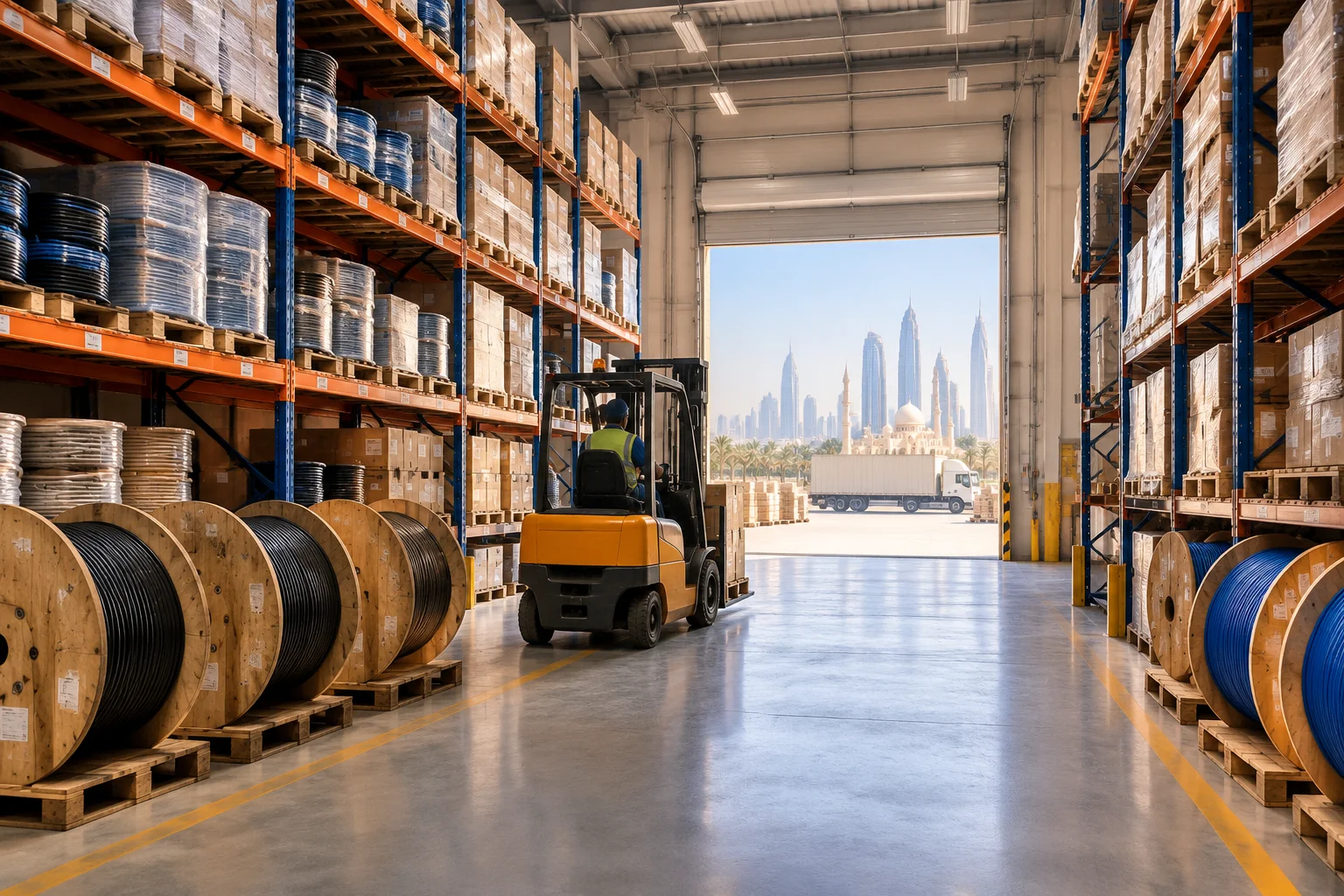
For most Gulf projects the practical recommendation is a distributor with stock in a UAE free zone plus a Saudi partner for in-Kingdom delivery: UAE hubs cover the Emirates, Qatar, Oman, Kuwait and Bahrain quickly, while Saudi work needs local conformity documentation. Expect landed prices around 0.40 to 0.85 USD per meter for F/UTP Cat6 depending on jacket and volume, stock delivery in 3 to 10 days, and 25 to 40 days if the reel has to be produced in Asia first.
How Shielded Cat6 Reaches a Gulf Project
Middle East distribution is shaped by two facts: almost no LAN cable is manufactured in the region, and project specifications are written by consultants who expect documentation to match the drawing. Cable therefore arrives by sea from Asia or Europe and passes through a distributor that holds stock, handles conformity paperwork and delivers to site. The distributor’s real value is not the reel itself but the paperwork and the delivery window.
Metal-clad industrial work is common in the region – petrochemical, desalination, cement, aluminium smelting, logistics automation – and those are exactly the environments where shielded Cat6 earns its premium. A distributor that only stocks unshielded Cat6 will offer to “order it in”, which usually means a 30 to 45 day wait and no local test support.
Buyers should also expect the question of who carries the risk on site acceptance. In a hot climate with long cable routes through process areas, shield continuity after installation is the failure mode that matters, and a distributor that can send a technician with a Fluke DSX and shielded adapters is worth a premium over one that only delivers boxes.
Market-by-Market Sourcing Picture
Indicative landed ranges below are for F/UTP Cat6, 23 AWG solid, PVC or LSZH, in project volumes. They exclude installation and vary with copper, freight and documentation requirements.
| Market | Typical stockholding | Common specification | Indicative landed (USD/m) | Delivery from local stock |
|---|---|---|---|---|
| UAE | Broad, free-zone warehouses | F/UTP LSZH, 305 m reels | 0.40 – 0.70 | 3 – 7 days |
| Saudi Arabia | Project-based, growing local stock | S/FTP for process areas, LSZH | 0.45 – 0.85 | 7 – 14 days |
| Qatar | Narrow, order-driven | F/UTP LSZH, CPR-style declarations | 0.48 – 0.80 | 10 – 15 days |
| Oman and Kuwait | Limited, cross-border supply | F/UTP PVC or LSZH | 0.50 – 0.88 | 10 – 20 days |
The pattern is consistent: the deeper the local stock, the tighter the price band and the shorter the delivery. Saudi projects often carry the widest range because industrial specifications there frequently call for braided shielding in process areas, which pushes the number upward and narrows the supplier field at the same time.
What a Good Regional Distributor Provides
Stock, not just a catalogue
Ask for the reel count on hand by construction and jacket, with lot numbers. A distributor holding 20 reels of F/UTP LSZH can support a phased fit-out; one holding two reels is really a trader with a showroom.
Conformity and documentation
Gulf markets operate their own conformity schemes, and requirements differ between the UAE, Saudi Arabia and Qatar. Ask the distributor to state which documents it supplies for your destination and to show an example set from a previous shipment. This is a documentation question, not legal advice: confirm the current requirement with your importer or consultant.
Technical support on site
The shielding benefit depends on grounded jacks and panels. A distributor that stocks shielded keystone jacks, shielded patch panels and grounding kits alongside the cable removes the most common installation error in the region.
Freight and customs fluency
Free-zone consolidation, land transport to Saudi or Oman, and correct documentation for reels on pallets all affect the delivered date. Ask for the transit time from the free zone to your site, not the transit time from the port.
MOQ, Lead Time and Order Shape
Regional distributors rarely publish MOQ, because it depends on whether the item is on the shelf. The bands below reflect common practice.
- Stocked reels: 100 – 500 m per SKU, delivered in 3 to 10 days.
- Indent order from Asia: 5,000 – 10,000 m per construction, 15 to 30 days production plus 25 to 40 days sea freight and clearance.
- Private label for a distributor: 5 – 10 km, typically annual programme.
- Project buffer: add 10 percent to the take-off for shield damage and termination waste.
For phased industrial projects the sensible structure is a stock draw for the first phase and an indent for the balance, with both tied to the same construction and lot family so that installed channels certify consistently. Reel sizes matter here: 500 m drums reduce joint count on long tray runs, while 305 m reels suit floor-by-floor distribution. Our note on STP Cat6 reel sizes explains the handling trade-offs.
Verifying Shield Performance Before Acceptance
In a hot, dusty, electrically noisy plant the acceptance test is the only proof that the shielding works. Build it into the distributor agreement.
- Request the factory datasheet with a frequency sweep to 250 MHz and the shield construction drawing, not a distributor-branded summary sheet.
- Check the reel label and lot number against the factory packing list to confirm the cable is the construction ordered.
- Measure drain-wire to drain-wire continuity on each delivered reel and record resistance values.
- Certify at least one channel per 500 m with a Fluke DSX-8000 or DSX-5000 and shielded channel adapters, and retain the report.
- Confirm that jacks, panels and patch cords in the same bill of materials are shielded and bonded to ground.
- Inspect jacket print for construction, AWG, flame rating and lot; reject reels where print is missing or mismatched.
- Collect RoHS and REACH declarations plus the conformity documents agreed for the destination market before shipment leaves the free zone.
If the distributor cannot support items three and four, the shielding claim is untested and the premium is unjustified.
Questions Buyers Ask Gulf Distributors
Which constructions do you actually hold in stock today? Request counts and lot numbers. A vague answer usually means the item is on a vessel rather than on a rack.
Who handles the conformity paperwork for my destination? The answer should name documents and a responsible party, not “we will manage it”. Confirm current requirements with your importer.
Can you supply shielded termination hardware with the cable? Mixed shielded cable and unshielded jacks is the most common specification error in the region, and it silently removes the benefit you paid for.
Three Buyer Scenarios
- Desalination plant expansion, 9 km: S/FTP in process areas and F/UTP in admin blocks, sourced through a UAE distributor with an indent for the braided volume.
- Logistics automation retrofit, 3,200 m: stock draw from Dubai against a two-week shutdown window, price secondary to delivery certainty.
- Industrial city fit-out in Saudi Arabia, 15 km: in-Kingdom distributor with local conformity documentation and staged deliveries over four months.
Shortlisting in Practice
Ask three distributors in each target market for the same specification, then compare on four axes: stock depth by construction, documentation package, on-site test capability, and delivered date to site. Price comes last because the spread between a stocked reel and an indent is mostly freight and time, not cable quality. Buyers running a parallel tender in Europe should also read the notes on STP Cat6 suppliers in Germany for how documentation-driven markets compare, and the market-by-market view in the UAE distributor guide.
FAQ
1. Which Middle East market holds the most STP Cat6 stock?
The UAE, and specifically its free-zone warehouses, carries the deepest stock and serves the wider Gulf quickly. Saudi Arabia has growing local stock driven by project demand, while Qatar, Oman and Kuwait usually work on an order-driven basis. For multi-country projects, a UAE hub plus a Saudi partner is the common structure.
2. What does STP Cat6 cost in the Gulf?
Indicative landed prices run about 0.40 to 0.70 USD per meter in the UAE for F/UTP Cat6, and 0.45 to 0.85 in Saudi Arabia where braided constructions are more common in process areas. Jacket compound, volume and documentation requirements move the figure. Treat these as planning bands rather than quotations.
3. What conformity documents should a distributor provide?
Requirements differ between the UAE, Saudi Arabia and Qatar, and change over time, so ask the distributor to state which documents it will supply for your destination and to show a recent example set. Confirm the current requirement with your importer or consultant. The distributor should name a responsible party, not promise to manage it.
4. How long does delivery take from a Gulf distributor?
Stocked reels typically arrive in 3 to 10 days within the UAE and 7 to 20 days elsewhere in the region, depending on land border formalities. If the construction has to be produced in Asia first, allow 15 to 30 days production plus 25 to 40 days sea freight and clearance.
5. Can a distributor support shielded channel testing?
The better ones can, and it matters in hot, dusty process plants where site acceptance decides payment. Ask whether they will certify channels with a Fluke DSX and shielded adapters, and whether they stock shielded jacks, panels and grounding kits. Without those the shielding claim is untested.