
Buyers searching for STP Cat6 in the UAE rarely lack offers. The difficulty is telling a real stockist from a broker who forwards the inquiry to a factory in Shenzhen and adds a margin. Distributor choice in this market shapes landed cost, documentation quality, reel availability and, most of all, whether the shield is bonded correctly at the patch panel you install. This guide compares the channels that supply Dubai, Abu Dhabi and the northern emirates, sets out indicative price bands, and gives a verification routine you can run before the first pallet ships.
Quick answer:
For most UAE projects, use a Jebel Ali or Dubai industrial-area distributor that holds F/UTP and S/FTP Cat6 reels in stock and can show a third-party test report with shielded adapters. Expect roughly USD 0.35-0.60 per meter landed for F/UTP 23 AWG PVC, and 3-7 days from local stock. Caveat: free-zone stock is often re-packed from bulk drums, so confirm reel labels and lot numbers match the test report before you accept delivery.
Which STP Cat6 Distributor Should You Use in the UAE?
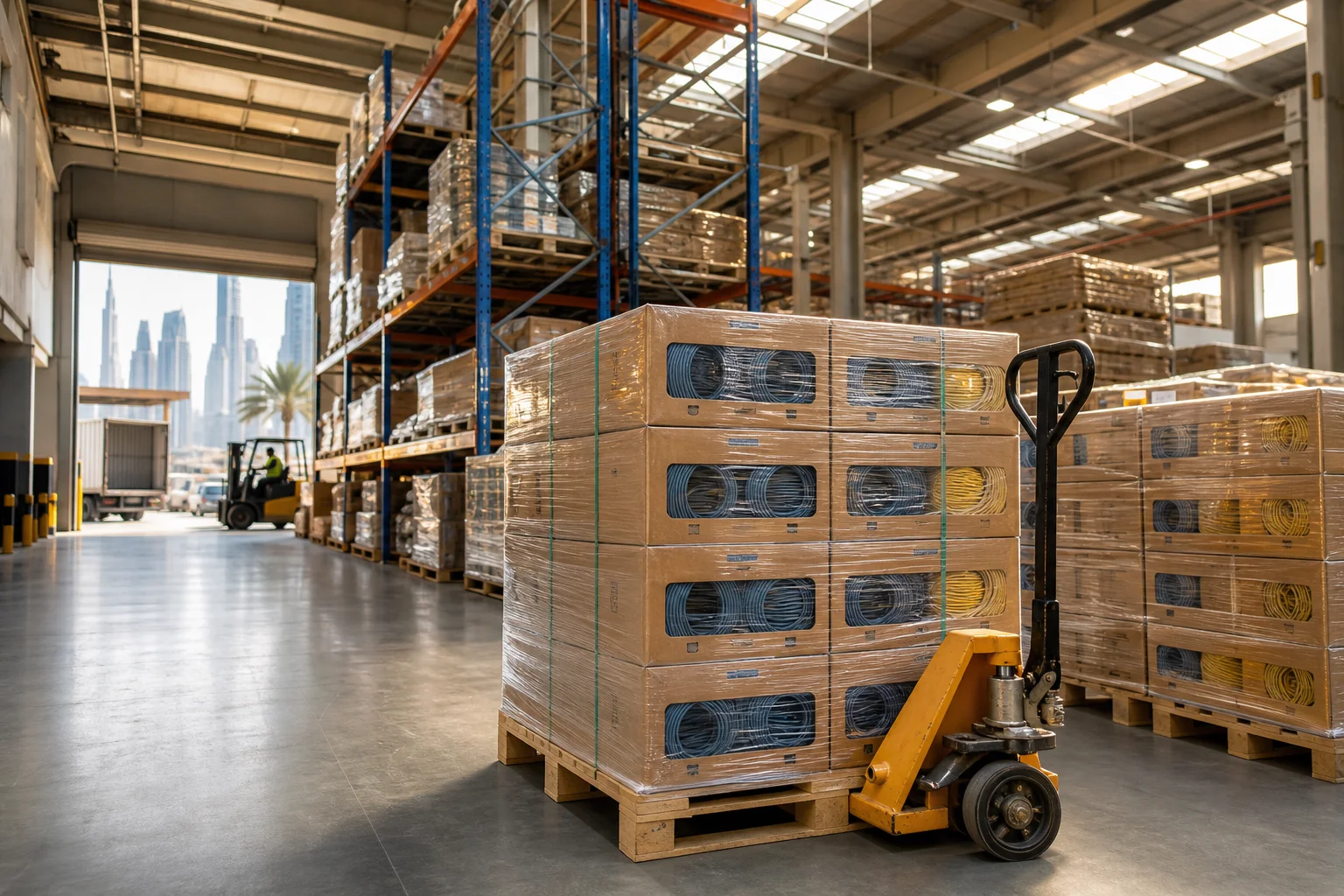
The UAE is a re-export and project market, not a manufacturing one. Almost every shielded Cat6 reel sold in Dubai was made in a Chinese, Indian or Turkish cable plant, then imported by a distributor, a contractor or a free-zone trading company. That structure is useful, because stock is close to site, but it also means the same cable can be quoted at four different prices depending on how many hands it passes through and how much of the specification survives the journey. This guide looks at what each channel really delivers, what the price bands look like in 2026, and how to test a distributor before you commit a project to them.
What a UAE STP Cat6 Distributor Actually Adds
A distributor in this market performs four practical functions: holding reel stock so a contractor is not waiting on a container, cutting and re-reeling to project lengths, matching shielded jacks and panels to the cable construction, and handling import paperwork. The last point matters more than buyers expect. A reel that arrives without a datasheet showing a frequency sweep to 250 MHz, a shield construction drawing and RoHS/REACH declarations is hard to submit to a consultant and easy to reject at handover, which usually lands on the installer rather than the seller.
What a distributor does not automatically add is testing. Plenty of trading offices in Deira and Sharjah never open a carton. If your specification depends on shielded performance in an EMI-heavy plant room or a chiller plant with VFDs, shield continuity and drain-wire termination have to be written into the purchase order, with the test method named. They will not happen by default, and a shielded cable landed on unshielded jacks gives you the cost of STP with the behaviour of UTP.
Channel Comparison: Stockist, Trader or Factory Direct
The four routes below cover most UAE purchasing. Price bands are indicative and expressed per meter; they move with copper, shield type and jacket, so treat them as a screening tool rather than a quotation.
| Channel | Typical stock position | Indicative price band (USD per meter) | Lead time | Best fit |
|---|---|---|---|---|
| Dubai trade counter stockist | 100-500 m per SKU, mostly F/UTP 23 AWG PVC | 0.55-0.90 ex-stock | 3-7 days | Fit-out and repair work under 2 km |
| Jebel Ali free-zone distributor | Container lots, mixed SKUs, some LSZH | 0.35-0.60 landed equivalent | 1-3 weeks | Contractors needing staged release |
| Regional trader or broker | No stock, quote only | 0.30-0.50 FOB | 4-8 weeks | Tenders where price dominates |
| Factory direct from Chinese clusters | Production to order, 3,000 m and up per jacket or print run | 0.28-0.48 FOB | 25-40 days door to door | 5 km and above, OEM print or LSZH |
| GCC re-exporter | Bonded stock, cross-border delivery | 0.40-0.65 delivered | 1-2 weeks | Multi-country rollouts |
The spread between the cheapest and most expensive line is roughly two to one, and it is not explained by copper alone. Free-zone stock priced at the bottom of the band is often F/UTP with a 0.40 mm foil and a thin PVC jacket, which is a legitimate product but a different one from the S/FTP the consultant specified. Always ask which construction the quoted price refers to before comparing numbers.
What Moves the Price: Shield, Jacket and Copper
Three variables account for most of the difference between quotes. Shield type comes first: F/UTP with an overall foil sits at the lower end, S/FTP with a braid over each pair foil typically adds 25-40 percent for the same copper weight, and SF/UTP falls between them. Jacket comes second: PVC is the baseline, LSZH adds roughly 10-20 percent, and an outdoor PE jacket with UV stabilisation adds more again. Conductor gauge is third: 23 AWG is the norm for Cat6, and any offer of 24 AWG is lighter copper on a longer pair lay, so check the datasheet before assuming a bargain.
Landed cost is a separate calculation. Add ocean freight and insurance to the FOB figure, then the five percent UAE import duty on cable, clearance and inland delivery. A container of reels is heavy, so freight per meter is not trivial, which is why a factory-direct price that looks 30 percent cheaper often lands within 10 percent of Dubai stock once duty and clearance are counted.
Lead Times and Reel Availability in the UAE Market
Stocked reels in Dubai move in 3-7 working days, which is why contractors accept the ex-stock premium on small jobs. Custom jacket colour, printed branding or LSZH in a non-standard length usually means 15-30 days of production plus shipping, so four to six weeks door to door if the factory has the compound in stock. Sea freight from South China to Jebel Ali is roughly three weeks port to port, and clearance adds a few days. If a project has a hard handover date, order the shielded jacks and panels at the same time as the cable; a mixed delivery is the most common cause of a stalled containment schedule.
Reel formats matter as much as total quantity. Most UAE stock is 305 m pull boxes or 500 m reels, with 1,000 m wooden drums available on order. Long horizontal runs in warehouses and yards are easier from drums, while riser work in towers is easier from boxes that fit a service lift. Confirm the format in writing, because a distributor who substitutes four 305 m boxes for a 1,000 m drum changes your pull plan and your scrap rate.
Three UAE Buyer Scenarios
- Fit-out contractor, 1,800 m for a Dubai office tower. Local stock wins here. The volume is below a sensible factory order, the schedule is tight, and the shield requirement is modest because the risers are away from heavy drives. A trade counter with F/UTP 23 AWG PVC boxes plus a matched shielded patch panel solves it in a week.
- Industrial EPC, 12 km for a Jebel Ali process plant. This is a factory-direct case: S/FTP, LSZH where the fire strategy demands it, printed reel labels per lot, and a pre-shipment inspection before the container leaves. Expect 15-30 days production plus freight, and insist on a Fluke DSX test on a sample reel with shielded adapters.
- Systems integrator supplying three GCC sites. A free-zone distributor with bonded stock and cross-border delivery is usually the least painful route, because one purchase order can release cable to Dubai, Riyadh and Muscat without three separate import files, and the documentation set stays identical across sites.
How to Verify a UAE STP Cat6 Distributor Before the First Order
Run these checks in order. The first three take a morning and eliminate most of the risk.
- Ask for the datasheet of the exact construction quoted, with insertion loss, NEXT and return loss values swept to 250 MHz, not a generic catalogue page.
- Request a test report from a Fluke DSX-8000 or DSX-5000 channel test using shielded adapters, with the reel lot number visible on the same document.
- Take a 1 m sample from stock and check shield continuity end to end with a multimeter, plus drain-wire contact at both terminations.
- Confirm the shield construction physically: overall foil only is F/UTP, braid plus pair foils is S/FTP, and the jacket print should state the construction and the standard it claims.
- Verify traceability: reel label, lot number, factory name on the carton and the importer of record should line up. A distributor who cannot name the plant behind the cable is reselling an unknown lot.
- Book a pre-shipment inspection on the first container, covering reel count, length tolerance, jacket print and a random shield continuity check on two reels per pallet.
Documentation to Request With Every Quote
A complete UAE submittal package for shielded Cat6 is short and specific: the construction datasheet, RoHS and REACH declarations, a shield grounding diagram showing how the drain wire terminates at jack and panel, reel label artwork, and the test report. For projects with a fire-engineering strategy, add the jacket’s flame and smoke classification and confirm it matches the specification clause. Distributors who hold this set already are usually the ones who have supplied consultants before, and that is a better signal than any showroom.
Compare the documentation quality against the price band, not in isolation. A quote at the top of the local band with a full test report and matched shielded panels is often cheaper than a mid-band quote that forces you to buy new jacks, re-terminate a floor, and explain a failed channel test at handover. For regional comparisons beyond the UAE, see our guide to the STP Cat6 distributor landscape across the Middle East, and if budget approval is the blocker, start from STP Cat6 price per meter before you ask for quotes.
Finally, confirm schedule commitments in the same document as the price. A distributor who quotes 3-7 days on stock but cannot confirm reel count on hand is quoting hope. Ask for the current stock list by SKU and a written substitution rule naming the construction and test evidence required for any alternative. Phased release planning is covered in our STP Cat6 lead time guide.
Red Flags in UAE STP Cat6 Offers
Three patterns recur. The first is a shielded price with an unshielded datasheet attached, which happens when a trader quotes STP and ships F/UTP because the buyer never opened the specification. The second is a test report with no lot number and no shielded adapters, which proves the cable passes on a bench but says nothing about the reel in your warehouse. The third is a reel label printed by the distributor rather than the factory, which breaks traceability the moment a channel test fails. Any of the three is a reason to slow down, request a sample reel, and test before the balance of the order is released.
FAQ
1. How much does STP Cat6 cost from a UAE distributor?
Indicative ex-stock prices in Dubai run about USD 0.55-0.90 per meter for F/UTP 23 AWG PVC, with S/FTP higher. Free-zone container stock and factory-direct orders land nearer USD 0.35-0.60 per meter. All figures move with copper price, shield type, jacket and volume, and they exclude VAT and installation.
2. Can a UAE distributor supply LSZH shielded Cat6 quickly?
Sometimes, but stock is thinner than PVC. LSZH in S/FTP is usually a production order of 15-30 days plus freight unless a free-zone holder happens to carry the exact construction. Confirm the compound, the flame classification on the jacket print and the test report before accepting a fast delivery promise.
3. Do I need shielded jacks and panels for STP Cat6?
Yes. The shield only works when it is bonded at both ends through shielded jacks, panels and grounded racks. Installing STP on unshielded hardware adds cost and capacitance without delivering the EMI benefit, and it often fails shield continuity tests at commissioning. Budget for matched hardware at quotation stage.
4. What lead time should I plan for a container of STP Cat6?
Allow 15-30 days for production, about three weeks of ocean freight to Jebel Ali and a few days for clearance, so roughly six to eight weeks door to door. Stocked reels in Dubai move in 3-7 days. Add a week if a pre-shipment inspection or a custom jacket print is required.
5. How do I check shield continuity on a delivered reel?
Take a sample length, terminate both ends on shielded jacks, and measure resistance from the drain wire at one end to the shield at the other with a multimeter. A reading of a few ohms confirms continuity; an open circuit means a broken foil or an unconnected drain wire. Follow with a DSX channel test using shielded adapters.