
A wholesaler quotes Cat7 at an attractive rate per metre, the buyer orders 6,000 m, and the delivery arrives on six 1,000 m plywood reels that no one on site can move without a forklift. Reel format is the most overlooked line in a Cat7 purchase order. It decides how the cable is pulled, how much is wasted at the end of a run, how freight is calculated, and whether the receiving site can handle the delivery at all. This guide covers the formats wholesalers stock and how to specify them so the price advantage survives to site.
Quick answer: Asian and European wholesalers stock 100-200 m coils, 305 m boxes, 500 m reels and 1,000 m plywood reels, with 2,000-3,050 m drums made to order. The 500 m reel is the safest default for project work at 22-30 kg, and 305 m boxes suit trade distribution. Choose the format from the receiving end backwards, because anything above 50 kg needs equipment on site.
What Reel Sizes Do Cat7 Bulk Cable Wholesalers Offer?
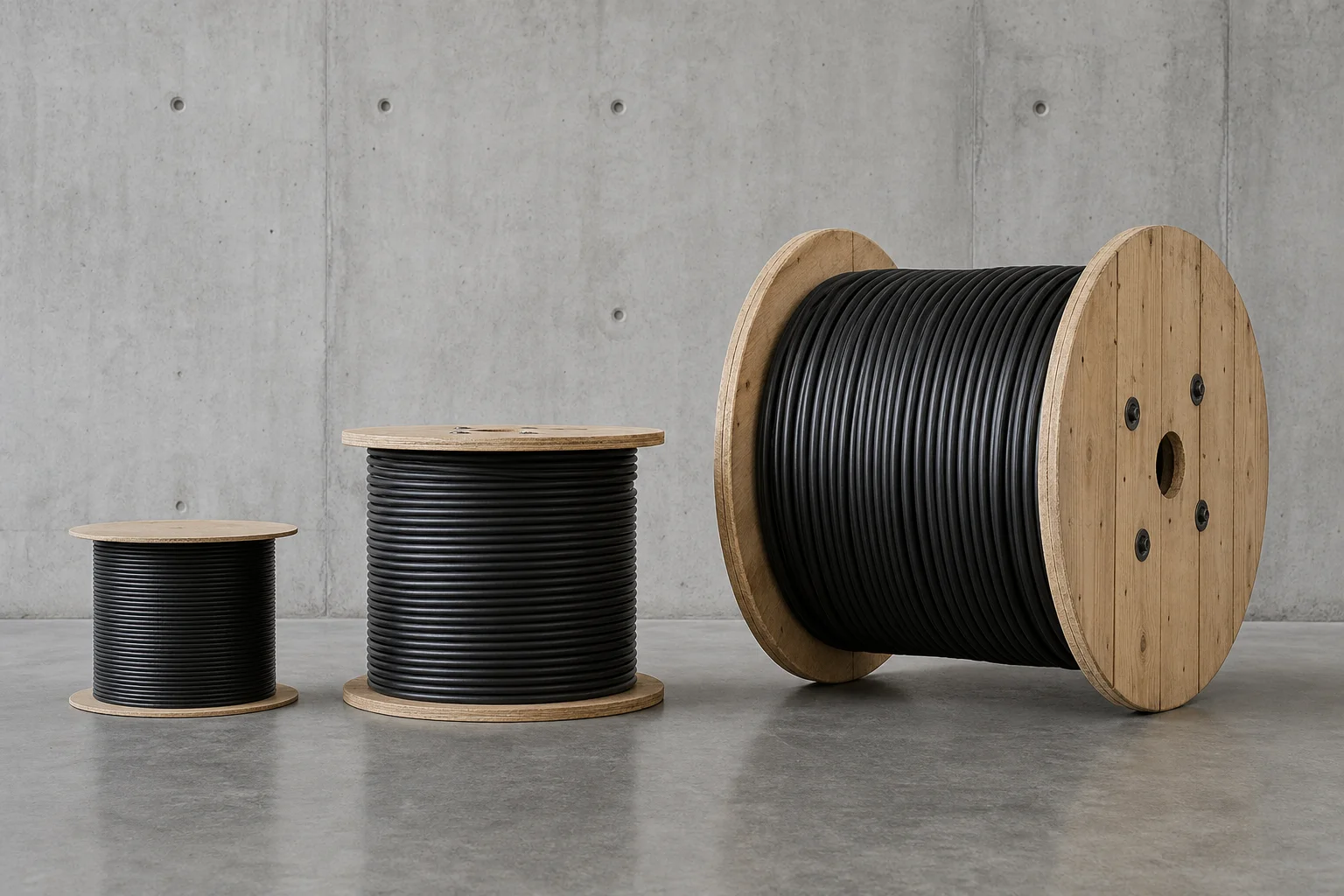
A wholesaler quotes Cat7 at a competitive rate per metre, the buyer orders 6,000 m, and the shipment arrives on six 1,000 m plywood reels that no one on site can move without a forklift. Reel format is the most overlooked line in a Cat7 purchase order. It determines how the cable is pulled, how much is wasted at the end of a run, how the freight is calculated, and whether the installer can handle the delivery at all. This guide sets out the formats wholesalers stock, the weight bands that come with them, and how to specify reels so the price advantage survives to site.
The reel and package formats that wholesalers actually stock
Cat7 S/FTP is heavier than an unshielded cable of the same length because of the foil, the braid and the drain wire, and the reel must carry that weight without crushing the outer layers. The table below shows the formats commonly available from Asian wholesalers and European distributors, with indicative weights for a 23 AWG S/FTP construction in PVC. LSZH jackets run slightly heavier.
| Package format | Typical length | Outside diameter and weight band | Handling requirement | Typical order band |
|---|---|---|---|---|
| Shrink-wrapped coil | 100-200 m | 0.25-0.35 m, 6-12 kg | One person, hand carry | 10-50 coils, stocked |
| Cardboard box, 1,000 ft pattern | 305 m | 0.30-0.40 m, 14-20 kg | One person with a cart | 10-40 boxes, stocked |
| Plastic or plywood reel | 500 m | 0.40-0.55 m, 22-30 kg | One person with a reel stand | 5-20 reels, stocked |
| Plywood reel, project format | 1,000 m | 0.60-0.80 m, 42-58 kg | Two people or a pallet jack | 2-10 reels, made to order |
| Heavy drum, long-run format | 2,000-3,050 m | 1.00-1.25 m, 85-135 kg | Forklift or crane, reel stand mandatory | 1-4 drums, made to order |
The 500 m reel is the workhorse of the European project market, and the 305 m box is the workhorse of the US and UK trade market because those specifications are written in feet. The 1,000 m reel offers the lowest handling count per metre but crosses a weight threshold that changes who can receive the delivery. Below 30 kg a single installer can move a reel; above 50 kg the site needs equipment, and above 85 kg the freight forwarder needs a forklift at both ends.
Wholesalers also quote by reel count rather than metre count for stocked formats, which is why a 3,000 m requirement may be quoted as six 500 m reels instead of a single 3,000 m drum. That is a stocking decision, not an attempt to inflate the order: drums are built to order and usually carry a longer lead time. Buyers comparing bulk Cat7 price offers should convert every quote to a price per metre landed, including the reel and pallet surcharge, before comparing headlines.
How buyers control risk on reel format and length
The controls below are cheap to apply and catch the failures that only appear when the drum is opened on site.
- Weigh a sample reel. Copper weight is the clearest signal of conductor size. A 500 m reel of 23 AWG S/FTP that arrives well below the expected band usually has thinner conductors or less braid coverage.
- Check the length tolerance in writing. Ask for the declared tolerance, typically 0.5-1% under nominal, and confirm that metre marking starts at the inner end so the installer can measure the remaining length.
- Inspect flange and drum condition. Crushed flanges and broken plywood mean jacket deformation on the outer layers. Photograph the pallet on arrival before signing the delivery note.
- Require metre marking and a lot number. Jacket print should show the construction, the standard, the metre count and a lot code that links back to the test report.
- Confirm the inner end is accessible. Some reels are wound so the inner end is buried under the outer layers, which forces the installer to unreel the whole drum before pulling a run.
- Match the reel to the pulling method. A 1,000 m reel on a fixed stand is efficient for long horizontal runs, and a poor choice for a multi-floor fit-out where the cable must be carried.
- Check the pallet and stacking plan. Reels shipped upright on a single pallet cost less in LCL freight than reels shipped loose, and they arrive with less damage.
- Ask for the packaging specification. UV wrap, edge protection and desiccant matter for outdoor storage and for sea freight through humid routes.
These checks belong in the pre-shipment inspection scope, which is the same discipline used when verifying a Cat7 manufacturer for any other order.
Three buyer scenarios and the reel format that fits
- Electrical contractor cabling a single building, 9,000 m. The practical answer is a mix: 500 m reels for floor-by-floor distribution and two or three 1,000 m reels for the vertical backbone runs. An all-drum order looks cheapest per metre and then requires a forklift at a site that has none.
- Distributor serving trade counters, 24 SKUs. Stocked 305 m boxes and 500 m reels sell through fastest because they match how installers buy. Long drums tie up capital and floor space, and they rarely move without a project attached.
- OEM brand packing its own label, 15 km per year. Here reel size is a marketing decision as much as a logistics one, and 500 m reels with printed labels and branded flanges are typical. Expect 3,000-10,000 m per construction as a production minimum and confirm the reel label artwork early.
The freight maths that makes a bigger reel expensive
Sea freight is charged on volume or weight, whichever is greater, and reels are inefficient in both dimensions. A 1,000 m reel occupies more container space per metre than two 500 m reels stacked on a pallet, even though it weighs the same. For LCL shipments the difference can exceed the per-metre saving, particularly on short routes where the minimum chargeable volume dominates.
Full container loads reverse the logic. Once a buyer fills a 20 ft container, pallet configuration and reel diameter decide how many metres fit, and a mixed load of 500 m and 1,000 m reels usually beats a uniform load. Buyers near a port should also price the option of shipping 305 m boxes, which stack efficiently and can be received without equipment. The general rule is that reel format should be chosen from the receiving end backwards, not from the factory floor forwards.
Buyer question: is a longer reel always cheaper per metre?
Usually, but not reliably. A 1,000 m reel saves on flanges, labelling and handling per metre, so the ex-works price per metre is often lower than the same cable on 500 m reels. The saving shrinks or disappears once freight volume, forklift requirements, and cut waste at the end of a run are counted. A site that pulls 90 m runs from a 1,000 m reel ends up with a partial reel that cannot be returned.
The better question is how much of the reel will be consumed without a cut. Where runs are long and continuous, larger reels win. Where runs are short and distributed, smaller reels win even at a higher unit price. Buyers ordering through a European Cat7 wholesale channel can often mix formats within one order, which is the cheapest way to solve both cases at once.
Finally, confirm what the wholesaler means by a reel length. Some quote the nominal length wound at the factory, others quote a guaranteed usable length after the inner end is dressed. The difference is small in percentage terms and large in a project where the last run is 40 m short, so it belongs in the purchase order rather than in a conversation.
FAQ
1. What is the most common Cat7 bulk cable reel size?
500 m reels dominate European project orders, while 305 m boxes dominate US and UK trade orders because those markets specify in feet. Asian wholesalers stock both, plus 1,000 m plywood reels for larger projects. The 100 m coil is used mainly for samples, small site top-ups and retail packaging rather than for structured cabling volumes.
2. How much does a 500 m Cat7 reel weigh?
A 500 m reel of 23 AWG S/FTP in PVC typically falls in the 22-30 kg band, reel included. LSZH jackets run slightly heavier. That weight matters because it sits at the limit of what one person can move with a reel stand, so most sites prefer it over 1,000 m reels that need two people or a pallet jack.
3. Can I order a custom reel length?
Yes, above a production minimum. Custom winding of 600 m, 750 m or 1,000 m is normally available from 3,000-10,000 m per construction, and the factory will schedule a rewinding run rather than pull from stock. Below that quantity, buyers are usually offered the nearest stocked format plus a length tolerance in the purchase order.
4. Why does reel diameter affect freight cost?
Sea freight is charged on chargeable volume or gross weight, whichever is higher, and large reels waste container space because the drum core carries no cable. Two 500 m reels on a pallet often occupy less chargeable volume than one 1,000 m reel of the same total length. For LCL shipments, that volume difference can exceed the per-metre saving on the larger reel.
5. What should I check on delivery of Cat7 reels?
Check flange condition, pallet integrity and jacket print before signing. Weigh one reel per lot against the expected band, confirm the lot number matches the test report, and verify that metre marking is visible at the outer end. Photograph any crushed flange immediately, because outer-layer deformation is a transport claim rather than a manufacturing defect.