
Searching for Cat7 online returns thousands of listings that look identical: same product photo, same headline specification, prices that differ by a factor of three. For a buyer sourcing for a project or a resale catalogue, the question is not which listing is cheapest but which channel matches the quantity, the documentation requirement and the risk you are willing to carry. This guide compares the channels that genuinely supply Cat7, gives indicative price bands for each, and lists the checks to complete before any payment leaves your account.
Quick answer:
For 1 – 10 reels, buy from a verified marketplace seller or a regional distributor holding bonded stock, at roughly USD 0.55 – 2.20 per meter, and insist on escrow or card payment plus a sample. For 5 km and above, go direct to a factory in the Shenzhen or Dongguan cable cluster at USD 0.45 – 1.20 per meter. The caveat: neither route is safe without a test report and a verified business identity.
Where to Buy Cat7 Ethernet Cable Online Safely
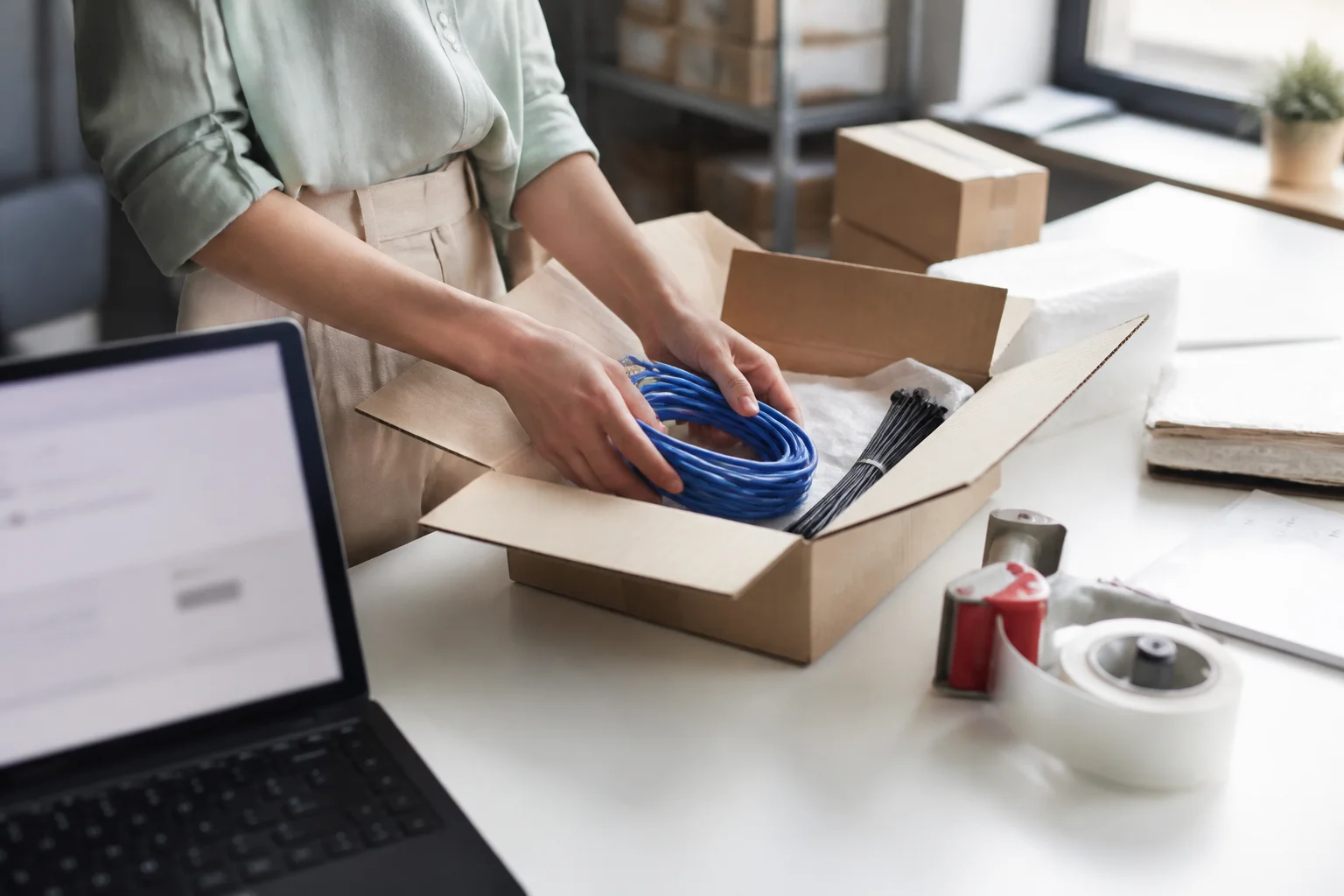
The channels that actually supply Cat7 online
Cat7 is a Class F construction under ISO/IEC 11801, rated to 600 MHz, and it is not a TIA recognised category. That matters online, because a large share of listings use the label loosely. The table below compares the channels a commercial buyer will encounter, with indicative price bands and the verification each channel makes possible.
| Channel | Best fit | Indicative price band (USD per meter) | Typical MOQ | Verification available |
|---|---|---|---|---|
| Verified marketplace sellers (Alibaba.com, Made-in-China, Global Sources) | First order, 1 – 10 reels, sample buying | 0.55 – 1.50 | 100 – 500 m per SKU | Business licence check, trade assurance escrow, sample orders, inspection services |
| Direct factory enquiry from the Shenzhen and Dongguan clusters | 5 km and above, OEM print and packing | 0.45 – 1.20 | 3,000 – 10,000 m for custom work | Factory audit, ISO certificates, lot test reports, pre-shipment inspection |
| EU or UK distributor e-commerce with bonded stock | Project deadlines, CPR documentation needs | 0.90 – 2.20 | 1 reel | CPR class declaration, EN 50575 documentation, local returns |
| Brand-owner web stores and installer portals | Small quantities, warranty-backed assemblies | 1.50 – 4.00 | 1 piece | Published warranty, channel support, no factory visibility |
| Trade fair follow-up (Canton Fair, Hong Kong sourcing shows) | Qualifying suppliers face to face | 0.50 – 1.30 | Sample then 3,000 m and above | Direct meeting, factory visit invitation, reference customers |
Prices above are indicative FOB or ex-warehouse bands and move with copper, jacket compound, gauge and freight. They are useful for spotting an outlier, not for setting a target. A listing at half the bottom of the band is describing a different product, usually a thinner conductor, lighter braid or unshielded plugs.
What changes the number
Channel margin and service. A distributor holding bonded stock in Europe carries duty, VAT, warehousing and returns, and that shows up as a 30 – 60 percent premium over factory FOB. You are buying availability and paperwork, not cable alone. A marketplace seller with no stock carries none of that and prices closer to the factory, with the risk sitting with you.
Quantity and cut lengths. Reels are priced per meter; cut lengths are priced per piece, and the cutting, terminating, testing and packing can double the effective per-meter cost below 5 m. If your requirement is 200 patch cords rather than 200 m of cable, buy assemblies from an assembler rather than cable from a cable factory.
Freight and duties. A single reel shipped by air can cost more in freight than the cable. Consolidated sea freight needs volume and patience: 25 – 45 days to Europe and 25 – 40 days to the United States, plus clearance. Online checkout prices rarely include destination duty, and that is where budget overruns appear.
Documentation. A datasheet with a full frequency sweep, RoHS and REACH declarations and a CPR class statement cost the supplier real money. Listings that omit them are cheaper for a reason, and the missing paperwork becomes your problem at project handover.
Payment method. Escrow, letter of credit and card payment each add a cost that is priced into the quote. A seller who only accepts bank transfer to a personal account is not offering a discount; they are removing your recourse. For a per-meter benchmark before you compare channels, see Cat7 price per meter.
How to verify a seller before you pay
- Check the registered business name and licence number on the marketplace profile against a company registry, and confirm the address matches the factory you expect.
- Ask for the ISO 9001 and ISO 14001 certificates and verify them with the issuing body, checking that the scope includes cable extrusion.
- Request a Fluke DSX-8000 or DSX-5000 Channel or Permanent Link report for the exact construction you are buying, not a generic PDF.
- Buy one sample reel through the platform’s escrow, then measure conductor diameter, weigh the copper and confirm the jacket print matches the datasheet.
- Ask for a video call from the extrusion floor with the machine running and the reel labels visible, which is difficult to stage and easy to fake with photos.
- Book a third-party pre-shipment inspection for the first order and make the balance payment conditional on the report.
Three buyer scenarios
- Facilities manager needing 600 m for one building. The requirement is speed and traceability, not the last few cents. Buy two 305 m LSZH reels from a distributor with bonded stock in the region, at the upper part of the band, and keep the invoice and CPR declaration for the building file. Delivery in days beats a factory order that arrives in six weeks.
- Integrator tendering a 12 km fit-out. Go to two or three factories directly, compare on identical datasheets, and treat the marketplace listing as market intelligence rather than as the purchase route. Ask for a factory audit or a live video walk-through, and agree the test protocol before the price.
- Online retailer building a Cat7 listing. Source plain PVC S/FTP from a verified marketplace seller for the first 3 km to validate demand, then move to a factory with OEM print once volume is proven. Never let a marketplace seller supply your branded cartons without an agreed artwork proof and an inspection.
Is a marketplace listing cheaper than a factory website?
Sometimes, and for reasons that have nothing to do with the cable. Marketplace sellers compete on a visible price and often absorb freight into the unit price, while factory websites quote FOB and expect you to arrange logistics. For a single reel, the marketplace usually wins on landed cost. Above roughly 5 km, the platform fee and the intermediary margin become visible, and a direct factory quote wins, provided you have the audit and the test protocol in place. The reverse is also true: a factory that will not quote below 10 km is not a fit for a 600 m requirement, no matter how good the price looks.
Red flags in online Cat7 listings
Be cautious with listings that show Cat7 in the title but Cat6A in the specification table, that promise 1000 MHz on a 600 MHz product, that quote per piece without stating the length, or that offer connectorised Cat7 patch cords at a price below the cable alone. Equally, a seller who cannot name the shield construction in writing is unlikely to have tested it. Cross-check the claims against our guide to verifying a Cat7 manufacturer, and if the seller is an intermediary, read how Chinese Cat7 wholesalers operate before sending a deposit.
Timing an online purchase around stock
Online availability is not the same as deliverability. A listing that shows 5,000 m in stock may be quoting the factory’s warehouse rather than the seller’s, which turns a three-day promise into a three-week production wait plus freight. Before paying, ask where the meters physically sit, request a photograph of the reel labels in that location, and confirm the incoterm the price assumes: ex-works, FOB or delivered duty paid. For anything on a project deadline, the safe pattern is to buy the first reel at a premium from regional stock and place the volume order in parallel, so that installation can start while the container is on the water. Buyers in Europe should also confirm the CPR class documentation before dispatch rather than after arrival, because a missing declaration can hold a shipment at customs for longer than the production run took.
FAQ
1. Is it safe to buy Cat7 cable on an online marketplace?
It can be, if you use escrow, verify the business licence, and buy a sample before the main order. The risk is not the platform but the seller behind the listing. Treat any seller who refuses escrow, a test report or a video call as a reason to move to the next listing.
2. Why is Cat7 cheaper on some listings than others?
Usually conductor gauge, braid coverage, jacket compound or reel length. A listing at half the normal band is often AWG 24 rather than AWG 23, or F/FTP described as S/FTP. Ask for gauge, shield type and a lot test report before comparing prices.
3. Can I buy Cat7 online in small quantities?
Yes. Verified marketplace sellers and regional distributors both supply single reels, typically 100 – 500 m, and some sell cut lengths. Expect the top of the band and slower documentation, but the MOQ barrier is low compared with a direct factory order.
4. What documents should come with an online Cat7 order?
A datasheet with a frequency sweep to 600 MHz, RoHS and REACH declarations, a CPR class statement where the cable enters an EU building, a test report for the lot, and a reel label with a traceable lot number. Without those, the purchase is hard to defend at handover.
5. Do I pay duty when buying Cat7 cable online from Asia?
Usually yes, and it depends on the destination, the declared value and the cable classification. Checkout prices normally exclude it. Ask the seller for the HS code and confirm the rate with your broker before ordering, because duty and clearance can add a meaningful share to a small shipment.