
Healthcare projects are where shielded Cat6 stops being a preference and becomes a line in the specification. Imaging suites, operating theatres, laboratories and plant rooms introduce field strengths that ordinary office cabling never sees, and hospital engineering teams know it. That makes supplier qualification harder than a price comparison: you need a factory that builds foil or braided constructions as routine product, documents shield continuity, and can survive a tender review. This guide covers what each hospital area actually demands and the evidence a supplier should produce before award.
Quick answer:
Qualify suppliers that build shielded Cat6 as standard product, hold a documented 250 MHz sweep, test shield continuity at the connector, and can supply Fluke DSX reports run with shielded channel adapters. For imaging rooms and plant areas specify S/FTP; for general clinical floors F/UTP is usually sufficient. The caveat: no cable meets a hospital requirement on its own if the jacks, panels and bonding are unshielded or the installation is not commissioned with the right adapters.
Which STP Cat6 Suppliers Meet Hospital EMI Requirements?
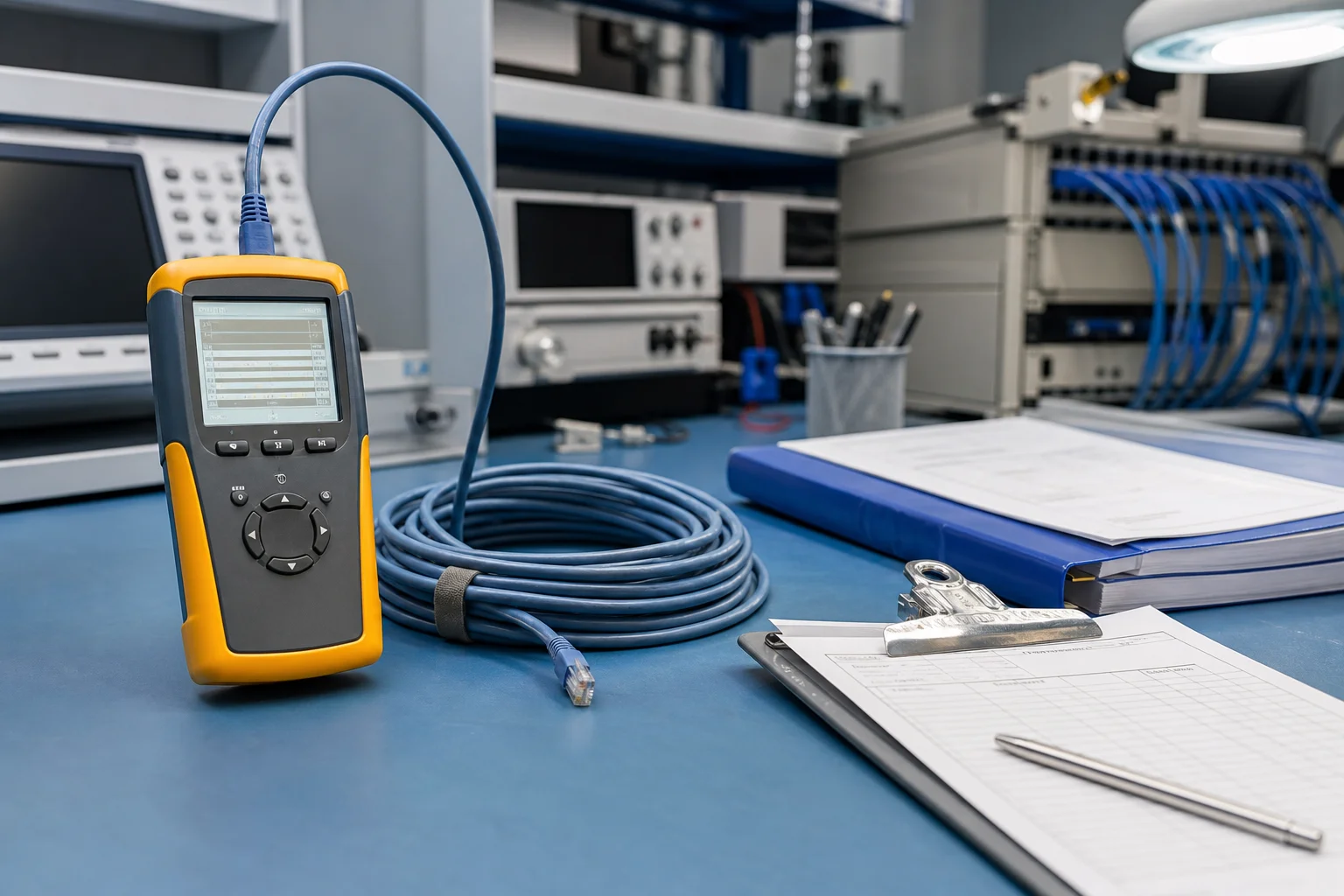
What Hospital EMI Requirements Mean at the Order Desk
Hospital engineering specifications rarely say shielded cable because the building is a hospital. They say it because specific areas generate or tolerate electromagnetic disturbance: MRI and CT rooms, interventional suites, laboratories with analytical instruments, kitchens with large motors, laundry plant and the risers that carry power between them. In those areas an unshielded link can carry intermittent errors that are difficult to reproduce and expensive to investigate, because the disturbance arrives with a scan or a motor start rather than continuously.
For a buyer, that translates into three procurement consequences. The order is usually split by area rather than purchased as one SKU. The documentation pack matters as much as the cable. And the supplier must be able to demonstrate shielded construction capability, not just add a foil when asked. A factory that extrudes unshielded cable all year and buys shielded reels from a neighbour cannot control lot consistency, and lot consistency is exactly what a staged hospital fit-out needs.
Shielded Cat6 remains a 250 MHz construction under TIA-568.2-D Cat6 and ISO Class E, in F/UTP or S/FTP form. Nothing about a healthcare setting changes the electrical standard. What changes is how strictly the shield is expected to be bonded and proven.
Area by Area: Where the Shield Is Actually Required
The table maps typical hospital zones to a construction and to the evidence a supplier should be able to support. Treat it as a starting point for a project specification, not a substitute for the engineer of record. Indicative FOB bands assume 500 m reels of 23 AWG solid conductor.
| Zone | Interference source | Recommended construction | Evidence to request |
|---|---|---|---|
| MRI and CT suites | High field gradients, RF cabins | S/FTP, LSZH, 23 AWG | Shield continuity report, DSX with shielded adapters |
| Operating theatres | Electrosurgical units, imaging arms | S/FTP or F/UTP, LSZH | Construction diagram, lot traceability |
| Laboratories | Analytical instruments, centrifuges | F/UTP, LSZH | 250 MHz sweep, RoHS and REACH |
| Plant rooms and risers | Motors, pumps, power feeders | F/UTP, LSZH or PE by route | Jacket data, CPR class for EU stock |
| Ward and admin floors | Low, distributed equipment | UTP acceptable, F/UTP optional | Standard cat6 datasheet |
| Indicative FOB, 500 m reel | Not applicable | F/UTP USD 0.20 – 0.40 per m | S/FTP USD 0.30 – 0.60 per m |
Two practical notes on that table. First, LSZH jacketing appears in most clinical areas because of fire and smoke performance in occupied buildings, and it adds cost over PVC. Second, outdoor or duct routes through plant areas may call for a PE jacket, which is a different product with a different lead time. Confirm both before comparing quotes, because a supplier quoting PVC against an LSZH specification will look 20 percent cheaper for no legitimate reason.
What a Healthcare-Capable Supplier Looks Like
The first differentiator is whether the factory braids or foils as a routine process. A supplier with a standing shielded line has tooling, tension control and inline continuity checks already in place. A supplier that sources shielded reels on demand has none of that, and their lot-to-lot variation shows up when a second phase of the building is wired six months later.
The second differentiator is documentation discipline. Healthcare tenders ask for a datasheet with a frequency sweep, a construction drawing, declarations for restricted substances, a CPR class where the project is in the EU, and often a sample reel for the engineer to inspect. A factory that answers those requests within a week is a factory that has answered them before.
The third is willingness to test in front of you. Ask for a live video call at the quality bench showing a shield continuity measurement on a finished assembly, and ask for the instrument model and calibration date. Suppliers who build shielded product do this without hesitation. Suppliers who resell it usually offer a photo of a report instead. The manufacturer verification guide sets out the full sequence.
Documentation Hospitals Ask For at Tender
Most healthcare tenders converge on a similar pack, and preparing it once saves weeks on every subsequent bid. Expect to supply: a datasheet with insertion loss, return loss, NEXT and PS-NEXT to 250 MHz; a shield construction diagram showing foil orientation and braid coverage; a declaration of conductor metal and gauge; jacket compound data including fire performance; RoHS and REACH statements; lot numbering and reel labelling convention; test reports naming the instrument and adapter type; and packaging details for staged deliveries.
Staged delivery is the item buyers underestimate. A hospital is wired in phases over many months, and each phase may need a partial pallet. Suppliers who can hold stock against a call-off schedule, or who can repeat a lot number on request, remove a great deal of site friction. That capability is worth more than a cent per metre, and it belongs in the tender questions rather than in the negotiation. See STP Cat6 lead time for how call-off schedules interact with production slots.
Buyer Questions We Hear Most
Is S/FTP always required in imaging areas?
Not universally, but it is the safer default where field strength is highest and the cable route passes close to equipment. S/FTP adds a braid over the pair foils, which improves protection at higher frequencies and gives a more robust mechanical shield. Where the route is short and well separated, F/UTP is often accepted. The decision belongs to the project engineer, and the supplier should be able to quote both.
Does the cable have to be LSZH in a hospital?
Most clinical and public areas in modern healthcare projects specify a low smoke zero halogen jacket, and many also require a CPR class in the EU. That is a project requirement, not a universal rule. Confirm the jacket and class from the specification before quoting, because substituting PVC to hit a price is the most common reason a delivery gets rejected at site.
Can a supplier certify an installed link?
Rarely, and you should not expect it. The factory certifies the cable lot. The installing contractor certifies the channel with a field tester and shielded adapters. What the supplier must provide is the design basis and the test method, so the commissioning results can be compared against something. Ask for the adapter model and the test standard in writing.
Three Buyer Scenarios
- Main contractor on a new wing. Needs 12 km split across three phases, LSZH throughout, S/FTP for imaging and F/UTP elsewhere. The decisive supplier capability is a call-off schedule with repeatable lot numbers, not the lowest quote on the first 4 km.
- Hospital engineering department replacing a riser. A smaller order of 1.5 km where the constraint is access windows. Bonded regional stock or a supplier with an EU warehouse wins, because a 30 to 45 day sea leg would miss the shutdown window.
- Medical equipment integrator. Ships imaging rooms as packaged projects and needs short shielded lengths with connectors already fitted. They buy from a factory that offers assembly as well as reels, and they carry the DSX file for each shipped room.
Verification Checklist Before Award
- Factory audit covering the braiding and foil lines, not only the extrusion line.
- Live shield continuity demonstration: drain wire to connector shell, measured and recorded.
- Fluke DSX-8000 or DSX-5000 permanent link test with shielded channel adapters, report files shared.
- Datasheet sweep to 250 MHz, with curves rather than a single pass or fail claim.
- Sample reel delivered for the project engineer to cut, inspect and terminate.
- RoHS and REACH declarations, plus CPR class evidence for EU-bound stock.
- Pre-shipment inspection with measured lengths, reel counts and pallet label photos.
- Written confirmation of lot retention and repeatability for later project phases.
Shortlisting in Practice
A workable shortlist for a healthcare project is three suppliers: one factory in a major cable cluster with a standing shielded line, one regional distributor holding bonded LSZH stock, and one specialist assembler if the project includes pre-terminated room kits, which the OEM STP Cat6 from China overview covers. Score them on documentation completeness and test transparency first, price second. The supplier who answers the technical questions in a week and the commercial questions in a day is almost always the cheaper partner over the life of a phased hospital build.
FAQ
1. Which shielded Cat6 construction suits a hospital best?
S/FTP in imaging and interventional areas where field strength is highest, and F/UTP for laboratories, plant rooms and general clinical floors where the source is lower. LSZH jacketing is common across both. The final choice belongs to the project engineer, so ask suppliers to quote both constructions at the same AWG.
2. What test evidence should a healthcare supplier provide?
A datasheet sweep to 250 MHz, a shield construction diagram, a continuity measurement from drain wire to connector shell, and DSX-8000 or DSX-5000 reports naming shielded channel adapters. Add RoHS, REACH and CPR class declarations where applicable. Reports run with unshielded adapters do not evaluate the shield path.
3. Can hospital cabling be supplied in phases?
Yes, and it usually is. Ask for a call-off schedule with fixed unit pricing for a defined period, agreed lot repeatability and partial pallet shipments. Suppliers who hold stock or reserve production slots for repeat orders make phased delivery predictable. Confirm the arrangement in writing before the first phase ships.
4. How long does a hospital cable order take?
Stocked reels ship in 3 to 7 days. Made-to-order LSZH production runs 15 to 30 days, and sea freight adds 30 to 45 days to Europe or 25 to 40 days to the US. Phased projects should place the first order against the earliest phase and reserve capacity for later phases rather than ordering everything at once.
5. Do shielded jacks have to come from the same supplier as the cable?
Not necessarily, but the channel has to be qualified as a system. Matching cable and jack families reduces the risk of impedance mismatch and makes the manufacturer responsible for the whole link. If you mix brands, commission with a field tester using shielded adapters and keep the results with the project file.