
Private-label STP Cat6 is one of the easier cable products to outsource in China and one of the easier ones to get wrong. The market is deep, but the suppliers that answer an inquiry are a mix of real shielded-pair factories, private-label packagers and trading desks with a website. Choosing between them is a question of matching profile to order size, then verifying the capability that the profile implies. This guide sets out the five supplier profiles worth shortlisting for OEM STP Cat6 and the checks that tell them apart.
Quick answer:
Direct answer: the five profiles worth shortlisting are Pearl River Delta shielded-pair specialists, Jiangsu and Zhejiang LAN cable OEMs with LSZH capability, northern volume plants, Guangdong private-label packagers, and export-oriented plants with existing EU documentation. Custom OEM starts around 5 to 10 km per construction with 25 to 40 days of production. The caveat: a low OEM quote usually means the shield construction was quietly simplified, so verify foil coverage and braid density on a sample reel.
Top 5 STP Cat6 OEM Manufacturers in China
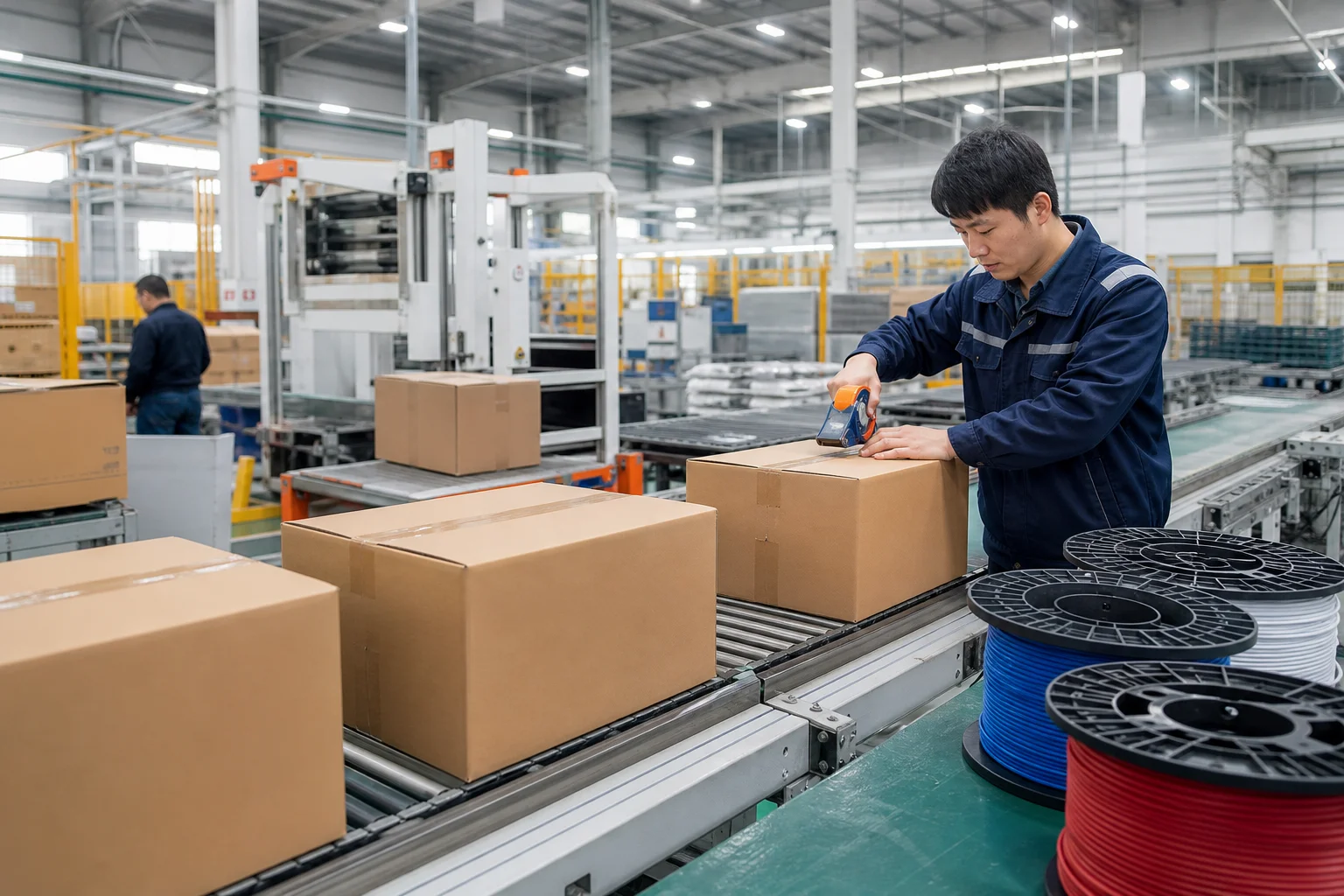
Private-label STP Cat6 is one of the easier cable products to outsource in China and one of the easier ones to get wrong. The market is deep, but the suppliers that answer an inquiry are a mix of real shielded-pair factories, private-label packagers and trading desks with a website. Choosing between them is a question of matching profile to order size, then verifying the capability that the profile implies. This guide sets out the five supplier profiles worth shortlisting for OEM STP Cat6 and the checks that tell them apart.
What OEM actually covers in shielded Cat6
In this product category, OEM rarely means a new design. It means putting your identity on a construction the factory already runs. The customisable variables are the jacket compound and colour, the print legend on the jacket, the reel or drum format, the label and lot coding, the carton artwork, and the accessory set that ships with the reel. The shielded construction itself, meaning foil coverage, braid density, drain-wire arrangement and conductor size, should stay on the factory standard unless you are prepared to fund tooling and a qualification cycle.
That distinction matters commercially. A buyer who asks for a bespoke shield geometry gets a quotation with a tooling line, a longer first-article cycle and a much higher minimum. A buyer who asks for a custom print on a standard S/FTP construction gets a normal OEM quote with a 5 to 10 km minimum and a packaging proof. Most brands are better served by the second route.
The five profiles worth shortlisting
The table compares the five profiles on the terms that decide whether a quote is usable. Figures are ranges because plant capacity, copper index and jacket choice move every number.
| Supplier profile | Main cluster | Typical OEM MOQ | Production lead time | Indicative FOB per 305 m (USD) | Best fit |
|---|---|---|---|---|---|
| Shielded-pair specialist | Shenzhen and Dongguan | 5 – 10 km | 20 – 30 days | 110 – 175 | S/FTP and high-shield-coverage ranges |
| LAN cable OEM with LSZH lines | Jiangsu and Zhejiang | 8 – 15 km | 25 – 35 days | 120 – 180 | EU projects needing CPR documentation |
| Volume plant | Northern China | 15 – 30 km | 25 – 40 days | 95 – 150 | PVC F/UTP sold on price |
| Private-label packager | Guangdong | 3 – 5 km | 12 – 20 days | 125 – 190 | Small brands, mixed SKU cartons |
| Export-documented OEM plant | Pearl River Delta | 10 – 20 km | 25 – 35 days | 130 – 195 | Buyers who need full test files |
Profile 1 and 2: the specialists and the LSZH lines
The Shenzhen and Dongguan cluster is where most shielded-pair work in China sits, largely because the electronics supply chain around it supplies foil, braid wire and shielded connectors in the same industrial belt. Plants here tend to be mid-sized, run two to six lines, and are comfortable with S/FTP at tighter braid coverage. They are the natural first call for a range that has to look and test like a premium product.
Jiangsu and Zhejiang plants are usually larger and broader, with UTP volume funding the operation and shielded lines added for export customers. Their advantage is compound capability: LSZH and CPR-rated jacket compounds are easier to source and qualify there, and the documentation pack tends to be more complete. Their weakness is attention, since a 10 km shielded order is a small job for a plant that ships containers of UTP every week.
Profile 3, 4 and 5: volume, packaging and documentation
Northern volume plants compete on copper efficiency and price. A well-run northern plant can undercut a southern specialist on plain F/UTP PVC by 10 to 20 percent, and it will be honest about the fact that S/FTP is not its strength. If your range is sold on price into a market that does not specify braid coverage, this profile is viable; if your customers test, it is not.
Guangdong private-label packagers buy finished cable and add the brand layer: printed cartons, custom reel labels, polybag and header sets, mixed pallets. They accept the lowest minimums and the shortest lead times, and they are the right answer for a brand testing four SKUs in small volumes. The trade-off is that they cannot control the shield construction, so the factory behind them still needs to be identified and approved.
Export-documented OEM plants sit at the top of the cost band and the top of the reassurance scale. They maintain frequency sweeps to 250 MHz, shield construction diagrams, RoHS and REACH declarations, lot traceability and third-party test files, because their existing customers demand them. For a brand entering the EU, paying 8 to 12 percent more for a supplier whose documentation already passes a customs or consultant review is usually the cheaper decision.
A buyer question: is this a factory or a trading layer?
Both can be legitimate, but they carry different risk. A trading company with strong factory relationships can consolidate several constructions into one container and handle export paperwork well, which is genuinely useful for a small buyer. What it cannot do is control a production slot or absorb a quality failure. Ask directly whether the quoted plant is owned, contracted or brokered, and ask for the production address that will appear on the shipping documents. A supplier who hesitates on that question is telling you something useful.
There is a simple structural test. Request a short video walk of the shielded line with the foil applicator and braiding machine visible, filmed on the same day as the conversation, and compare the plant layout with the address on the business licence. Trading layers rarely pass that test without help from the factory, and the help itself reveals the relationship.
Audit routine for OEM shielded cable
Run the following in order. It takes about two weeks and prevents most of the expensive failures in this category.
- Confirm business licence scope includes cable manufacturing, not only trading, and match the address to the plant you expect to visit.
- Ask for the shielded line inventory: number of braiding machines, foil applicators and the maximum reel length each line can wind.
- Request a sample reel of the exact OEM construction, produced on the line that will run your order, with the jacket print you intend to use.
- Test the sample with shielded channel adapters on a Fluke DSX-8000 or DSX-5000 and ask for the raw file, not a screenshot.
- Check shield continuity and drain-wire bond resistance across the full reel, then repeat after a simulated pull.
- Verify jacket print against the datasheet: construction code, AWG, flame rating and the standard claimed.
- Collect RoHS and REACH declarations, plus the CPR class reference if the goods are bound for the EU.
- Book a pre-shipment inspection covering reel count, label and lot code, carton artwork and a random electrical spot check.
Three buyer scenarios
- The new brand with one hero SKU. Wants 4 km of F/UTP PVC with its own print and cartons. The packager profile fits: 3 to 5 km minimum, 12 to 20 days, and a packaging proof cycle. Insist on knowing the underlying factory and approve that plant separately, or the brand carries a quality risk it cannot see.
- The distributor adding a shielded line to an existing UTP range. Needs 12 km of S/FTP LSZH across two SKUs and already has EU customers. The documented OEM plant is the right partner at 25 to 35 days, and the documentation pack is worth more than a 10 percent price difference.
- The tender-driven buyer on a public project. Needs 20 km of F/UTP with test files that a consultant will review. Volume plant plus third-party testing is the cost-efficient route, provided the test house is named in the purchase order and the sampling plan is agreed before production starts.
Reading an OEM quote correctly
Compare quotes line by line rather than at the total. Four items carry the difference: conductor size, shield construction, jacket compound and reel format. A quote that looks 15 percent cheaper almost always differs on one of them, most often by using a thinner foil or lower braid coverage, or by quoting a 305 m reel with a shorter actual length. Ask for the nominal length, the tolerance on that length, and the net copper weight per reel.
Packaging is the second trap. Printed cartons, custom labels and pallet configuration are usually priced separately, and a quote that excludes them will look better than it is. Ask for a landed-cost sheet that includes packaging, palletisation, inland haulage to the terminal and the documentation fee, then compare. Buyers who also need to understand volume thresholds should review the MOQ structure before negotiating, and anyone unsure about the plant behind the brand should treat manufacturer verification as a separate workstream rather than a checkbox at the end.
Finally, sequence the work. Approve the sample, approve the packaging proof, then release production. Reversing that order is the most common reason an OEM order misses its handover date, and no amount of expediting recovers a printed carton that has to be redone.
Start with our guide to verifying an STP Cat6 manufacturer before you shortlist, then set volume expectations against STP Cat6 MOQ ranges. Buyers comparing stock-based supply with OEM can also review STP Cat6 wholesalers in China.
FAQ
1. What is a realistic MOQ for OEM STP Cat6 in China?
Custom jacket print and packaging usually starts at 5 to 10 km per construction, while a private-label packager working from finished stock may accept 3 to 5 km. A bespoke shield geometry or a non-standard AWG pushes the minimum to 15 to 30 km because it needs tooling and a qualification run. Always confirm whether the minimum applies per SKU or per order.
2. How long does an OEM order take from artwork to shipment?
Allow 25 to 40 days in total. Packaging artwork approval takes 3 to 7 days, production of shielded cable 20 to 30 days, and testing plus pre-shipment inspection 2 to 5 days. First orders run longer than repeats because the print legend and carton proof have to be signed off, and any correction restarts that step.
3. Can the factory print my brand on the jacket?
Yes, jacket printing is standard OEM work and is done with an inkjet or hot-stamp legend during extrusion. Expect a 5 to 10 km minimum for a custom legend, and ask for a print proof on a short sample run before the full order. Confirm that the legend still includes the construction code and flame rating, since omitting them undermines the datasheet.
4. Should I buy OEM direct from a factory or through a trading company?
A factory gives you control over the production slot and a direct route to quality records. A trading company can consolidate several constructions into one shipment and handle export paperwork, which suits small buyers. Either way, identify the plant that will actually run the cable and approve it, because the trading layer cannot absorb a quality failure on your behalf.
5. What documentation should an OEM supplier provide?
A datasheet with a frequency sweep to 250 MHz, a shield construction diagram, RoHS and REACH declarations, a reel label with lot traceability, and the raw test file from the shielded channel test. For EU-bound goods, add the CPR class test reference. Ask for these before the order, not after, because a supplier who cannot produce them upfront usually cannot produce them later either.