
Buyers who want an STP Cat6 factory in the United States usually discover the same thing: domestic wire and cable capacity is real, but thin for shielded LAN construction. Most US plants quote project volumes, and several sellers described as US suppliers are distributors holding imported reels. This guide maps the routes that genuinely work, from Northeast and Midwest plants to cross-border production, with indicative landed cost bands, MOQ and lead-time ranges, and the audit steps that separate a factory from a warehouse.
Quick answer: Domestic STP Cat6 capacity exists but is concentrated: a handful of US wire and cable plants in the Northeast, Midwest and Southeast can extrude and braid shielded constructions, and most of them quote project volumes rather than single reels. For under 5 km, expect 15 to 30 days lead time and a premium of roughly 20 to 60 percent over FOB China. For volume, cross-border production in northern Mexico plus a US warehouse often lands cheaper. Verify shield continuity and Fluke shielded-channel test data before you award.
Where to Find an STP Cat6 Factory in the United States
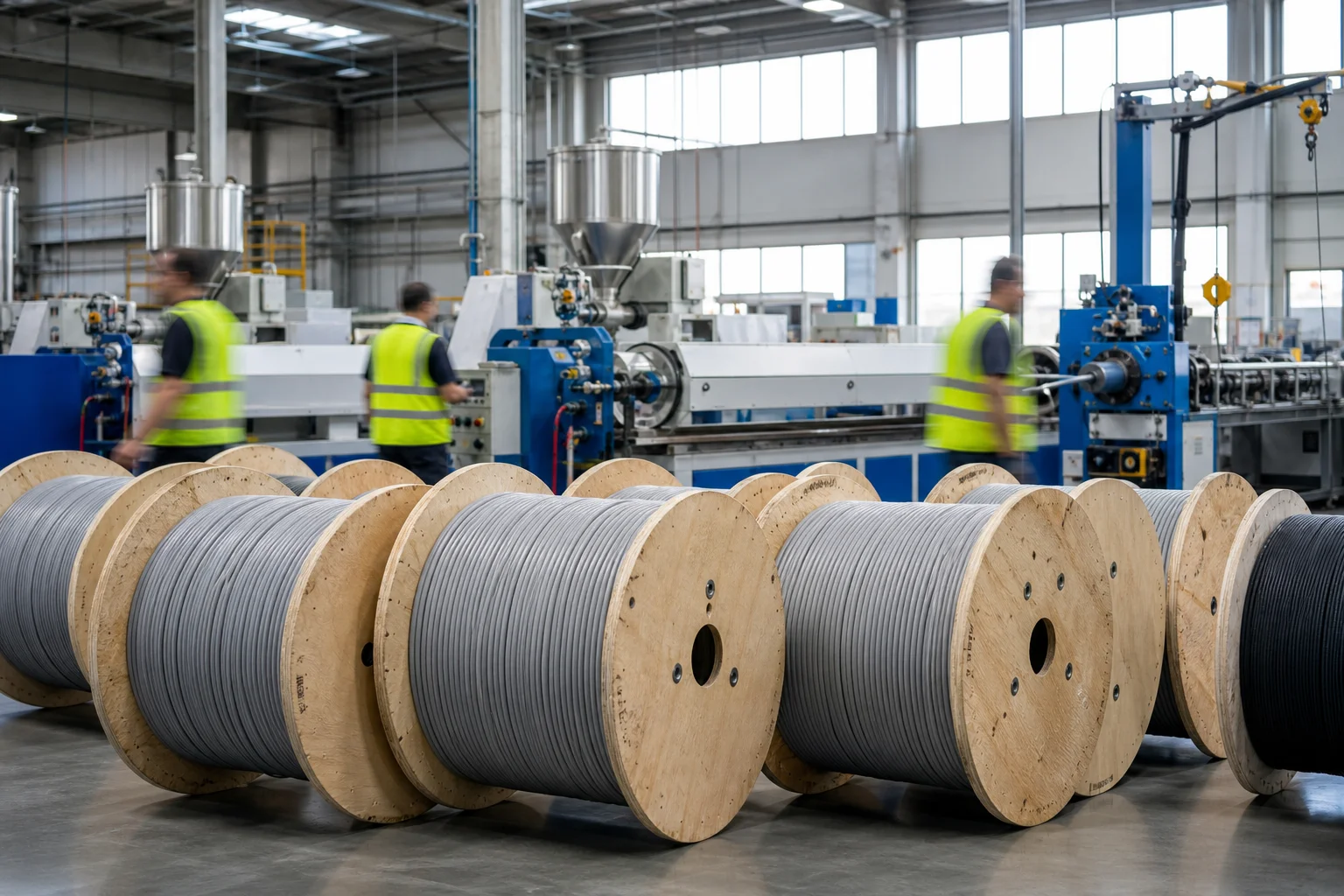
Domestic STP Cat6 capacity exists but is concentrated: a handful of US wire and cable plants in the Northeast, Midwest and Southeast can extrude and braid shielded constructions, and most of them quote project volumes rather than single reels. For under 5 km, expect 15 to 30 days lead time and a premium of roughly 20 to 60 percent over FOB China. For volume, cross-border production in northern Mexico plus a US warehouse often lands cheaper. Verify shield continuity and Fluke shielded-channel test data before you award.
What “US Factory” Really Means in Shielded Cat6
The United States has real wire and cable manufacturing, but very little of it is dedicated to commodity LAN cable. Domestic plants concentrate on plenum and riser constructions for commercial projects, specialty jackets, tactical and industrial cable, and private-label work for distributors. Shielded Cat6 sits in the specialty bucket, which means availability follows project pipelines instead of warehouse shelves.
That shapes the sourcing conversation. A US plant will usually ask for a project schedule, a jacket specification and an expected annual volume before it quotes, because setting up a braiding and foil line for 600 m is not economic. Buyers who arrive with a datasheet, a target date and a realistic annual quantity get answers; buyers asking for “a price on Cat6 STP” generally do not.
It is also worth separating three things that get confused in conversation: a plant that compounds and extrudes its own cable, a contract manufacturer that assembles and tests cable made elsewhere, and a distributor with a US warehouse and a foreign factory behind it. Only the first is a factory in the strict sense, and only the first can change a shield construction without a third party in the loop.
Supply Routes Compared
Indicative numbers below are for F/UTP Cat6, 23 AWG, 305 m reels. Figures vary with copper, jacket compound, volume and the state of the freight market, so treat them as planning bands rather than quotes.
| Route | Typical MOQ | Lead time | Indicative landed cost (USD/m) | Best fit |
|---|---|---|---|---|
| US plant, domestic production | 3,000 – 10,000 m | 15 – 30 days | 0.45 – 0.75 | Federal or specification-driven projects needing domestic origin |
| US contract manufacturer, imported core | 1,000 – 5,000 m | 10 – 20 days | 0.38 – 0.62 | Custom jacket print with short notice |
| Mexico cross-border plant plus US warehouse | 5,000 – 20,000 m | 20 – 35 days | 0.33 – 0.52 | Volume industrial rollouts on a North American schedule |
| Asia import, US third-party warehouse | 10,000 m or one container | 25 – 40 days plus buffer | 0.30 – 0.48 | Price-led tenders with a 6 to 8 week horizon |
Read the table as a trade-off between origin, responsiveness and price. The domestic column is not a premium for patriotism alone: it buys shorter supply lines, easier witness testing, and origin documentation that some funded projects require. Whether that is worth 30 percent depends on the contract, not on the cable.
Where Domestic Capacity Sits
Northeast and Midwest plants
Legacy wire and cable capacity in these regions is strongest in plenum and riser constructions for commercial buildings, with shielded LAN cable usually available as a made-to-order line. Plants here are used to specification review and third-party inspection, so they handle a Fluke acceptance protocol without friction.
Southeast industrial belt
The Southeast has attracted newer extrusion and assembly capacity, including plants set up for industrial and specialty cable. These sites tend to be more flexible on jacket compounds and more willing to run smaller shielded batches than older facilities.
Cross-border production
Northern Mexico hosts substantial cable assembly and jacketing capacity feeding US distribution, and it sits inside a short truck lane to Texas and the Midwest. For volume orders it is often the most competitive North American option, with a lead time closer to a domestic plant than to a sea container.
Distributors with import links
Many “US suppliers” are distributors holding Asian-made shielded Cat6 in US warehouses. That is a legitimate and often sensible route for 100 to 500 m orders, provided the distributor can produce the factory datasheet, lot traceability and test reports rather than relabelling a generic specification.
MOQ, Lead Time and How US Plants Quote
Domestic quotations are built differently from Asian FOB quotes. Expect a per-meter price that already includes packaging, a separate line for testing if witness testing is requested, and freight quoted either delivered or ex-works. Setup charges may appear for non-standard jacket colours.
- Stocked construction, small order: 100 – 500 m, often shipped from distributor stock in 3 – 7 days.
- Made to order: 3,000 – 10,000 m, 15 – 30 days, with jacket print and reel labelling included.
- OEM programme: 5 – 10 km annually, released in call-offs against a blanket order.
- Inspection: add 2 – 5 working days for third-party pre-shipment inspection.
Blanket orders with scheduled releases are the standard way to make a domestic plant competitive. Committing to an annual quantity while drawing stock quarterly gives the plant a reason to hold your construction, which then cuts your lead time on every later release. Our breakdown of STP Cat6 lead times shows how much of a project delay is production and how much is logistics.
Verifying Shield Quality in a Domestic Supply Chain
Domestic origin is not a substitute for testing. Shielded cable can fail the same ways in Ohio as in Guangdong, so the checks below belong in the purchase order wherever the reel is made.
- Confirm the production address in writing and check it against the business registration; “US-based” frequently means a sales office.
- Ask for the shield construction: foil orientation, braid coverage, drain-wire gauge and how the drain wire is bonded to the foil.
- Require a datasheet with a frequency sweep to 250 MHz and margins, not just pass or fail statements.
- Run end-to-end drain-wire continuity on delivered reels and log resistance values against the factory limit.
- Certify one mock channel with a Fluke DSX-8000 or DSX-5000 and shielded channel adapters, and keep the report as an acceptance record.
- Check jacket print for construction code, AWG, flame rating and lot number at both ends of each reel.
- Request RoHS and REACH declarations plus any project-specific origin or content documentation before the run starts.
Witness testing is easier to arrange domestically and is the strongest reason to pay the premium. Being in the room while the channel is certified removes the argument later. If the plant resists a witnessed DSX run on shielded adapters, that is information about the plant.
Questions US Buyers Ask Before Committing
Is the cable actually made here, or assembled here? Ask for the extrusion location and the braiding line. Assembly-only suppliers will describe “final assembly” and “testing” rather than drawing and jacketing.
Can you hold stock against a blanket order? Many plants will, once an annual volume is committed. This is the single most effective way to shorten repeat lead times.
Do you support shielded jacks and panels too? A plant that only sells cable may not warn you that unshielded jacks nullify the shielding. Ask for a compatible termination reference before installation design is frozen.
Three Buyer Scenarios
- Municipal water treatment upgrade, 7 km: domestic origin required by the funding terms, so the buyer accepts a 0.45 – 0.75 USD/m band and books witness testing at the plant.
- Machine builder shipping to three states, 2,500 m: buys from a US contract manufacturer for 10 – 20 day turnaround on custom jacket print, accepting a mid-band price.
- Distribution chain refresh, 40 km: sources cross-border or imports into a US warehouse and trades two extra weeks of lead time for a materially lower landed cost.
How to Run the Search Efficiently
Start from the specification, not from a supplier list: fix the construction, AWG, jacket, reel length and test protocol, then ask five to eight candidate plants the same four questions – production address, shield construction, MOQ, and lead time on that exact specification. The answers will sort the field quickly. Compare landed cost rather than ex-works price, and include testing and inspection in the model. Buyers also weighing an Asian factory against a domestic one should read our comparison of Cat7 factory options in the USA, which follows the same logic for the higher-frequency construction, and the checklist for verifying an STP Cat6 manufacturer applies unchanged to domestic plants.
FAQ
1. Is there a US factory that makes shielded Cat6 cable?
Yes, but capacity is concentrated in a limited number of wire and cable plants in the Northeast, Midwest and Southeast, and most quote project volumes rather than single reels. Many sellers described as US suppliers are distributors holding imported stock. Ask for the production address and the extrusion and braiding location before assuming domestic manufacture.
2. How much more does US-made STP Cat6 cost?
Indicative landed cost for domestic production runs roughly 0.45 to 0.75 USD per meter, against 0.30 to 0.48 for an Asian import through a US warehouse. The gap of about 20 to 60 percent buys shorter supply lines, easier witness testing and origin documentation. Whether that is justified depends on the contract terms.
3. What lead time should I expect from a US plant?
Made-to-order shielded runs typically take 15 to 30 days after specification approval, with 10 to 20 days possible from a contract manufacturer using imported core. Stocked constructions from a distributor ship in 3 to 7 days. Add 2 to 5 working days if third-party pre-shipment inspection is required.
4. What MOQ applies to domestic production?
Most US plants want 3,000 to 10,000 m per construction to justify setting up a shielded line, and OEM programmes usually start at 5 to 10 km annually. Below that, a distributor or a contract manufacturer is more realistic. Blanket orders with quarterly releases are the usual way to reach the threshold.
5. Can I witness testing at a US factory?
Often yes, and it is the strongest reason to pay a domestic premium. Ask to attend a Fluke DSX certification of a mock channel using shielded channel adapters, and request the report as an acceptance record. A plant that resists witnessed shielded testing is telling you something about its process control.