
You need Class F cable for a US project, you want a domestic point of contact, and you want the material on site in weeks rather than months. The problem is that the phrase Cat7 cable factory USA describes a market that barely exists in the form buyers imagine. Genuine 600 MHz extrusion capacity sits mostly in Europe and Asia, while most American supply is assembly, jacketing, private label or distribution of imported reels. Knowing which of those you are actually buying decides your MOQ, your lead time, your paperwork and who carries the risk when a 600 MHz sweep fails on site.
Quick answer: There is very little dedicated Cat7 extrusion in the United States, because Cat7 is an ISO/IEC 11801 Class F construction at 600 MHz and TIA standards stop at Cat6A. The practical US route is a domestic assembly or contract-manufacturing shop that cuts, terminates and tests imported Class F cable, backed by a master distributor holding bonded stock, with direct import from an EU or Asian plant for volumes above roughly 5 km. Caveat: get the extrusion and assembly split in writing, because it decides who is accountable for test failures.
Where Can You Find a Cat7 Cable Factory in the United States?
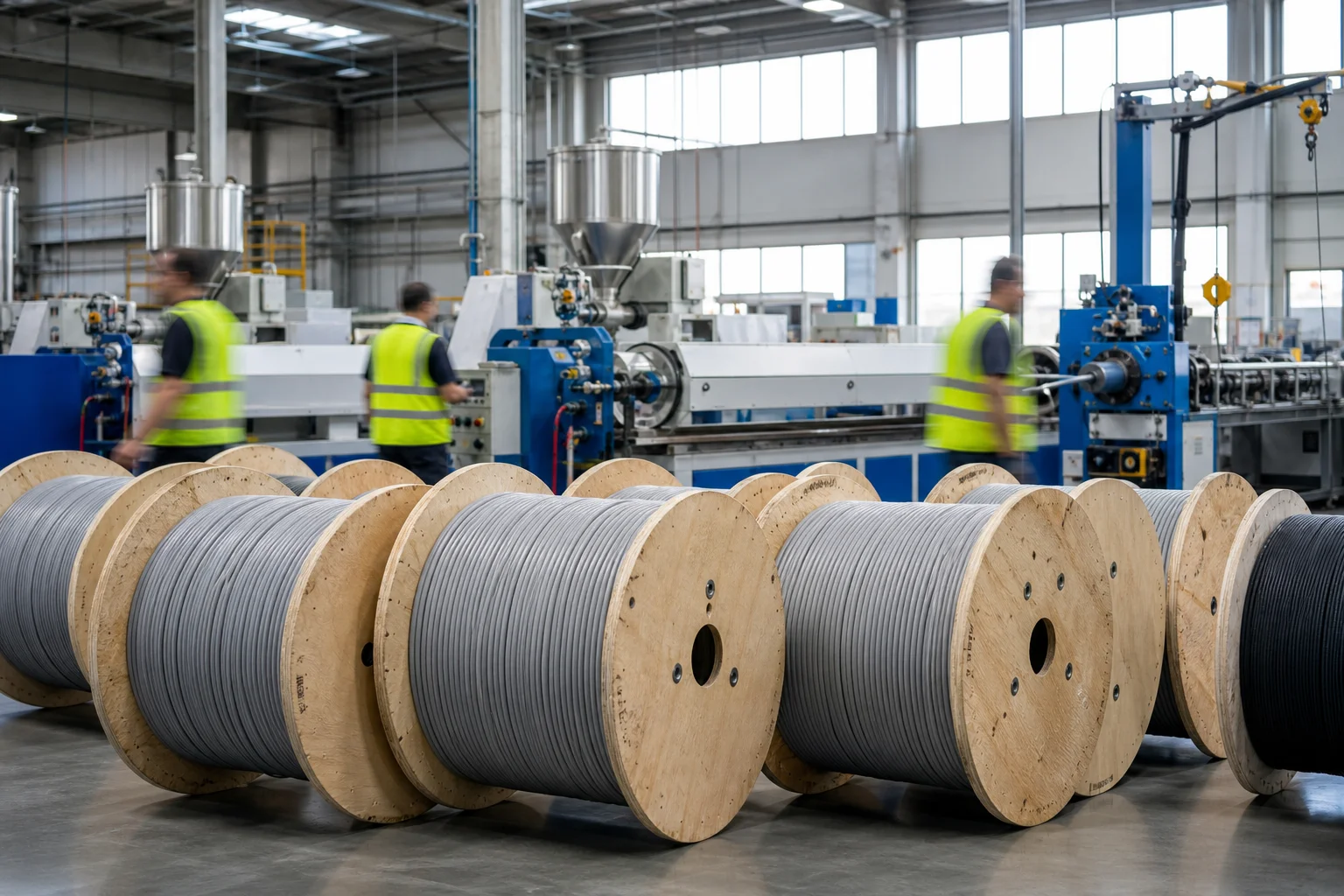
The plant you are looking for is rarely a Cat7 plant first and a cable plant second. Class F capacity in the United States is thin, domestic supply is mostly assembly plus distribution, and the definition of the product is not even part of the local cabling standard. That does not make a US route a bad decision. It changes the questions you ask before the first purchase order.
Where Cat7 Cable Supply in the United States Actually Comes From
Cat7 means an ISO/IEC 11801 Class F construction: 600 MHz, S/FTP with PiMF pair shielding, usually 23 AWG solid copper, terminated on GG45 or TERA or on 8P8C depending on the vendor. It is not a TIA-recognised category. TIA/EIA stops at Cat6A, Class EA, 500 MHz. That single fact explains the market. US specifiers normally write Cat6A, so US plants do not dedicate extrusion line time to a construction their home standard does not recognise. When an American buyer insists on Class F, the cable almost always crosses a border at some point.
Four channels do the real work.
US assembly and contract manufacturing. Shops in New England, the Mid-Atlantic and the upper Midwest buy finished Class F cable on reels and cut, terminate, test, label, kit and pack it. This is where most short lead times in the US come from. You get 3 to 7 day shipment on a stocked item and a domestic phone number when something goes wrong, but you inherit their choice of cable, not yours.
Regional master distributors and importers. Port-adjacent warehouses and national branch networks hold 305 m boxes and 500 m reels of European or Asian Class F cable. They carry the customs clearance, the inventory risk and the datasheet. For a distributor testing demand, this is the lowest-commitment entry point.
Direct import from European Class F plants. Germany, the Netherlands, Poland and Italy have manufacturers that list Class F as a catalogue product rather than a special. The paperwork is usually stronger, including EN 50575 declarations of performance with a Dca, Cca or B2ca class, and the price is 40 to 90 percent above Asian equivalents at equal volume.
Direct import from Asian extrusion clusters. Shenzhen and Dongguan in Guangdong, plus industrial zones in Vietnam, run S/FTP lines continuously and quote aggressively above roughly 5 km. The cable can be excellent. The documentation burden is yours, and a 25 to 40 day ocean leg to a US port has to be built into the project programme.
The distinction that decides commercial accountability is extrusion versus assembly. In an assembly shop, conductor drawing, insulation, pair shielding, overall braid and jacket all happened somewhere else. Ask which operations take place inside the building you audit, and put the answer in writing. If the answer is cutting and terminating, then a 600 MHz sweep failure on site is a cable problem owned by a party you have never met.
United States Cat7 Supply Channels Compared
| Channel | Where it sits | Typical MOQ | Lead time | Evidence to expect |
|---|---|---|---|---|
| US assembly and contract manufacturing | New England, Mid-Atlantic and Midwest industrial parks | 100-500 m per stocked SKU; 3,000-10,000 m for custom jacket, colour or length | 3-7 days ex-stock; 15-30 days to build | ISO 9001; Fluke DSX-8000 channel or permanent link reports; lot labels |
| US master distributor or importer | National branch networks and port-adjacent hubs | 100-500 m reels and 305 m boxes; cut lengths from 50 m | 1-5 days domestic ground | Importer datasheet with 600 MHz sweep; plant test reports; jacket print |
| Direct import, European Class F plant | Germany, Netherlands, Poland, Italy | 1,000-5,000 m per type; 5-10 km for OEM print | 15-30 days production; 20-35 days sea to the US East Coast | EN 50575 declaration of performance with Dca/Cca/B2ca; ISO 9001 and 14001; sweep to 600 MHz |
| Direct import, Asian extrusion cluster | Shenzhen, Dongguan and Vietnam industrial zones | 3,000-10,000 m custom; 5-10 km for OEM print and packaging | 15-30 days production; 25-40 days sea to the US West Coast | ISO 9001; third-party Fluke reports; RoHS and REACH declarations; copper weight certificate |
| US brand with offshore plant, private label | US sales office, EU or Asian production site | 5-10 km for printed jacket and retail packaging | 30-60 days first run; 15-30 days repeat | Brand-owned specification sheet; notified body reports; traceable lot numbering |
What Does Cat7 Cable Cost Through a US Channel?
Indicative FOB ranges for Cat7 S/FTP 4-pair, 23 AWG solid, on a 305 m reel sit at roughly USD 0.55-1.10 per metre. Where you land inside that band depends on order volume, jacket (PVC versus LSZH), shielding (S/FTP versus F/FTP), reel length, test documentation and the copper price on the day. 22 AWG constructions and Cat7A, which is Class FA at 1,000 MHz, sit above the band. Every one of those figures is indicative and moves with copper, so treat a range as a planning input. For current benchmarks see Cat7 price per metre.
Landed cost in the US adds ocean freight, port and customs charges, duty, drayage, incoming test and distributor margin. A US-assembled or private-label reel typically lands at 1.6-2.8 times the FOB cable cost, and buying a domestic stock item in 305 m boxes at small quantity often reaches 2.5-4 times. Because most US projects baseline on Cat6A, compare like for like: Cat7 S/FTP usually carries a 30-60 percent premium over Cat6A S/FTP of the same AWG and jacket. That premium buys 600 MHz of characterised bandwidth your domestic standard does not require, which is a specification decision before it is a price decision.
Quote with a copper basis clause and a validity window of 7 to 15 days. Copper is a commodity, and a price without a basis is not a price.
What Paperwork Should Travel With a US Cat7 Shipment?
Documentation is the cheapest insurance in this category, and it is also where thin supply chains show. Ask for four items before release: a datasheet with a frequency sweep plotted to 600 MHz, RoHS and REACH declarations, the declaration of performance or equivalent conformity statement for the jacket, and a reel label that ties the lot number to the test record.
How to Verify a Cat7 Supplier Before You Place a PO
A US address is not evidence of manufacturing, and a PDF certificate is not evidence of a factory. Work through this sequence in order, because each step filters the next.
- Confirm the claimed standard. Ask for the construction in writing: Class F, 600 MHz, S/FTP with pair shielding, AWG, jacket compound. If the reply says Cat7 with no frequency reference, the supplier is selling a label.
- Validate ISO 9001 and ISO 14001 certificates. Check the issuing body, the certificate number and the expiry date, and confirm the scope covers the specific product line rather than a trading address.
- Demand third-party test reports, not photographs of a tester. A Fluke DSX-8000 or DSX-5000 Channel or Permanent Link report at 600 MHz should carry a date, operator, cable ID and connector ID. Run headroom, not pass or fail, is what predicts field performance.
- Order two sample reels from different production lots. Cut them, weigh the copper, measure pair shield coverage, read the jacket print, and have a lab or your own DSX test a 90 m permanent link. Two lots reveal consistency, which one lot never will.
- Audit the plant, or commission a third-party audit. Walk the extrusion line, the braiding and shielding stage, the jacketing and the final test bench.
- Challenge the termination and grounding story. Shielded Cat7 with unshielded RJ45 plugs fails Class F testing. Ask how the vendor bonds the shield to the connector and what they recommend for patch panels.
- Book pre-shipment inspection. Agree an AQL sampling plan, a reel length check, a print check and a packing check before production ends, not after the container is sealed.
- Verify traceability end to end. A lot number on the reel label must match the test report, the packing list and the invoice. Without that chain, warranty conversations go nowhere.
- Ask what marking you may legally apply. Listing marks apply to the product as tested, not to a similar product from another plant. Get the supplier’s position in writing before you print cartons. For deeper checks see how to verify a Cat7 manufacturer.
Three Buyer Scenarios and the Route That Fits
The right channel depends on volume, deadline and compliance risk.
- A systems integrator with a 40,000 m hospital job and a European consultant’s specification. The spec names Class F, the schedule is 14 weeks, and the consultant wants test reports at handover.Route: direct import from an EU plant for bulk reels, with a US assembly partner for patch cords and pre-terminated runs. The import leg needs 20-35 days at sea, so the order has to be released in week one. See Cat7 MOQ by order type before you commit to the reel split.
- A regional distributor testing whether Cat7 deserves shelf space. Demand is unclear, cash is committed, and a container is out of the question. Route: buy 10 to 20 reels from a US master distributor, sell against real purchase orders for two quarters, then negotiate direct import once annual volume is visible. You pay a margin for optionality, and at this stage it is the cheaper mistake.
- An OEM brand that wants its own name printed on the jacket. Nothing off the shelf will do, and packaging has to match a retail listing. Route: Asian extrusion cluster with 5-10 km for printed jacket and packaging, a first-article approval round, then a repeat order cycle of 15-30 days. Budget 30-60 days for the first run and do not schedule a launch on the optimistic end.
FAQ
1. Are there real Cat7 cable factories in the United States?
There are cable plants that assemble, jacket and test Class F cable, but very few extrude dedicated Cat7 constructions. Because Cat7 is an ISO/IEC 11801 Class F product at 600 MHz and TIA standards stop at Cat6A, US manufacturers concentrate on Cat6A. Most domestic Cat7 supply is imported cable finished or distributed locally.
2. Can Cat7 cable legally be sold in the US if TIA does not recognise it?
Yes. TIA recognition is a standards question, not a legal one. Cat7 sold in the US is normally positioned as an ISO/IEC 11801 Class F product, and buyers should ask for a 600 MHz sweep rather than a TIA category claim. Check any listing mark against the exact construction that was tested.
3. What is the minimum order for US-assembled Cat7 cable?
For stocked reels and boxes, 100-500 m per SKU is typical, and cut lengths from about 50 m are common. Custom jacket colour, print or non-standard length usually starts at 3,000-10,000 m. Private label with printed jacket and retail packaging generally needs 5-10 km.
4. How long does Cat7 take to reach a US site?
Domestic stock ships in 1-7 days by ground. US assembly of imported reels takes 15-30 days. Direct import runs 15-30 days of production plus 25-40 days at sea to the West Coast or 20-35 days to the East Coast, so 6 to 10 weeks door to door is a realistic planning figure.
5. Should a US buyer choose Cat7 or Cat6A?
If your specification is TIA-based, Cat6A at 500 MHz meets it and usually costs 30-60 percent less than Cat7 S/FTP. Choose Class F when a consultant, a European client or a campus standard names it, or when 600 MHz headroom is contractually required. Decide the standard before you negotiate price.