
Every Cat7 supplier describes itself as a manufacturer, and most are not. The difference rarely shows in the price; it shows in the third delivery, when the jacket print changes, the copper weight drops and the test report turns out to be a scan issued for a different construction. Verifying a Cat7 manufacturer is not one certificate check. It is a short sequence of evidence requests that separates a factory from a trader and a controlled process from a brochure, completed before the deposit is paid.
Quick answer: Verify in this order: business licence and plant address, certificate issuer lookup, a Class F type test report showing a 600 MHz sweep, per-lot Fluke DSX-8000 results with serial ranges, a weighed copper sample, and an independent pre-shipment inspection. A video audit is worth adding above roughly 5,000 m. If the company name on the certificate does not match the quoting entity, stop.
How Do You Verify a Cat7 Cable Manufacturer?
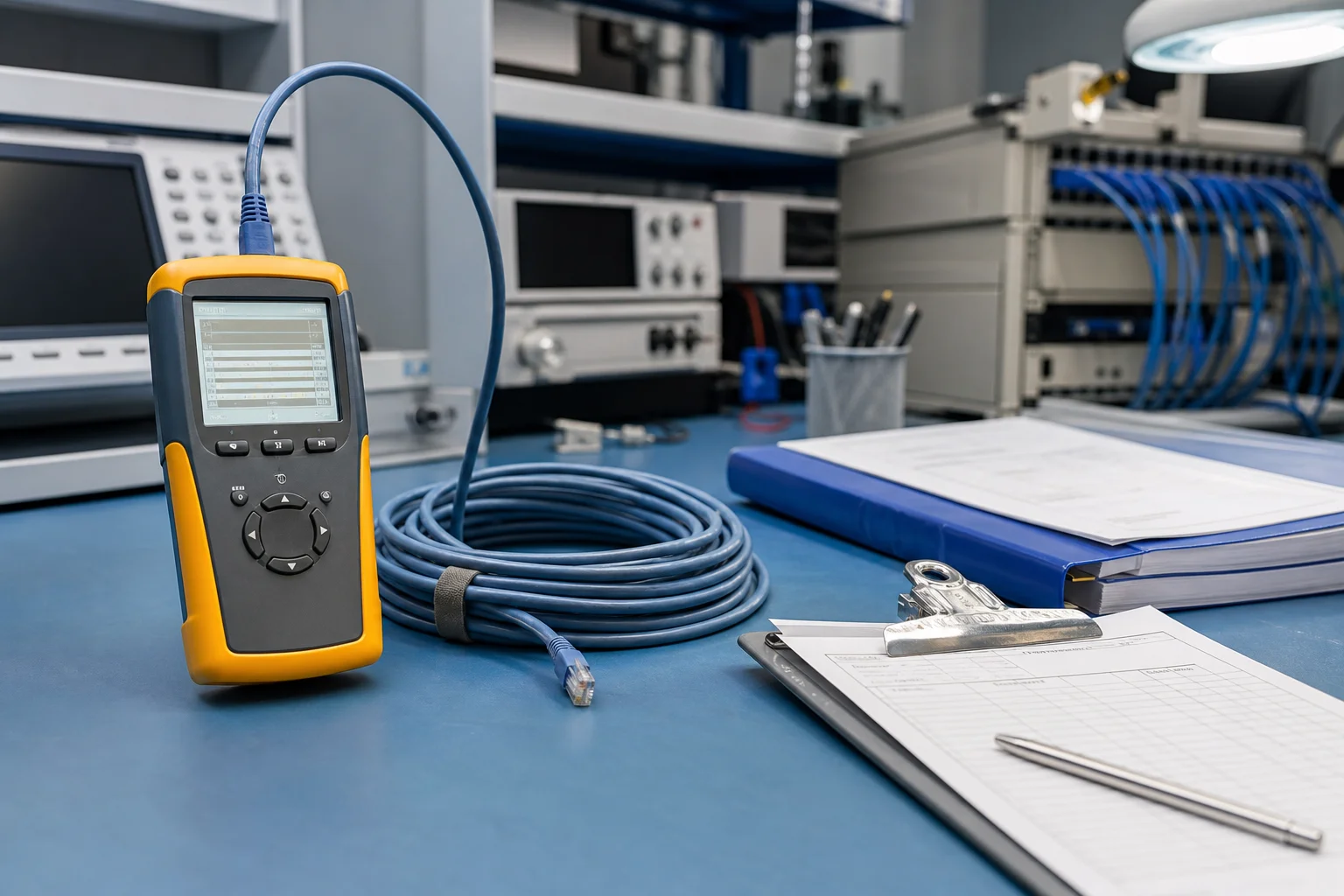
Every Cat7 supplier claims to be a manufacturer. Most are not, and the difference rarely appears in the price. It appears in the third delivery, when the jacket print changes, the copper weight drops and the test report is a scan of a document issued for a different construction. Verifying a Cat7 manufacturer is not a single certificate check. It is a short sequence of evidence requests that separates a factory from a trader, and a controlled process from a brochure, before money moves. This guide sets out what to ask for, in what order, and what a weak answer looks like.
The evidence a Cat7 factory can actually produce
Each item below answers a different question, and none of them substitutes for another. The effort column is realistic for a buyer working at a distance, which is the situation most importers are in.
| Evidence requested | What it proves | Typical review effort | Weak answer looks like |
|---|---|---|---|
| ISO 9001 certificate with scope | A quality system exists and is audited by a recognised body | 15-30 minutes, plus issuer verification | Expired date, scope covering trading rather than cable production, or a certificate with no accreditation mark |
| ISO 14001 certificate | Environmental process control, relevant for EU tenders | 15-30 minutes | Same document number across two suppliers, or a scope that excludes the plant |
| Third-party type test report to ISO/IEC 11801 Class F | The construction reaches 600 MHz with margin | 1-2 days, including a frequency sweep read | Report with no sweep, no lab identity, or a Cat6A report presented as Cat7 |
| Fluke DSX-8000 Channel or Permanent Link report per lot | Production units, not just prototypes, pass | 1-2 days | Generic PDF with no serial range, no limit line and no test date |
| Factory audit, on site or by video walk-through | Extrusion, pairing, shielding, jacketing and testing exist in one plant | 1-2 days plus travel | Tour that shows a warehouse and a showroom but no extrusion line or test bench |
| Copper weight and conductor measurement | Declared AWG and braid coverage are real | 1 hour with a scale and micrometer | 23 AWG stated on the jacket, strands measuring closer to 24 AWG |
| CPR class declaration under EN 50575 | Reaction to fire is classified for EU sale | 30-60 minutes | Class claimed on the datasheet with no test body, no class and no declaration reference |
| Pre-shipment inspection report | The shipped lot matches the approved sample | 5-7 days before booking cut-off | Inspection refused unless the balance is paid first |
Two of these are decisive. The Class F type test separates a real Cat7 construction from a Cat6A cable with a new jacket print, because reaching 600 MHz with margin requires the S/FTP shielding and the pair geometry to be right. The per-lot Fluke report separates a factory that tests from one that samples once a year. Buyers who only have time for two checks should use these.
It also helps to know what Cat7 is not. It is an ISO/IEC 11801 Class F construction, not a TIA category, so a US supplier claiming TIA Cat7 is describing something that does not exist in the standard. That is not automatically fraud, but it is a signal that the documentation was written by a sales department rather than an engineer.
How buyers control risk: a verification sequence that scales with order size
Verification depth should follow order value. A 500 m sample order does not justify a two-day audit; a 20 km annual contract does. The sequence below runs from cheapest to most expensive, and each step can stop the process.
- Verify the legal entity and the plant address. Ask for the business licence, the production address and a utility or lease document. A supplier whose plant address is a residential unit is a trader.
- Check the certificate issuer, not just the certificate. Look up the accreditation body and the certificate number on the issuer’s own site. Scanned PDFs with altered dates are common and easy to catch.
- Read the type test report for the sweep. The report should show insertion loss, NEXT, PSNEXT, ACR-F and return loss across the frequency range to 600 MHz, with a margin column.
- Request a per-lot Fluke file before the first shipment. Insist on serial ranges and a date inside the production window. A report older than the lot proves nothing.
- Buy sample reels from two production lots. Test both independently, or send them to a local lab. Consistency between lots matters more than a single good result.
- Weigh the copper. Cut a 1 m sample, strip the jacket, and compare conductor diameter and braid coverage with the datasheet. This takes an hour and catches the most common cost reduction.
- Run a video or on-site audit. Ask to see the extrusion line, the pair shielding operation, the jacket printing and the test bench in one continuous session, not in edited clips.
- Book pre-shipment inspection independently. Use a third-party inspector with a written checklist that includes reel weight, jacket print, lot marking and packaging.
- Hold back a retention. Keeping 10-20% of the value against the inspection report changes how quickly documentation appears.
For buyers sourcing through China Cat7 wholesalers, the practical filter is to ask for the plant address and the export licence before discussing price. Suppliers who answer both within a day are usually factories; suppliers who answer with a catalogue are usually intermediaries.
Three buyer scenarios and how much verification each needs
- First order, 500 m sample, new supplier. Skip the audit and spend the effort on documents: licence, Class F report, one Fluke file, a weighed sample and an independent inspection. Total cost is modest and it answers whether a second order is worth placing.
- Project order, 20 km for a hospital or campus. This justifies a full sequence including a video audit, two-lot sample testing and pre-shipment inspection on every shipment. The buyer should also confirm CPR class and request the declaration before tender submission, because a missing class can disqualify the cable after the project is won.
- Annual OEM contract with private label. Verification becomes a schedule rather than an event: quarterly lot testing, an annual audit, and a documented change-notification clause so that a plug, compound or conductor change cannot happen silently. This is the only structure that keeps consistency across ten or twenty production runs.
The traps that pass a weak verification
The most common failure is a genuine certificate belonging to a different company. Trading companies routinely forward a partner factory’s ISO certificate and test report with the partner’s name removed from the covering email. The check is simple: the company name on the certificate must match the company issuing the quotation, or the supplier must disclose the relationship in writing.
The second trap is a genuine report for a different product. A Cat6A Class EA report at 500 MHz looks similar at a glance and is often supplied for a Cat7 enquiry. Look for the class, the frequency limit and the construction description on the same page.
The third is a laboratory report with no sample identity: no construction code, no date, no client reference. It may be authentic and still tell a buyer nothing about the cable in the quotation. Finally, watch for jacket claims such as UL or ETL listing without a file number, and CPR classes quoted without a test body. These are checkable in minutes and are the fastest way to judge whether a supplier’s documentation culture is real. Buyers comparing plants in the Vietnam Cat7 factory market should apply exactly the same tests, since location changes logistics, not evidence standards.
Buyer question: do you need a factory audit for a first order?
Not always. A first order of a few hundred metres is better served by document checks, a weighed sample and an independent inspection than by a two-day visit. The audit earns its cost when the order value, the certification exposure or the reorder intention is high enough that a failed lot would be expensive to replace.
What a buyer should never skip is the identity check. Confirming that the quoting company owns the plant that holds the certificate costs nothing and eliminates the most common form of misrepresentation in this category. Everything else can scale with the size of the order, and the Cat7 OEM sourcing process sets out how those checks change once private-label tooling and artwork enter the picture.
FAQ
1. How can I tell if a Cat7 supplier is a real factory?
Ask for the business licence, the production plant address and a utility or lease document, then compare the company name with the name on the ISO certificate. A real factory answers within a day and can show an extrusion line, a shielding operation and a test bench in one session. A trader forwards a partner’s certificate and avoids the plant address question.
2. What should a Cat7 Class F test report contain?
It should reference ISO/IEC 11801 Class F and show results to 600 MHz, including insertion loss, NEXT, PSNEXT, ACR-F and return loss, with margin columns and the tested construction. The report needs a laboratory identity, a date and a sample reference. A one-page summary with no frequency sweep is not sufficient evidence for a project specification.
3. Is Cat7 a TIA standard?
No. TIA recognises categories up to Cat6A, which corresponds to Class EA at 500 MHz. Cat7 is an ISO/IEC 11801 Class F construction at 600 MHz. A supplier advertising TIA Cat7 is either mislabelling the product or misunderstanding the standard, which is a useful signal about the quality of its technical documentation.
4. How much does third-party inspection cost relative to the order?
Pre-shipment inspection is usually a modest fixed fee per man-day plus travel, and it is economical on orders above a few thousand metres. On a 500 m sample order it can approach the value of the freight, which is why document checks and a weighed sample are the better first-line tools for small orders.
5. How often should a manufacturer be re-verified?
Documents should be re-checked annually, and per-lot test evidence on every shipment. A full audit every one to two years is reasonable for an active supplier, and any change of plant, ownership or major equipment should trigger a fresh review. Reorders are where substitution happens, because attention drops once the relationship feels established.