
Almost every private-label Cat7 reel sold outside Europe and Japan comes out of a Chinese plant, and the difference between a good OEM programme and an expensive lesson is usually decided before the first purchase order. Class F capacity in China is genuinely deep: screened pairs, braids, LSZH compounds and 600 MHz testing are routine rather than special. The risk sits elsewhere, in brand ownership, certificate scope and whether the plant that quoted is the plant that will run your order. This guide covers the five clusters worth shortlisting and how to structure the programme around them.
Quick answer: Shortlist five clusters: Shenzhen and Dongguan for full S/FTP depth, Suzhou and Wuxi for process control, Zhejiang around Lin’an and Ningbo for volume and packaging, Hebei around Dacheng for cost, and inland Anhui or Jiangxi for price-led ranges. Expect OEM print and packaging from 5-10 km. Caveat: the quoted plant is not always the producing plant, so audit the entity that will print your brand.
Top 5 Cat7 Cable OEM Manufacturers in China
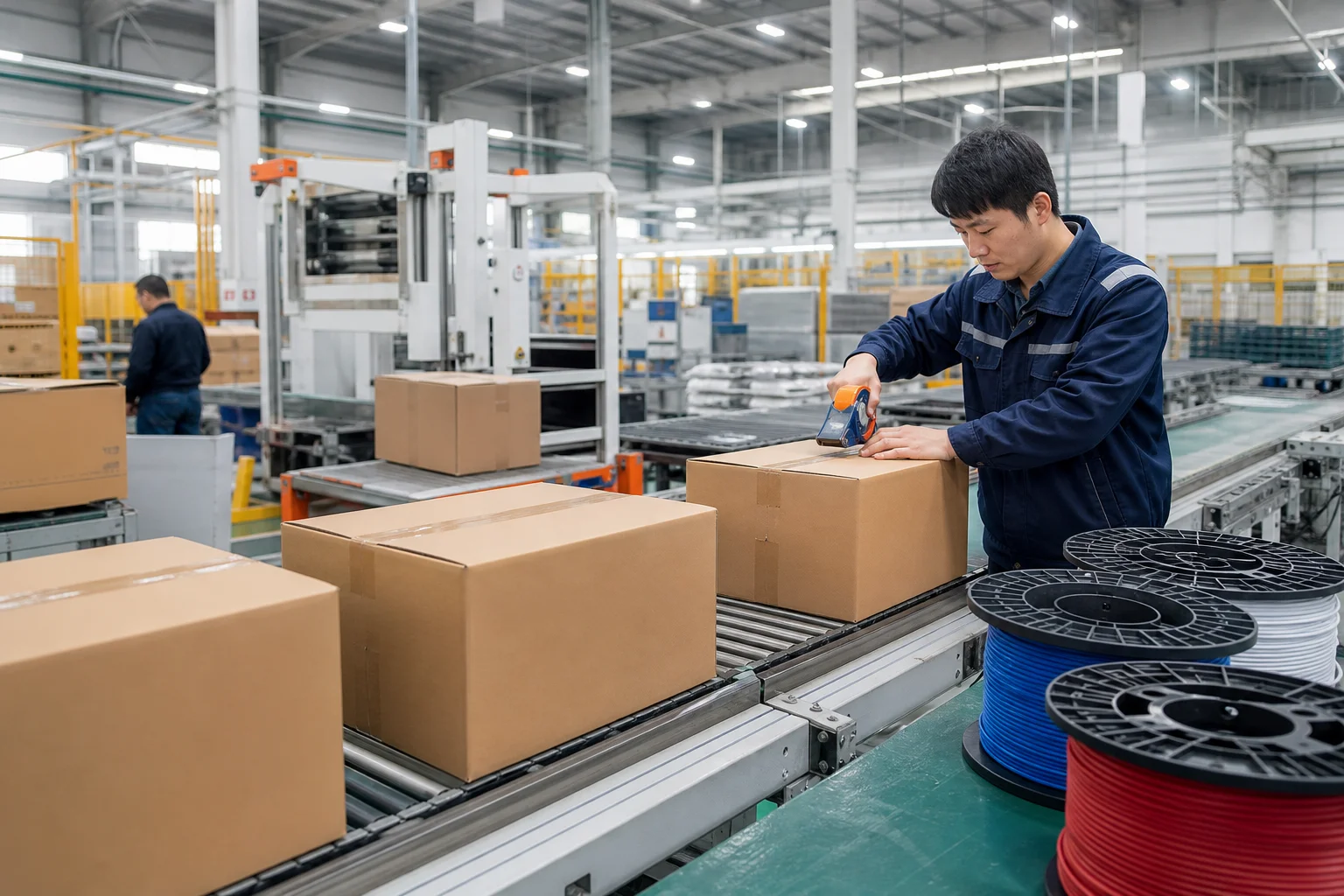
China is the only country where Cat7 OEM is a mature, routine business rather than a special request. Screened pair lines, braiding machines, LSZH compounding and 600 MHz test benches are all available inside the same industrial belt, and a private-label buyer can go from artwork to a container in a quarter. The competition is real, which keeps the price honest, and the depth is real, which means a genuine Class F programme is available at a volume a European plant would not quote. The work is in choosing the right cluster and the right entity.
Where Cat7 OEM Capacity in China Actually Sits
Five clusters dominate. Shenzhen and Dongguan in Guangdong hold the deepest concentration of network cable and patch cord plants, many of them built around export OEM programmes, with the shortest supplier chains for connectors, foil and packaging. Suzhou and Wuxi in Jiangsu are stronger on process control and on serving foreign brands that need documentation, and they sit close to Shanghai’s port. Zhejiang, especially around Lin’an and Ningbo, has a long history in cable and a strong packaging and hardware ecosystem, with Ningbo offering excellent container logistics. Hebei around Dacheng and Langfang is the cost-led volume belt, historically strong in power and coaxial cable and increasingly active in network cable. Inland provinces such as Anhui and Jiangxi offer lower labour cost and newer plants, usually with narrower product ranges.
Within each cluster, three kinds of supplier describe themselves as OEM factories. The first owns extrusion, screening, braiding and jacketing under one roof and can genuinely control construction. The second owns assembly and jacketing but buys screened cores from another plant, which is workable if the core source is disclosed. The third is a trading company with a factory address on its website. The last group is the reason buyers get surprised by a construction change between the sample and the third container, and the only defence is an audit of the entity that will print your brand.
The Five OEM Clusters Compared
Ranges are indicative for screened Cat7 with private-label packaging and move with copper, jacket compound, construction and volume.
| Cluster | OEM capability profile | MOQ range | Lead time range | Test and certification strength |
|---|---|---|---|---|
| Guangdong – Shenzhen and Dongguan | Full S/FTP in-house, patch cords, connectors, packaging under one supply chain | 5-10 km print; 100-500 m stock reels | 15-30 days plus 25-40 days sea | DSX-8000 reports routine; CPR and CE data on request |
| Jiangsu – Suzhou and Wuxi | Strong process control, foreign-brand programmes, cleaner documentation | 5-10 km; 3,000-10,000 m for construction changes | 20-30 days plus 25-40 days sea | ISO 9001 and 14001; third-party lab testing common |
| Zhejiang – Lin’an and Ningbo | Volume cable, packaging ecosystem, strong container logistics | 5-10 km print; 10 km and above for best price | 15-30 days plus 25-40 days sea | DSX reports available; Class FA less common |
| Hebei – Dacheng and Langfang | Cost-led volume, power and coaxial heritage, network cable expanding | 5-10 km; 3,000-10,000 m minimum on new constructions | 20-35 days plus 25-40 days sea | Basic ISO 9001; Class F lab evidence must be verified |
| Inland – Anhui and Jiangxi | Newer plants, lower labour cost, narrower ranges, fewer foreign clients | 3,000-10,000 m | 20-35 days plus 25-40 days sea | Thinner documentation; plan independent testing |
OEM MOQ, Tooling and Lead Time
Private-label print and packaging typically start at 5-10 km, and the best pricing usually appears at 10 km and above per construction. Below that, a factory will either refuse or quote a small-run premium that erases the cost advantage. Tooling is modest compared with most manufactured goods: print plates or a digital print setup for the jacket legend, artwork for cartons and reel labels, and sometimes a custom reel or box size. Ask whether tooling is charged once or per run, and who owns the print plates if you leave.
Lead time follows a predictable shape. Sample approval takes one to three weeks including courier, production of 15-30 days follows, and sea freight adds 25-40 days to the US or 30-45 days to Europe. Add booking, consolidation and inland delivery at both ends. A serious OEM buyer plans the first container five to six months ahead of the launch date, because the sample round usually takes two iterations and the second one is where construction gets corrected. Our guide to Cat7 wholesalers in China explains when buying through a wholesaler beats running an OEM programme.
OEM, ODM or Private Label: What Are You Actually Buying?
The three terms are used loosely and the difference matters commercially. Private label means an existing construction with your print and packaging: fastest and cheapest, but you inherit the factory’s design choices and cannot easily differentiate. OEM means the factory builds to your specification, including construction, copper size, shielding and jacket compound, which requires you to supply a real specification and to pay for the testing that proves it. ODM means the factory designs the product and you brand it, which is efficient but leaves the intellectual property with the factory unless the contract says otherwise.
For Cat7 specifically, most first-time buyers start with private label and discover that the reel is not quite what the datasheet promised, usually on pair shielding or copper size. A better sequence is to buy one construction as a private label, test it hard, then convert to OEM once you know exactly which parameters you need written into the specification. Whoever writes the specification controls the cost and the quality, so a buyer who sends a datasheet and a target price is really letting the factory choose both.
How to Audit a Cat7 OEM Factory in China
- Match the business licence, the export licence and the invoicing entity, and confirm whether the production address is the one you will audit.
- Ask whether screening, braiding and jacketing happen in-house, and request the line count and the construction each line is set up for.
- Verify ISO 9001 and ISO 14001 certificates with the issuing body and check that the scope covers screened network cable.
- Request a 600 MHz permanent-link and channel report at 90 m with a lot number, then retest a sample reel at a laboratory you appoint.
- Approve a golden sample in writing, keep a sealed reference at your end, and make the sample the contractual standard for every shipment.
- Check copper weight and DC resistance against the declared AWG on a 100 m sample, and repeat the check on each container.
- Confirm artwork ownership, print plate custody and a written commitment not to reuse your print for other customers.
- Book third-party pre-shipment inspection before the container is sealed, and keep the balance payment behind the report.
Each of these steps is expanded in our checklist for verifying a Cat7 manufacturer, including the questions that expose a trading company posing as a plant.
Three Buyer Scenarios
- New brand launching in the EU, 6 km first order. Use a Jiangsu or Guangdong plant with CPR testing experience, order private label at the 5-10 km threshold, and budget for one CPR test on the first lot. Do not promise a B2ca performance you have not tested.
- US distributor adding Cat7 next to Cat6A, 12 km per year. Choose Guangdong for screened depth and connector supply, hold a Cat6A alternative in the range because TIA does not recognise Cat7, and put the construction and copper weight into the OEM specification before the first print run.
- Middle East trading house needing the lowest landed cost, 30 km per year. Hebei or inland plants will win on price, but require independent testing on every lot and a golden sample, because cost-led plants change compound and copper size more readily than export-oriented ones.
Brand Ownership and Certificate Scope
Two legal details decide whether the programme survives. First, register your trademark in China before the first order, or at least before the packaging is printed: a factory that ends up owning your brand in its home market has leverage you cannot buy back cheaply. Second, understand certificate scope. A CE or CPR declaration is issued against a product and a manufacturer, so if you import under your own brand you become responsible for the declaration of performance and the technical file. Factories will supply the raw test data, but the document that goes into the market carries your name, so collect the data before launch rather than after a tender. Our note on Cat7 MOQ by order type shows where each of these commitments starts to make commercial sense.
FAQ
1. How do I find a real Cat7 OEM factory in China?
Start with the cluster rather than the listing: Shenzhen and Dongguan for screened depth, Suzhou and Wuxi for process control, Zhejiang for volume, Hebei and inland provinces for cost. Then verify that screening, braiding and jacketing happen in-house and audit the entity that will print your brand.
2. What is the MOQ for Cat7 OEM in China?
Private-label print and packaging usually start at 5-10 km per construction, with better pricing at 10 km and above. Below 5 km, factories tend to quote a small-run premium or refuse. Stock reels in a standard construction can be bought from 100-500 m per SKU.
3. How long does a Cat7 OEM order take from China?
Sample approval takes one to three weeks including courier, production takes 15-30 days, and sea freight adds 25-40 days to the US or 30-45 days to Europe. Plan five to six months from first contact to launch, because the sample round usually needs two iterations.
4. Who owns the CE or CPR certificate on private-label Cat7?
The importer does, in practice. Factories provide test data, but a declaration of performance and CE marking are issued against the product placed on the market under your brand, so you hold the technical file. Collect and verify the test reports before launch, not after a tender asks for them.
5. Is Chinese Cat7 cable good enough for European projects?
Yes, when the construction and testing are right. Chinese plants routinely build S/FTP with PiMF pair shielding and test to 600 MHz. The risk is a construction change between samples and production, so lock a golden sample, test each lot and confirm the CPR class on the exact construction you buy.