
The UAE is the fastest route to Cat7 cable in the Gulf and one of the easiest places to buy the wrong reel. Almost nothing in the market is manufactured locally: reels arrive from China, Europe or India, get stored in a free zone or an industrial warehouse and are resold under a distributor label. That is efficient, but it means the distributor you choose decides the construction you receive, the test evidence behind it and how quickly a shortfall gets fixed. This guide sets out which distributor type fits which buyer, what MOQ and lead times look like, and how to verify stock before a project order.
Quick answer: Match the distributor to the job. For a GCC project needing reels in weeks, use a stocked project distributor in Jebel Ali, Dubai Industrial City or Abu Dhabi with a named brand and current test reports. For re-export to Saudi or Africa, use a free zone trader with clean documentation. For private label, import direct instead. Caveat: almost no UAE distributor manufactures Cat7, so audit the reel and the paperwork, not the showroom.
Which Cat7 Cable Distributor Should You Use in the UAE?
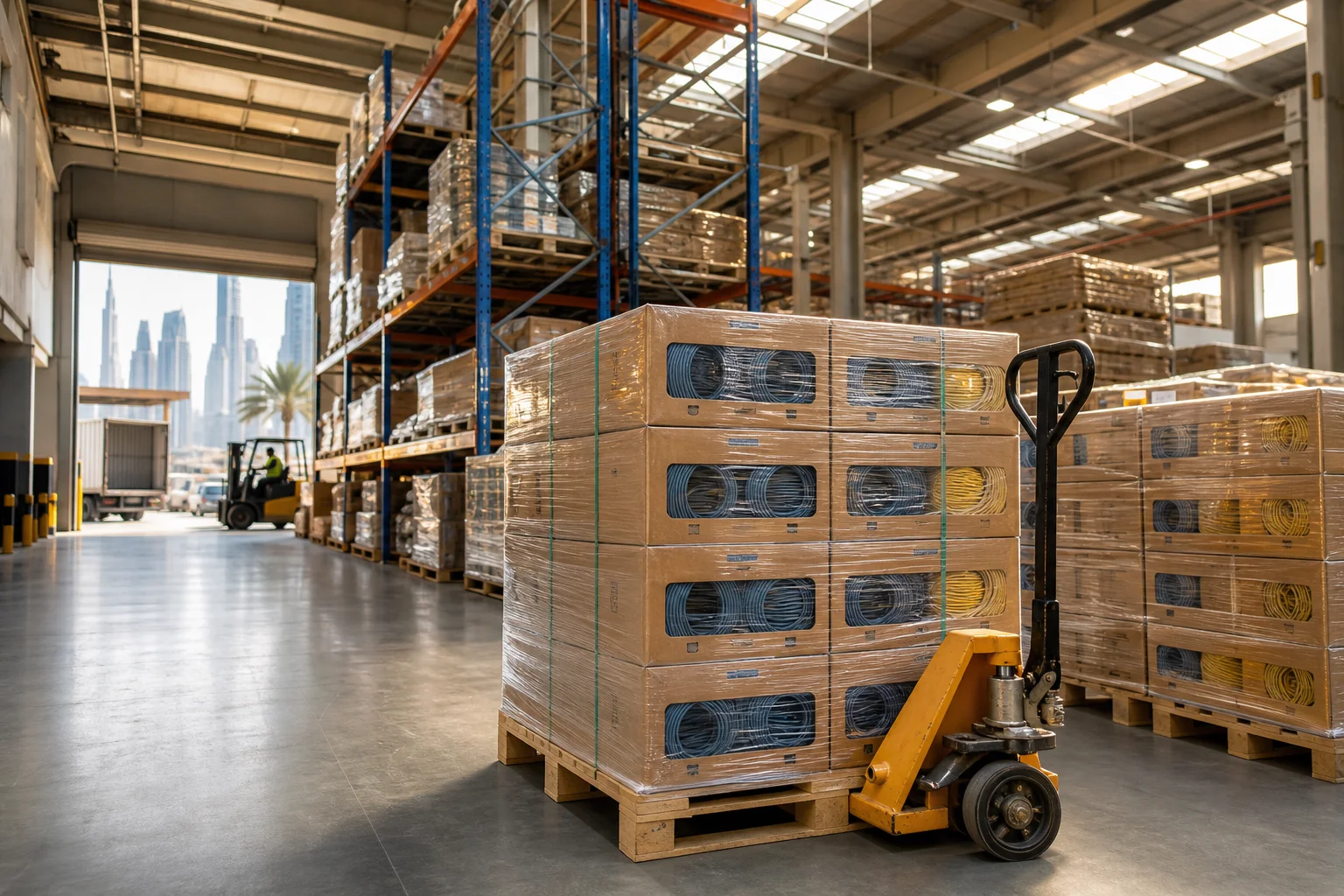
The UAE works as a distribution hub rather than a factory floor. Local cable production is concentrated on building wire and low-voltage power cable; screened Cat7 arrives by sea, sits in a free zone or industrial warehouse and is sold into projects across the Gulf, East Africa and South Asia. For a buyer that is good news on speed and bad news on traceability, because the reel in the warehouse may have changed hands twice before you see it. The distributor’s role, location and stock position tell you more about what you are buying than any catalogue page.
Where Cat7 Stock in the UAE Actually Sits
Four locations matter. Jebel Ali Free Zone holds the largest re-export stock, because goods can enter, be re-labelled and leave without customs duty and with straightforward documentation for onward shipment. Dubai Industrial City and Dubai Investment Park hold project stock for UAE mainland delivery, where a distributor needs a mainland licence to invoice local buyers. Sharjah’s free zones, including SAIF Zone and Hamriyah, host smaller traders with competitive rent and a strong Africa and CIS re-export flow. Abu Dhabi’s KIZAD and the Mussafah industrial area serve government and energy projects, where specification compliance is checked harder than price.
On top of geography sits a channel layer. Brand agents hold authorised stock and honour manufacturer warranties. Project stockists buy container loads of a few fast-moving constructions and sell in reel quantities. MEP trading houses bundle cable with containment, accessories and sometimes installation labour. System integrators hold pre-terminated assemblies and test on site. Deira trading houses handle small, mixed, cash-based orders. Only the first two are usually worth auditing for a Class F project, but the other three are where urgent small volumes actually come from.
UAE Distributor Types Compared
Ranges are indicative. Stock depth in the UAE changes weekly, so treat availability as a question to confirm rather than an assumption to plan around.
| Location and role | What they actually supply | MOQ range | Lead time range | Certification and test evidence |
|---|---|---|---|---|
| Jebel Ali Free Zone – re-export trader | Container stock of imported S/FTP, often own-label cartons | 100-500 m per SKU; full containers for re-export | 2-5 days ex-stock; 18-25 days from China on replenishment | Manufacturer test reports, sometimes generic; check lot numbers |
| Dubai Industrial City – project stockist | Named-brand reels held for mainland project delivery | 500-2,000 m typical | 2-7 days delivery in UAE | Brand datasheet, DSX permanent-link report, RoHS and REACH |
| Sharjah free zones – trading house | Mixed brands, small lots, Africa and CIS re-export | 100-500 m | 1-3 days ex-stock | Supplier-provided documents only; verify independently |
| Abu Dhabi, KIZAD and Mussafah – project supplier | Specification-compliant reels for energy and government work | 1,000-5,000 m | 5-15 days, some made to order | Full document package, third-party inspection common |
| System integrator – pre-terminated supply | Tested trunks and patch leads, connector bonding included | 50-200 assemblies | 5-12 days | Per-assembly channel test at 600 MHz |
| China factory direct – baseline | OEM and own-brand Class F, Class FA on request | 5-10 km for OEM print | 15-30 days plus 18-25 days sea to Jebel Ali | Full factory test data and factory audit access |
MOQ, Lead Time and What Stock Really Means
Ex-stock Cat7 in the UAE typically moves in 100-500 m increments per SKU, and a project stockist will usually quote from 500-2,000 m upwards. Replenishment from China takes 18-25 days by sea to Jebel Ali plus 15-30 days of production, so a distributor quoting four weeks on a construction it does not hold is really quoting a production slot plus freight, with the risk sitting on your schedule. Ask whether the reel is on the floor, in a bonded warehouse, or on order. The three answers carry very different prices.
Container economics matter as much as reel price. A 20-foot container holds a few hundred reels depending on reel size, so a distributor importing by the container has a cost advantage that a trader buying loose pallets cannot match. That advantage usually shows up as a lower price on two or three fast-moving constructions and a much higher price on anything unusual, such as Class FA, LSZH in a non-standard colour, or an outdoor PE jacket. For a project with mixed requirements, split the order: standard reels from a stockist, specials imported direct. Our overview of Cat7 distribution across the Middle East compares the UAE with Saudi and Qatari channels on the same basis.
Is a UAE Distributor the Same as a Manufacturer?
No, and the distinction decides how much of a claim you can verify. A distributor can show you a manufacturer datasheet, a test report and a certificate, but cannot show you the screening line, the foil applicator or the jacketing process. That means your audit has to shift from process to product: sample the reel, retest it, and read the jacket print and lot code against the manufacturer’s records. If the distributor cannot name the plant that made the cable, you have no route to a root-cause answer when a link fails Class F testing on site.
The practical test is simple. Ask for the manufacturer name, the plant location, the construction code and a test report whose lot number matches the reel label. A distributor with genuine brand stock answers in minutes. A trader moving grey stock answers with a datasheet and a promise. Neither answer is automatically disqualifying, but only the first one lets you build a specification around it.
How to Verify a Cat7 Distributor in the UAE
- Check the trade licence and free zone registration, and confirm whether the entity can invoice mainland UAE buyers or only free zone and export customers.
- Ask for the manufacturer name and plant location behind each SKU, then confirm the distributor is an authorised channel for that brand.
- Request a current 600 MHz permanent-link test report with a lot number, and compare it with the lot code printed on the reel label.
- Inspect a reel physically: PiMF pair shielding, overall braid, jacket print, reel label and a lot code that ties to the delivery note.
- Weigh a 100 m sample and check copper weight against the datasheet for the stated AWG, especially on own-label cartons.
- Confirm storage conditions: cable stored in direct sun or on a wet floor can fail on jacket integrity before it ever reaches site.
- For GCC re-export, verify the conformity documents the destination requires, such as SASO registration for Saudi Arabia, before the goods move.
- Agree in writing what happens on a failed site test: replacement from stock, credit note, or a joint retest at a named laboratory.
Buyers running the same checks across several ports of origin can reuse the framework in our guide to Cat7 importers and trading companies, which covers how to separate a stock-holding distributor from a broker.
Three Buyer Scenarios
- Dubai fit-out contractor, 1,200 m LSZH Cat7, three-week deadline. Use a project stockist in Dubai Industrial City with a named brand on the floor, take the reels in two deliveries, and test one reel per lot at 90 m before installation. Importing direct would miss the date by a month.
- African distributor re-exporting through Jebel Ali, 15 km per year. Use a free zone trader for consolidation and documentation, but specify the construction and the test report yourself, and appoint an inspector for the first two containers rather than trusting the carton print.
- Abu Dhabi energy project, 4,000 m with a full document package. Buy through a project supplier used to specification work, require third-party pre-shipment inspection and a 600 MHz channel report, and accept 5-15 days instead of chasing the cheapest ex-stock reel in Sharjah.
Documentation and Payment Practice
Ask for the datasheet with a frequency sweep, RoHS and REACH declarations, the manufacturer test report with a lot number, and a delivery note that matches reel labels. On payment, free zone traders often want full value before release, while project stockists will work on 30-day terms for established accounts. Neither is a red flag on its own, but a trader demanding full prepayment on an own-label reel with no plant name is a combination worth walking away from. Confirm Incoterms and who clears the goods, because in the UAE the difference between DAP and FOB can quietly exceed the price difference you negotiated. For volumes that justify going around the distributor, compare Cat7 MOQ levels by channel before deciding the middleman is worth removing.
FAQ
1. Does the UAE manufacture Cat7 cable?
Very little. Local cable production focuses on building wire and low-voltage power cable, while screened Cat7 is imported from China, Europe or India and distributed from free zones and industrial warehouses. That makes the distributor’s documentation and stock traceability more important than the country of origin label.
2. What MOQ does a UAE Cat7 distributor require?
Ex-stock sales typically start at 100-500 m per SKU, and project stockists usually quote from 500-2,000 m upwards. Re-export orders that fill a container get better pricing. Custom constructions, unusual colours and Class FA cable are normally made to order with a 5-10 km threshold.
3. How fast can I get Cat7 cable delivered in the UAE?
Ex-stock reels usually deliver in 2-7 days within the UAE. Replenishment from China takes 15-30 days of production plus 18-25 days of sea freight to Jebel Ali. If a distributor quotes two weeks on a construction it does not hold, confirm whether the reel is already in bond.
4. Which free zone is best for buying network cable?
Jebel Ali holds the deepest re-export stock and the simplest onward documentation. Sharjah free zones suit smaller lots and Africa or CIS re-export. For mainland UAE delivery, a distributor with a mainland licence, often based in Dubai Industrial City or Dubai Investment Park, avoids a second invoice chain.
5. Can a UAE distributor supply Cat7 for a Saudi project?
Yes, and it is common, but the destination conformity documents are the buyer’s responsibility to specify. Confirm SASO registration and any project-specific approvals before the goods leave the UAE, and make the requirement part of the purchase order rather than an email request.