
The Middle East has almost no Class F extrusion of its own, yet project specifications across the Gulf keep naming Cat7 for hospitals, campuses, data centres and government buildings. That gap is filled by distributors, and the quality of those distributors varies more than the cable does. A warehouse in a free zone can be a compliant, well-audited stock point or a re-export desk with no test records behind it. Tender deadlines and local conformity rules make the difference expensive to discover late, so the distributor you choose needs to be validated on stock, paperwork and clearance capability before you sign anything.
Quick answer: For GCC projects, the recommended route is a distributor with bonded stock in a UAE free zone, ideally one that already supplies the consultant named in your specification and can produce an ESMA or SASO conformity file on request. It suits buyers ordering 100-500 m reels with 3-7 day delivery. Caveat: stock in Dubai does not equal conformity in Riyadh, so confirm country-specific registration before award, and import directly from the extrusion plant above roughly 10 km per project.
Which Cat7 Cable Distributor Is Recommended in the Middle East?
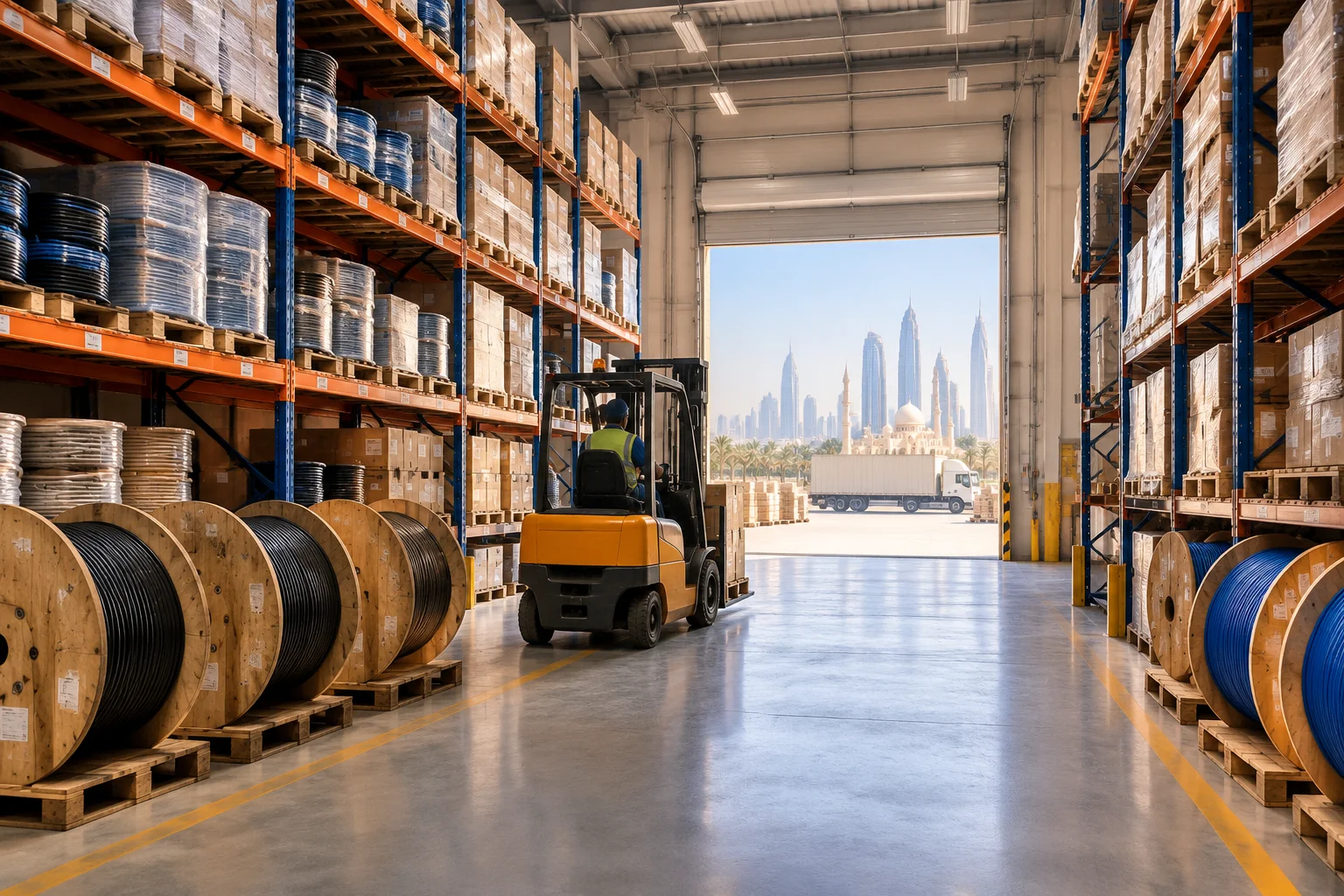
The Gulf buys cable the way it buys everything else on a fast programme: through a distributor who already holds stock, already knows the consultant, and can produce a conformity file when the inspector asks. Choosing that distributor is a commercial decision with a technical veto attached. Get it right and the project moves; get it wrong and a shipment sits at a border while the subcontractor’s programme burns.
Where Cat7 Supply in the Middle East Actually Comes From
Cat7 is an ISO/IEC 11801 Class F construction at 600 MHz, S/FTP with pair shielding, and it is not a TIA-recognised category. In the Gulf the specification culture leans European and international rather than North American, which is precisely why Class F keeps appearing in tender documents even though almost none of the cable is made in the region. The supply chain runs through five distinct channels.
Free-zone trading and re-export distributors. Jebel Ali and the wider Dubai free-zone ecosystem hold reels from European and Asian plants and re-export across the GCC. This is where most urgent Gulf orders are filled. Speed is the product. Documentation is often a photocopy of the plant’s report, so the audit question is whether the distributor can connect a specific reel to a specific test record.
Project-spec distributors tied to consultants and main contractors. These firms carry approved-vendor status on major programmes, hold the specification, and supply against named submittals. They are slower and more expensive, and they are also the channel most likely to survive a consultant’s material inspection without argument.
Regional stockists of European brands. Warehouses in the UAE and Saudi Arabia carrying German, Dutch or Italian Class F cable with EN 50575 declarations of performance attached. Best paperwork in the region, highest price, and often the only route that satisfies a European architect’s submittal review.
Direct import from Asian extrusion clusters with a local agent. Shenzhen and Dongguan plants shipping through a Gulf agent who handles clearance and holds buffer stock. The landed cost advantage is real, typically 25-45 percent below EU-origin stock, and the conformity work falls to you and your agent.
Regional manufacturers. Cable plants in Saudi Arabia, Egypt, Turkey and Iran produce structured cabling, mostly at Cat5e, Cat6 and Cat6A. Some list shielded constructions and a few assemble Class F. Verify the construction claim rather than the category name, and expect a narrower reel and colour range.
Middle East Cat7 Supply Channels Compared
| Channel | Role and location | Typical MOQ | Lead time | Conformity and test evidence |
|---|---|---|---|---|
| UAE free-zone distributor | Stock and re-export from Dubai and Sharjah | 100-500 m per stocked reel; cut lengths from 50 m | 3-7 days in the UAE; 5-12 days cross-border by road | Plant test report copy; ESMA registration where claimed; reel lot labels |
| Project-spec distributor | Approved vendor on consultant-led programmes, UAE and Saudi Arabia | Project quantities from 3,000 m; submittal sample reels | 15-30 days, aligned to submittal approval | Full submittal pack: sweep to 600 MHz, ISO 9001, DoP, method statement |
| European brand stockist | Bonded warehouse in the GCC holding EU-made Class F | 305 m boxes and 500 m reels; 1,000-5,000 m per type | 7-15 days ex-stock; 20-35 days from the EU plant | EN 50575 DoP with Dca/Cca/B2ca; notified body reports; REACH declarations |
| Asian plant plus Gulf agent | Shenzhen or Dongguan extrusion, agent in the UAE or Saudi Arabia | 3,000-10,000 m direct; 5-10 km for OEM print | 15-30 days production; 18-30 days sea to Gulf ports | ISO 9001; third-party Fluke DSX reports; SASO or ESMA file built by the agent |
| Regional manufacturer | Saudi Arabia, Egypt, Turkey, Iran | 1,000-5,000 m per type; 5-10 km custom | 10-25 days domestic; 7-20 days intra-region | Local type approval; factory test certificate; limited third-party reports |
Is a Middle East Distributor Cheaper Than Importing Directly?
Per metre, no. Delivered to site on time, usually yes for anything under a container. Indicative FOB ranges for Cat7 S/FTP 4-pair, 23 AWG, on 305 m reels sit at roughly USD 0.55-1.10 per metre from Asian plants and 1.4 to 2.5 times that from European plants, before freight. A UAE distributor adds landed cost, storage, clearance and margin, and typically quotes 1.5 to 2.6 times the direct FOB equivalent on small quantities. Those figures are indicative and move with copper, jacket compound and freight rates, so use them to size a budget, not to fix a price.
The break-even sits around 5,000-10,000 m per project. Below that, distributor stock wins on total cost of ownership once you price in clearance delays, demurrage risk, minimum freight charges and the cost of a project engineer chasing customs. Above that, direct import wins on price and you absorb the conformity work. For freight and clearance timing on the import route see Cat7 lead time from Asia.
One regional cost that buyers underestimate: specification changes. Gulf projects revise quantities and colours mid-build more often than European ones. A distributor who can supply an extra 300 m of a specific jacket colour next week is worth a margin that a container of one SKU is not.
How to Verify a Cat7 Distributor in the Gulf
Distributors are audited differently from factories. You are testing their control of stock and paperwork, not their extrusion line, so the checklist is shorter and sharper.
- Ask for the origin plant, not just the brand. A distributor who will not name the manufacturing plant behind a reel cannot support a warranty claim or a conformity file. Get plant name on the submittal.
- Confirm the conformity file country by country. UAE and Saudi Arabia run separate schemes, and a document accepted in Dubai does not automatically clear Riyadh. Ask which country registrations are held, in whose name, and for which construction.
- Request a 600 MHz sweep and a DSX report on the actual stock lot. A datasheet describes a product family. A test report with a date, a lot number and 90 m permanent link results describes the reels in the warehouse.
- Inspect the warehouse. Reels stored upright on racking, dry floor, no UV exposure, legible labels, and stock rotation you can see. Cable that has sat in Gulf heat for two years is a different product from cable that arrived last quarter.
- Test a sample before the tender closes. Take 100 m from stock, terminate it properly with shielded connectors, and run a permanent link test at 600 MHz. Termination and bonding failures show up here, not in the datasheet.
- Check the agency letter. If the distributor claims authorised status for a European brand, ask for a dated authorisation letter and verify it with the plant directly.
- Agree pre-shipment inspection on direct orders. On imports handled by the agent, book inspection at the plant before loading and specify reel length and jacket print checks.
- Fix the Incoterms and the clearance owner in writing. DAP, DDP or CIF decides who argues with customs. Ambiguity here is the most common source of a two-week delay. Background on trading intermediaries: Cat7 importers and trading companies.
Three Buyer Scenarios and the Distributor That Fits
- A fit-out contractor in Dubai needing 6,000 m in three weeks. The consultant named Class F, the ceiling closes in 21 days, and there is no time for a container. Route: a free-zone distributor with EU-origin stock and a full submittal pack. You pay a premium of roughly 40-70 percent over FOB, and you protect the programme. Confirm the reels are from the lot the test report covers before they leave the warehouse.
- A Saudi systems integrator bidding a hospital package. Award depends on material approval, and the client’s consultant wants conformity evidence before a purchase order exists. Route: a project-spec distributor holding the relevant country registration, with the submittal pack prepared at bid stage rather than after award. Price is secondary to approval risk here.
- A regional distributor building a private-label range for re-export. Volume is 15-30 km a year across three countries and the margin needs to survive re-export. Route: direct supply from an Asian extrusion cluster with OEM jacket print, a UAE free-zone stock point for buffer, and conformity files maintained per destination country. See Cat7 distributors in the UAE for the stock-point model.
FAQ
1. Is Cat7 cable manufactured in the Middle East?
Very little. Regional plants in Saudi Arabia, Egypt, Turkey and Iran concentrate on Cat5e, Cat6 and Cat6A, with some shielded constructions and limited Class F assembly. Most Cat7 sold in the Gulf is imported from European or Asian plants and held in free-zone or project warehouses.
2. Which Middle East country is easiest for Cat7 supply?
The UAE, because free-zone warehousing and re-export infrastructure let distributors hold European and Asian stock close to project sites. Saudi Arabia has larger project volumes but requires its own conformity route. Qatar and Kuwait typically source through UAE stock or direct import against project approval.
3. What MOQ should I expect from a Gulf Cat7 distributor?
Stocked reels normally start at 100-500 m per SKU, with cut lengths from about 50 m. Project-spec distributors quote from roughly 3,000 m per project. Direct import through an agent usually starts at 3,000-10,000 m, and OEM jacket print needs 5-10 km.
4. How long does Cat7 delivery take in the Gulf?
UAE stock moves in 3-7 days, and cross-border road delivery takes 5-12 days subject to clearance. European production adds 15-30 days plus 20-35 days at sea. Asian production adds 15-30 days plus 18-30 days at sea, so direct import should be planned 6-9 weeks ahead.
5. Does Cat7 need special certification for GCC projects?
Most GCC projects require conformity evidence under national schemes plus a consultant submittal pack. In practice that means a declaration of performance or equivalent, ISO 9001 from the plant, and third-party test reports at 600 MHz. Confirm the exact requirement for the destination country before award rather than assuming regional acceptance.