
XLR to RCA: Crossing the Balance Line
Quick answer / TL;DR: Short answer: wire XLR pin 2 to the RCA centre and pins 1 and 3 to the RCA shell for a standard unbalanced connection – or pin 1 only, with pin 3 floating, where hum demands it. Expect a level difference of a few decibels and the loss of common-mode rejection. Keep the cable short and avoid running it beside power.
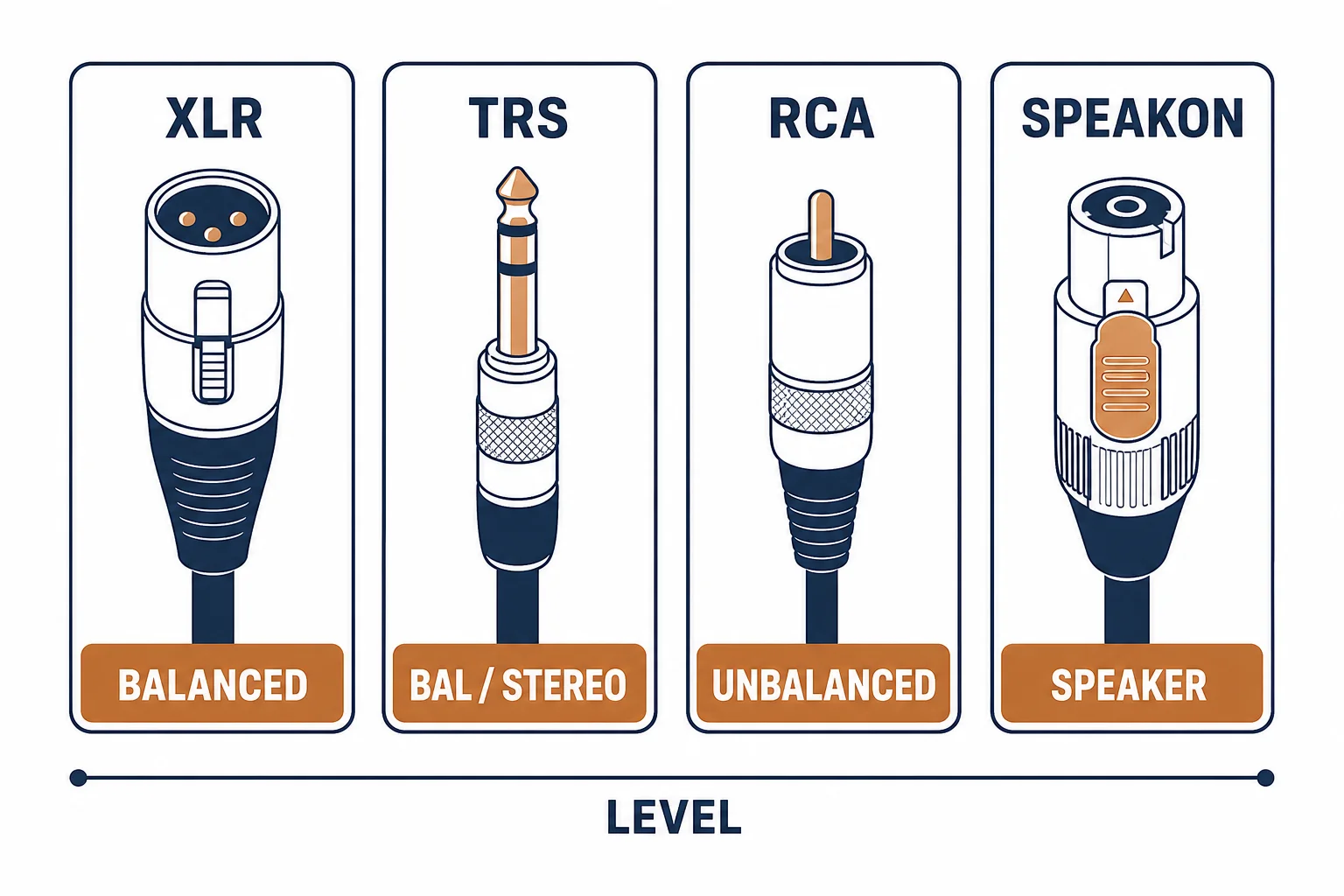
An XLR to RCA cable connects a balanced output to an unbalanced input, which means abandoning the noise rejection that balanced wiring exists to provide. It works, and it is the most common source of hum in small studios because the shield's role changes.
This is the conversion guide: the wiring convention, the level relationship, and the ground practice that keeps the result quiet.
The Wiring Convention
| The XLR pin | The signal | The RCA connection |
|---|---|---|
| 2 | Hot | Centre pin |
| 3 | Cold | Shell, or floating |
| 1 | Shield | Shell |
The two variants differ in where the cold leg goes, and the choice is a hum decision rather than a standards one.
The Level and Noise Consequences
- Balanced output to unbalanced input: workable with a small level change
- Common-mode rejection is lost
- Long runs become noise-prone
- Ground loops appear where two earthed devices meet
The consequences are why this cable is a studio convenience rather than a touring solution.
Standards and Verification
| The reference | The relevance |
|---|---|
| IEC 60268 | Audio interconnection |
| AES14 | Grounding practice |
| Continuity test | Pin 2 to centre, pin 1 to shell |
Per-device wiring is not provided in the knowledge base. The conventions are standard; test for hum after connecting rather than assuming.
Practical Notes
If hum appears, try the variant with pin 3 floating before adding an isolation transformer. The transformer is the reliable fix, but the wiring variant is free and often sufficient.
Real-World Applications
The mixer to hi-fi
A mixer's balanced output into a domestic amplifier: an XLR to RCA cable with pin 3 to shell, kept short – a quiet result in a small room.
The ground loop
The same connection producing hum: pin 3 lifted at the RCA end. The loop broke and the hum went – the wiring variant earning its place.
Related reading: The balanced XLR guide — blogs/news/xlr-mic-cable-guide
Related reading: XLR connector genders — blogs/news/xlr-connector-types
Frequently Asked Questions
Is an XLR to RCA cable balanced?
No – the RCA end is unbalanced, so the benefit of balancing is lost.
Which pin goes to the centre?
Pin 2, the hot leg.
Why is there hum?
Often a ground loop; try pin 3 floating or an isolation transformer.
Does it change the level?
Slightly – expect a few decibels of difference.
Sourcing cables for a project, a store, or a private-label line? Contact our B2B sales team for specifications, certification evidence, and volume terms – FOB and CIF options available. Request a quote or sample.