
XLR to 1/4 Inch: Two Plugs, Two Worlds
Quick answer / TL;DR: Short answer: XLR to TRS keeps the signal balanced if both ends are balanced; XLR to TS is unbalanced and loses common-mode rejection. Use TRS for line-level runs to mixers and interfaces, TS for instrument-level destinations. Check the destination's jack type before buying, and keep the cable short where it is unbalanced.
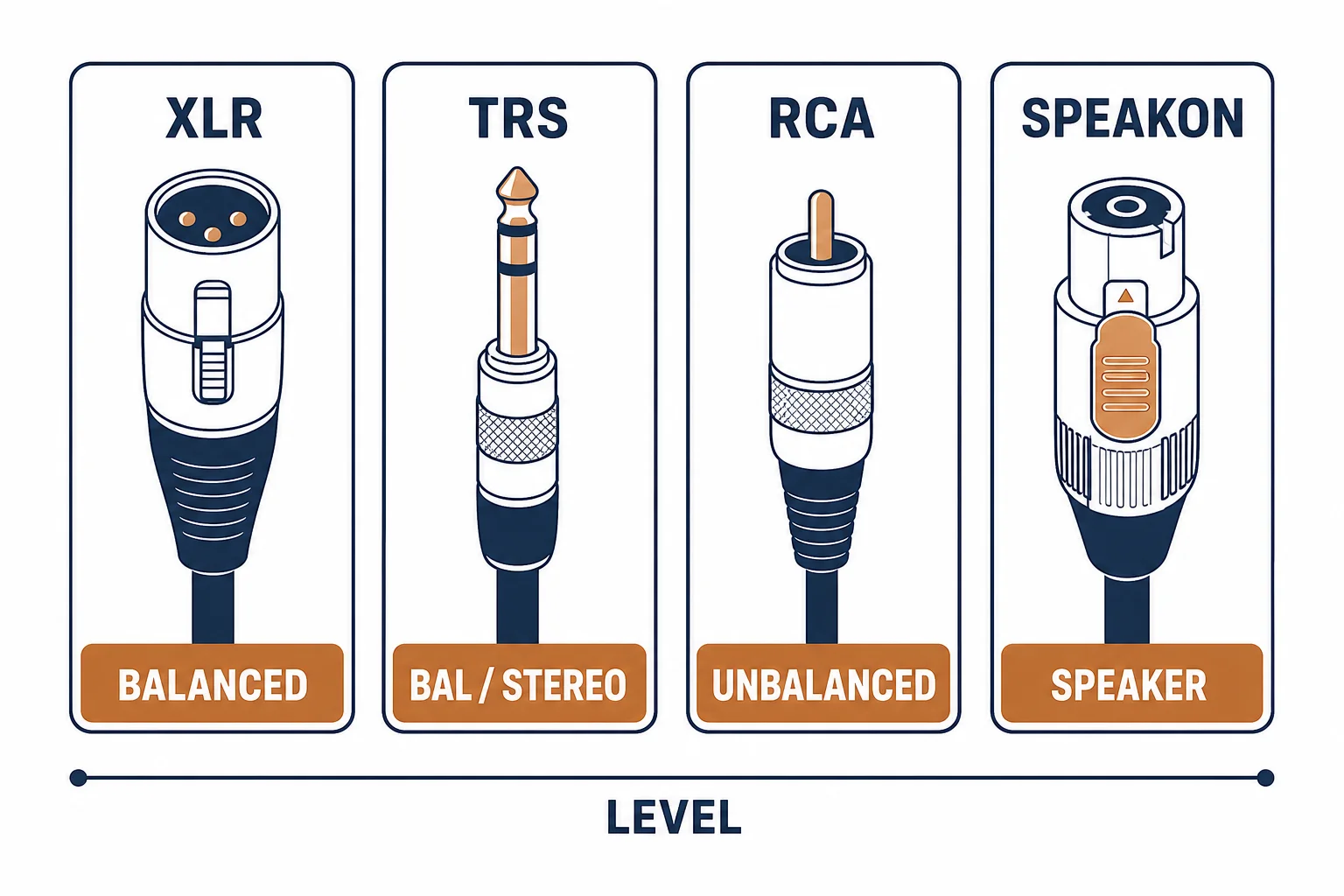
An XLR to quarter-inch cable joins a balanced microphone or line output to a jack input, or the reverse. Whether it stays balanced depends entirely on the jack: a TRS jack can carry a balanced signal, a TS jack cannot.
This is the XLR-to-jack guide: the TRS and TS distinction, the level question, and the installations where the cable is routine.
TRS Against TS
| The jack | The conductors | The balance |
|---|---|---|
| TRS | Tip, ring, sleeve | Balanced if both ends are |
| TS | Tip, sleeve | Unbalanced |
| The result | Noise rejection | Lost with TS |
The jack type decides whether the cable is balanced, and it is rarely labelled on the equipment.
The Level Question
- Microphone level into a line input: too quiet, needs a preamp
- Line level into an instrument input: too hot, may distort
- Match the level, not just the connector
- The cable cannot correct a level mismatch
Level mismatches are audible immediately; connector mismatches are often not, which is why the level check comes first.
Standards and Verification
| The reference | The relevance |
|---|---|
| IEC 60268 | Audio interconnection |
| AES14 | Grounding practice |
| Continuity test | Tip, ring and sleeve discrete |
Per-device jack types are not provided in the knowledge base. The wiring conventions are standard; check the manual for whether the jack is balanced.
Practical Notes
A cable labelled 'XLR to 1/4' may be wired TRS or TS, and the packaging often does not say. Buy from a listing that states the wiring, or test with a continuity meter before use.
Real-World Applications
The interface input
A microphone into an audio interface's combo jack: an XLR to TRS cable, balanced throughout – the noise floor as low as the interface allows.
The stage DI
A keyboard's line output into a DI box: XLR out to the console, balanced – the run long but quiet, which is what the balance is for.
Related reading: The TRS jack guide — blogs/news/quarter-inch-patch-cord
Related reading: Balanced to unbalanced conversion — blogs/news/xlr-to-rca-cable
Frequently Asked Questions
Is XLR to 1/4 balanced?
Only with a TRS jack at the quarter-inch end.
TRS or TS?
TRS for balanced line-level, TS for instrument level.
Does the cable change the level?
No – it carries whatever the source provides.
How do I check the wiring?
Continuity test tip, ring and sleeve against the XLR pins.
Sourcing cables for a project, a store, or a private-label line? Contact our B2B sales team for specifications, certification evidence, and volume terms – FOB and CIF options available. Request a quote or sample.