
XLR Patch Cables: Balanced by Design
Quick answer / TL;DR: Short answer: XLR patch cables use three pins – 1 shield, 2 hot, 3 cold – with a braided or foil shield and a balanced pair. Use them for microphone and line-level balanced runs; keep the shield connected at both ends for RF protection in audio, and choose lengths that avoid coils. For unbalanced gear, an XLR-to-TRS cable is the adapter, not a longer XLR.
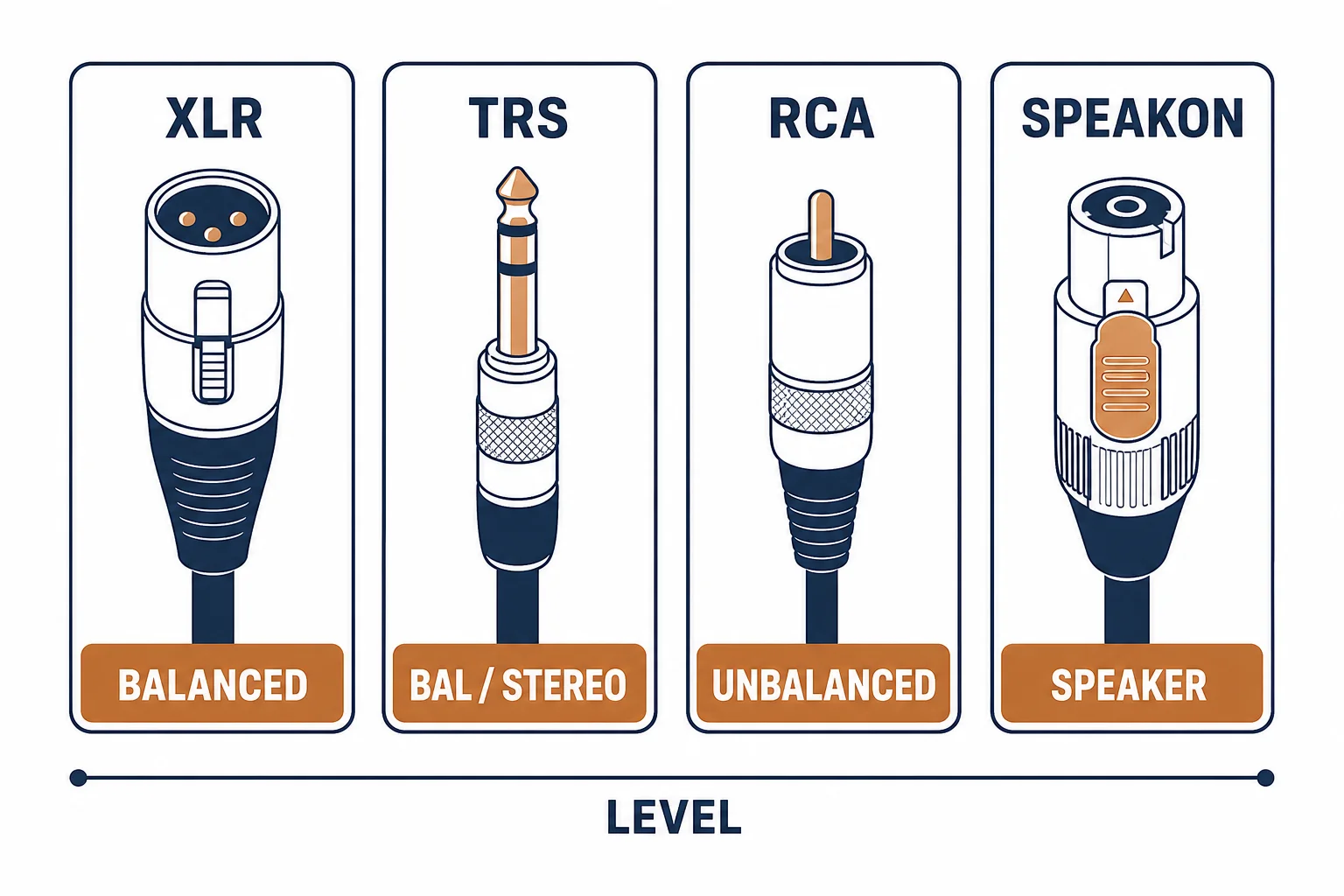
An XLR patch cable carries a balanced signal on three conductors: two signal legs and a shield. The balance is what makes a long microphone run quiet, and the shield is what keeps it that way in a room full of dimmers and power amplifiers.
This is the XLR patch guide: the pin standard, the shielding and ground rules, and the length choices that suit stage and studio patching.
The Three Pins
| The pin | The signal | The note |
|---|---|---|
| 1 | Shield and ground | The reference for the pair |
| 2 | Hot, positive | In phase |
| 3 | Cold, negative | Inverted – the balance |
The inverted leg is the whole point: interference arrives equally on both legs and cancels at the receiver.
Shielding and Ground
- Braided shield: better for stage use, more flexible and durable
- Foil shield: lighter, cheaper, less tolerant of repeated flexing
- Ground at both ends: standard for line-level audio patch cables
- Lift the shield at one end only to solve a specific hum, not by default
The ground rule is the one most often applied wrongly: a lifted shield fixes one hum and creates a new antenna.
Length and Handling
| The use | The length |
|---|---|
| Rack patching | 0.3-1 m |
| Stage to console | 5-10 m |
| Microphone to stage box | 3-10 m |
| Long runs | Prefer the balanced line, not a longer cable loop |
Standards and Verification
| The reference | The relevance |
|---|---|
| IEC 60268 | Audio system interconnection practice |
| AES14 | Professional audio grounding practice |
| Continuity test | Pin 1 to shell, 2 and 3 discrete |
Per-SKU conductor and shield data are not provided in the knowledge base. The pin standard is fixed; verify pinout and shield continuity on arrival.
Real-World Applications
The stage box run
Eight microphones to a stage box: braided-shield XLR cables at 8 m, pin 1 grounded at both ends – no hum with the lighting rig live.
The rack patch
A patchbay wired with 0.5 m XLR cables: short, colour-coded, tested pin by pin – the rack readable and quiet.
The lifted shield
A hum traced to a ground loop between console and amplifier: the shield lifted at one end of one cable, the loop broken. Documented, so the next engineer does not 'fix' it back.
Related reading: The instrument cable that is not balanced? Read the instrument cable guide — blogs/news/what-is-an-instrument-cable
Related reading: The audio family at a glance? Read the audio cable manufacturers guide — blogs/news/audio-cable-manufacturers
Frequently Asked Questions
What is an XLR patch cable?
A three-pin balanced audio cable with a shield, used for microphone and line-level patching.
Why does XLR reject noise?
The balanced pair carries equal and opposite signals, so interference cancels at the receiver.
Should the shield be connected at both ends?
For line-level audio, normally yes. Lift one end only to break a specific ground loop.
Can I use XLR for unbalanced gear?
Use an XLR-to-TRS adapter cable; a longer XLR will not convert an unbalanced output.
Sourcing cables for a project, a store, or a private-label line? Contact our B2B sales team for specifications, certification evidence, and volume terms – FOB and CIF options available. Request a quote or sample.