
XLR Microphone Cable: The Low-Level Run
Quick answer / TL;DR: Short answer: use a shielded, balanced XLR cable with pin 1 to the shell, and choose star-quad construction where the cable runs beside lighting or power. Keep microphone runs balanced at any length, coil over-under rather than around the elbow, and test pin by pin before blaming the microphone.
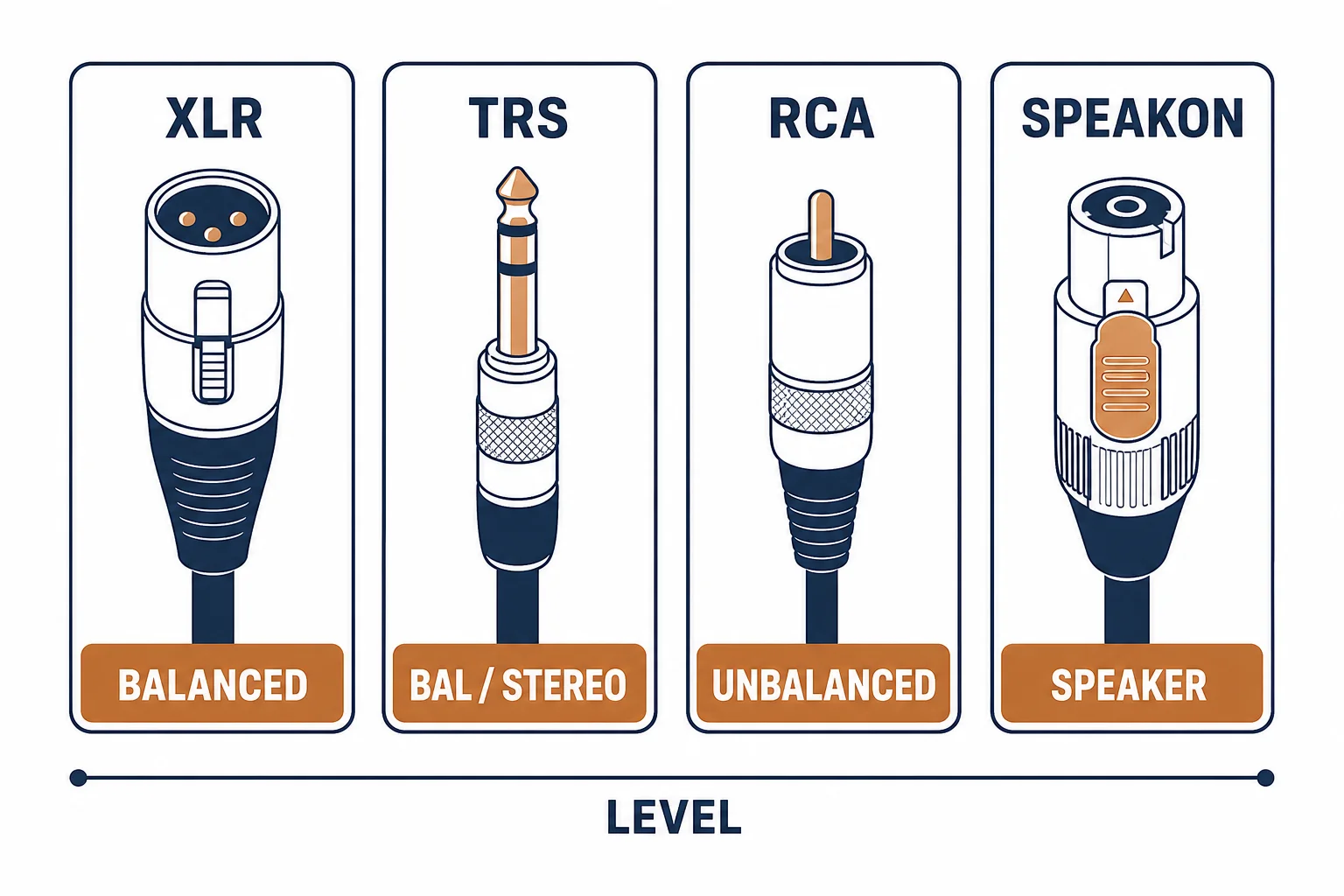
An XLR microphone cable carries a very low-level balanced signal, which is why it is shielded and why the shield matters more than in any line-level cable. It is also the cable most abused on stage: walked on, coiled around an elbow, and expected to work every night.
This is the microphone cable guide: the construction choices, the star-quad variant, and the handling rules that separate a cable that lasts a year from one that lasts a decade.
The Construction Choices
| The type | The shield | The use |
|---|---|---|
| Standard | Spiral or braid shield | General stage and studio |
| Star quad | Four conductors, two pairs | High-interference runs |
| Foil shield | Cheaper, less flexible | Fixed installs |
The star-quad construction costs flexibility and buys immunity – the trade that makes it worth carrying for problem venues.
The Length and Level Rules
- Balanced at any practical length
- Long runs are fine if the shield is intact
- Low level means the shield is doing most of the work
- A damaged shield shows as hum, not as silence
The failure mode of a microphone cable is usually hum or intermittent crackle, which is easy to misattribute to the microphone.
Handling
| The practice | The reason |
|---|---|
| Over-under coiling | No twists, no internal stress |
| No elbow wrap | Conductors kink at the connector |
| Strain relief at the plug | The joint is the weak point |
| Test before the show | Cheaper than during |
The coiling method is the single biggest factor in stage-cable life.
Standards and Verification
| The reference | The relevance |
|---|---|
| IEC 60268 | Audio interconnection |
| AES14 | Grounding practice |
| Continuity test | Pin 1, 2, 3 discrete, no shorts |
Per-SKU conductor and shield data are not provided in the knowledge base. The pin standard is fixed; verify pinout and shield continuity on arrival.
Practical Notes
Cables fail at the connectors far more often than in the middle. A cable that crackles when the plug is wiggled needs re-termination, not replacement – and a spare cable on the night is worth more than either.
Real-World Applications
The problem venue
A stage beside dimmer packs: star-quad microphone cables used for the vocal lines – the hum that had plagued the standard cables disappeared.
The elbow coil
Cables coiled around the forearm after every show: two failed at the connector within a season. Over-under coiling taught to the crew – the failure rate dropped sharply.
The misdiagnosed microphone
A vocal microphone blamed for intermittent dropouts: the cable's pin 3 was intermittent at the plug. Re-terminated – the microphone had been fine throughout.
Related reading: The XLR patch cord — blogs/news/xlr-patch-cable-buying
Related reading: Instrument cables compared — blogs/news/what-is-an-instrument-cable
Frequently Asked Questions
What is an XLR microphone cable?
A shielded, balanced three-pin cable for low-level microphone signals.
What is star quad?
A four-conductor construction with two pairs, giving better immunity in noisy environments.
How long can a microphone cable be?
Balanced signals travel well; practical limits are set by the shield and the source, not the length.
Why does my cable hum?
Usually a broken shield or a ground loop, not the microphone.
Sourcing cables for a project, a store, or a private-label line? Contact our B2B sales team for specifications, certification evidence, and volume terms – FOB and CIF options available. Request a quote or sample.