
What Is the Best Type of Ethernet Cable: The Type Map
Quick answer / TL;DR: Short answer: the best type is the combination the install needs – category by speed and distance (Cat5e/Cat6/Cat6a/Cat8), construction by environment (U/UTP quiet, F/UTP noisy, solid for permanent runs, stranded for patch cords), jacket by route (PVC, LSZH, plenum/riser rated). No single type is best; the three choices are independent.
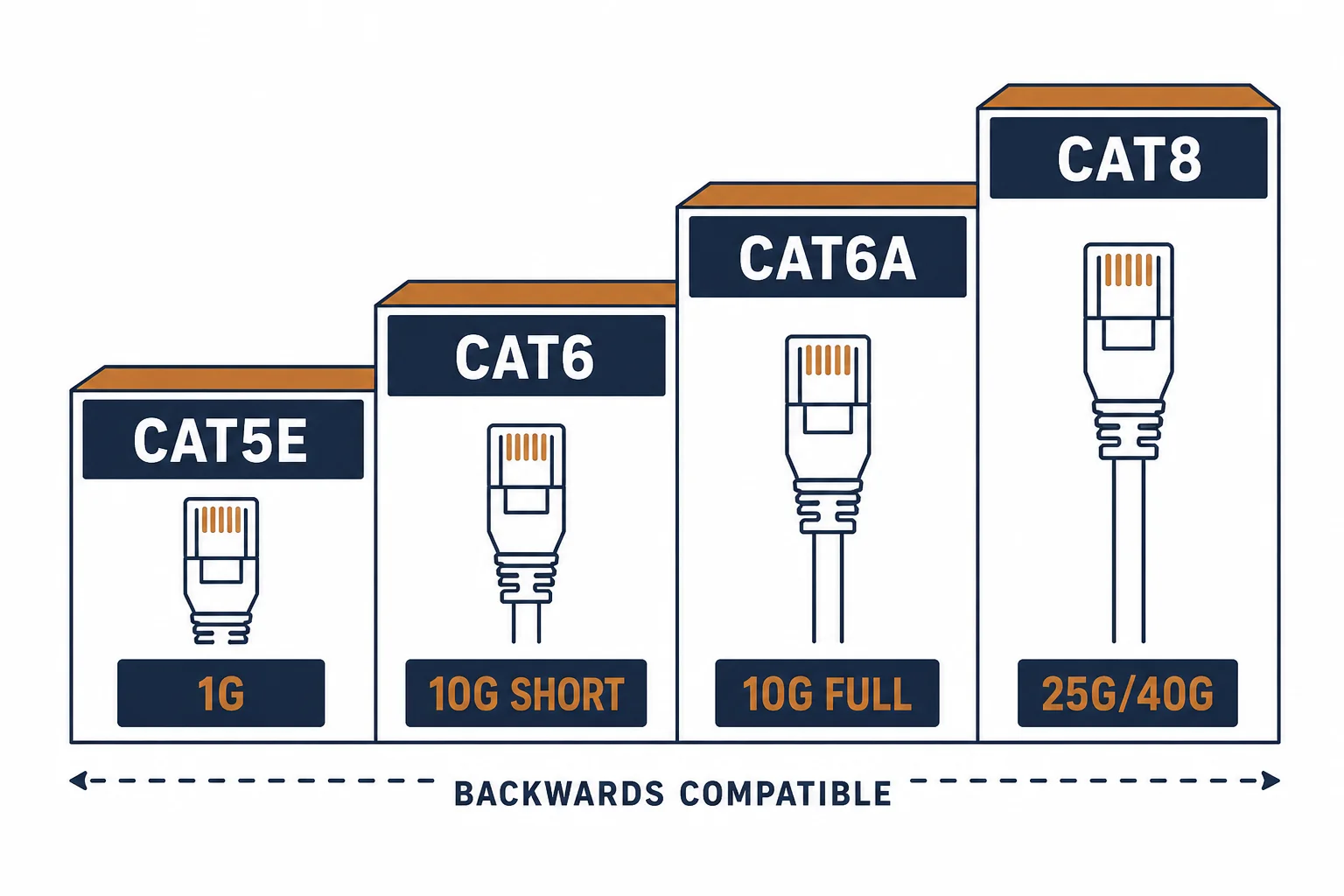
'Type' in ethernet cable covers three separate choices: the category (speed class), the construction (shielded or unshielded, solid or stranded), and the jacket (material and rating). Buyers conflate them and overpay in one dimension while under-specifying another. This guide separates the three and maps the types that matter in purchasing.
This is the type map: category, construction, jacket – each with the question it answers.
The Three Type Dimensions
| Dimension | The options | The question it answers |
|---|---|---|
| Category | Cat5e, Cat6, Cat6a, Cat8 | What speed and distance |
| Construction | U/UTP, F/UTP, S/FTP; solid or stranded | What environment and what flexibility |
| Jacket | PVC, LSZH, plenum, riser, outdoor | Where the cable may run |
The dimensions are independent: a Cat6a F/UTP solid plenum cable and a Cat6a U/UTP stranded patch are both 'Cat6a' and completely different products.
Construction Choices
- U/UTP: unshielded twisted pairs – the quiet-environment default
- F/UTP: an overall foil shield – the common answer to moderate EMI
- S/FTP: braid plus per-pair foil – industrial and high-interference paths
- Solid vs stranded: solid for permanent runs, stranded for patch cords that flex
The construction question is environment plus handling: where the cable goes, and whether it will move. The answering pair – shielding and stranding – follows.
Jacket Choices
| The jacket | The route |
|---|---|
| PVC | General indoor runs |
| LSZH | Low smoke, halogen-free – public and confined spaces |
| Plenum / riser rated | Air-handling and vertical shafts per local code |
| Outdoor / direct burial | Exterior runs with UV and moisture exposure |
Standards and Verification
| The reference | The relevance |
|---|---|
| TIA-568.2-D | Category and construction requirements |
| IEC 61156 series | Multicore and symmetrical pair cable constructions |
| UL 444 / NEC articles | Jacket ratings and permitted routes |
Per-SKU jacket and shielding options are not provided in the knowledge base. The three-dimension structure is standard; confirm the exact construction code (for example F/UTP) on the datasheet.
Real-World Applications
The quiet office
A software office with no heavy machinery: U/UTP Cat6 solid in the walls, stranded U/UTP patch cords at the desks – both dimensions matched to their jobs.
The hospital corridor
A clinical fit-out requiring low smoke: LSZH Cat6a F/UTP – the jacket and the shield each answering a different requirement.
The rooftop link
A run between buildings: outdoor-rated Cat6 with UV-resistant jacket – the jacket dimension carrying the decision the category could not.
Related reading: The non-standard CAT6E label explained? Read the naming guide — blogs/news/cat6e-naming-trap
Related reading: The Cat6a shielding question? Read is Cat6a shielded — blogs/news/is-cat6a-shielded
Frequently Asked Questions
What are the main types of ethernet cable?
Three dimensions: category (Cat5e to Cat8), construction (shielded or unshielded, solid or stranded), and jacket (PVC, LSZH, plenum/riser, outdoor).
Is shielded or unshielded better?
Shielded handles interference better; unshielded is simpler and sufficient in quiet environments. The environment decides, not preference.
What is the difference between solid and stranded?
Solid conductors suit permanent runs and punch-down termination; stranded conductors flex and suit patch cords.
Which type should a reseller stock?
U/UTP Cat6 solid in 305 m boxes plus F/UTP Cat6a for demanding jobs, with LSZH jackets where the local market requires them.
Sourcing Cat6 or Cat6a for a project, a store, or a private-label line? Contact our B2B sales team for datasheets, category test reports, and volume terms – FOB and CIF options available. Request a quote or sample.