What are the Different Types of HDMI Cables?
Several HDMI cable types exist in the market, each designed to meet a particular performance standard. And with continuous technological advancements emerging, HDMI specifications are correspondingly adjusted to ensure optimal capability and performance. With such variety, consumers may find it frustrating when determining the cable type best suited for their needs.
To assist us in exploring cable options, a basic guide is provided below. It will give us an overview of the cable types, their capabilities and how to differentiate them from each other. Furthermore, all HDMI cable products are required to be labeled with Cable Name Logos provided by HDMI Licensing Administrator Inc. To pick out the right cable, it’s highly recommended that consumers look for these logos whenever purchasing.
Standard HDMI Cable
The Standard HDMI Cable is designed to handle most home applications. It is tested to reliably transmit 720p up to 1080i, which are High-Definition (HD) resolution. This cable does not transmit 1080p (also an HD resolution), Ultra-HD (UHD) (3840×2160) and 4K (4096×2160) resolutions. Standard HDMI Cables are recommended for cable and satellite televisions, screen projectors, digital broadcast HD, upscaling DVD players, and other common displays.
Standard HDMI Cable with Ethernet
Standard HDMI Cable with Ethernet offers the same baseline capabilities and performance as that of Standard HDMI Cables. Additionally, it has a dedicated data channel, known as the HDMI Ethernet Channel. Both linked devices should have HDMI Ethernet Channel-enabled for data transmission functionality.
Note that this cable does not transmit 4K resolution. Likewise, very few products exist which can support Ethernet over HDMI compatibility. For example, Blu-Ray Disc Players and Home Theater Systems support Ethernet streaming channels.
Standard Automotive HDMI Cable
The Standard Automotive HDMI Cable is designed for internal cabling of vehicles equipped with onboard high-definition video and audio systems. It supports 720p up to 1080i resolution but does not support the HDMI Ethernet Channel.
An automotive system may be wired with one or more internal relays that can affect signal strength. To compensate with this, this cable needs to send a stronger signal than other cable types. Hence, Standard Automotive HDMI Cables are tested to a much higher performance standard.
A resistant cable, this cable type can withstand the unique stresses (vibration and temperature extremes) present in motoring environments. Using this automotive connection system, car manufacturers now can have a viable solution for HD distribution within a vehicle.
High-Speed HDMI Cable
High-Speed HDMI Cables handle resolutions of 1080p up to 4K at 60 Hz. This type also includes display technologies such as 3D and Deep Color. High-Speed HDMI Cables are recommended in a configuration where a 1080p display is being connected to a 1080p source, such as 4K-capable video game console or a Blu-Ray Disc Player.
High-Speed HDMI Cable with Ethernet
High-Speed HDMI Cables with Ethernet provide the same features of High-Speed HDMI Cables including resolutions of 1080p to 4K. It also includes display technologies such as 3D and Deep Color. Similar to Standard HDMI Cables with Ethernet, it has a dedicated channel called the HDMI Ethernet Channel. Both linked devices should have HDMI Ethernet Channel-enabled for data transmission functionality.
There are very few products that support Ethernet over HDMI compatibility. For example, Blu-Ray Disc Players and Home Theater Systems support Ethernet streaming channels.
High-Speed Automotive HDMI Cable
This cable is for automotive use and is designed and tested to meet higher performance requirements for High-Speed HDMI Cables. It is enabled to handle resolutions of 1080p and beyond, including advanced display technologies such as 4K, 3D and Deep Color.
Premium High-Speed HDMI Cable and Premium High-Speed HDMI Cable with Ethernet
These are special certification designations for High-Speed HDMI Cables that have been designed for reliable performance when using Ultra-HD (UHD) or 4K videos. These cables include features such as resolution at 60 frames per second with High-Dynamic Range (HDR), expanded color spaces including BT:2020 and 4:4:4 chroma sampling.
These cables offer low EMI (Electromagnetic Interference) that reduces interferences with nearby wireless devices. They are also identified by HDMI’s Licensing Administrator’s Premium HDMI Cable Certification Label for authentication verification.
Ultra High-Speed HDMI Cable
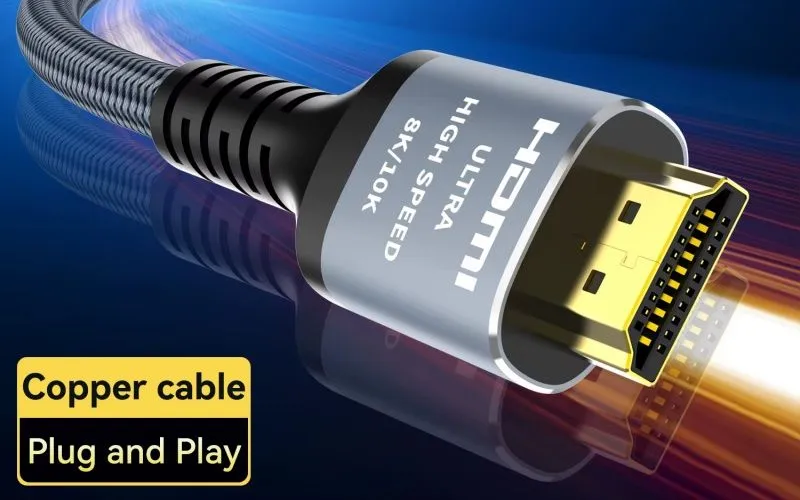
Ultra High-Speed HDMI Cables can deliver high-bandwidth features including 4K, 5K (5120×2880), 8K (1780×4320), and 10K (10328×7760) at 120 Hz. This cable supports 48 Gbps bandwidth and features low EMI. It also includes the HDMI Ethernet Channel as a valuable feature. It is backward compatible and can be used with the existing installed base of HDMI devices.
But the journey doesn’t stop here. Tech keeps evolving, and so does HDMI. Stay curious, explore new features, and ensure your setup is always ready to unleash its full potential.