
Weatherproof Ethernet: The Joint Matters
Quick answer / TL;DR: Short answer: use outdoor-rated cable (UV-stable, often gel-filled) and seal every exterior connector – a weatherproof enclosure, a gel-filled connector, or a self-amalgamating tape wrap with a drip loop. Do not rely on the cable rating alone: an unprotected plug will corrode even on a UV-rated cable.
A weatherproof ethernet installation usually fails at the connector rather than in the cable: water enters at the plug, tracks along the conductors by capillary action, and corrodes the contacts months later. Buying an outdoor-rated cable is half the job; sealing the termination is the other half.
This is the weatherproofing guide: what the cable rating covers, the connector methods that actually keep water out, and the installation details that decide the outcome.
What the Cable Rating Covers
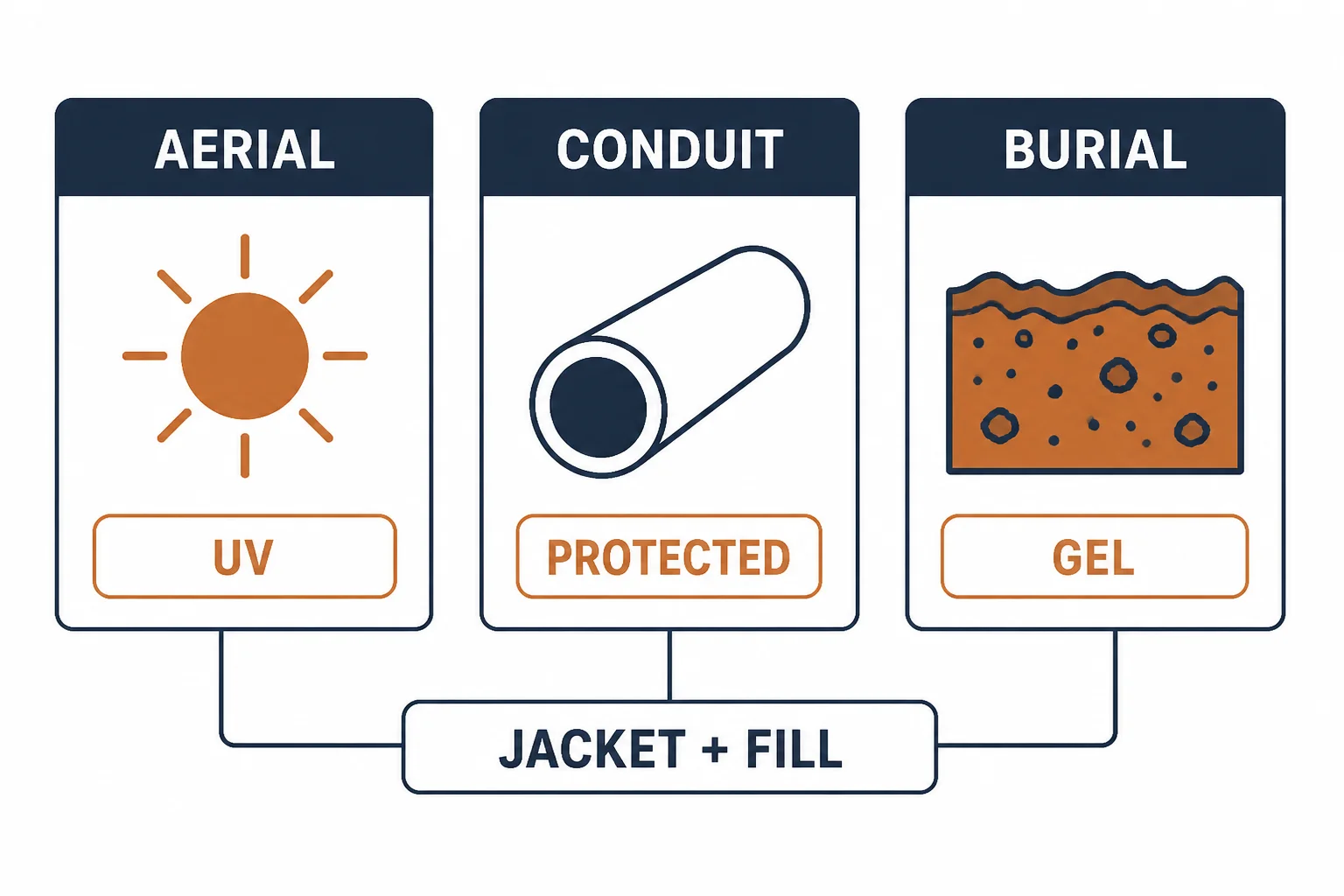
| The rating | The protection | The limit |
|---|---|---|
| UV-stable jacket | Sunlight degradation | Does not seal connectors |
| Gel-filled | Water along the cable | Bulkier, harder to terminate |
| Burial rated | Soil contact and water | Not for exposed connectors |
The jacket protects the cable; the connector is a separate problem with a separate solution.
Sealing Methods
- Weatherproof enclosure: the most reliable, and serviceable
- Gel-filled connector: quick, one-time
- Self-amalgamating tape plus a drip loop: effective where done properly
- Silicone grease in the plug: a supplement, not a seal
Every method works if applied correctly; the common failure is a partial wrap that traps water rather than excluding it.
The Installation Details
| The detail | The practice |
|---|---|
| Drip loop | Cable rises before entering the device |
| Entry point | Seal the wall penetration |
| Strain relief | Support before the connector |
| Serviceability | Leave access to the joint |
The drip loop is the cheapest defence: water runs to the lowest point and drips off instead of entering.
Standards and Verification
| The reference | The relevance |
|---|---|
| IEC 60529 | IP ratings for enclosures |
| TIA-568.2-D | Exterior cabling practice |
| UL 444 | Jacket ratings |
| Field test | Link test plus a visual seal inspection |
Per-product IP ratings are not provided in the knowledge base. The sealing principles are standard; confirm the enclosure rating rather than assuming it.
Practical Notes
A weatherproof installation should be inspectable: an enclosure with a lid beats a taped joint that cannot be checked without cutting it open. Where access is impossible, use gel-filled connectors and accept that the joint is permanent.
Real-World Applications
The pole camera
A camera on a pole in driving rain: outdoor cable, a sealed enclosure at the camera, a drip loop below the gland – two winters without a link fault.
The taped joint
A connector wrapped in tape with no drip loop: water collected in the wrap and corroded the contacts by spring. The joint remade in an enclosure – the tape had made it worse.
The unsealed penetration
A cable entering a building through an open hole: water tracked inside and reached the indoor jack. The penetration sealed and the external run given a drip loop – the path closed.
Related reading: The outdoor installation methods — blogs/news/outdoor-install-methods
Related reading: The burial construction and procedure — blogs/news/direct-burial-cat6-cable
Frequently Asked Questions
Is outdoor-rated cable weatherproof on its own?
No – the jacket resists UV and water along its length, but connectors need separate sealing.
What is the best way to seal a connector?
A weatherproof enclosure, or a gel-filled connector where access is impossible.
What is a drip loop?
A low point in the cable before it enters a device, so water drips off instead of running in.
Why do exterior links fail after months?
Water reaches the contacts and corrodes them – a delayed failure that looks like a cable fault.
Sourcing cables for a project, a store, or a private-label line? Contact our B2B sales team for specifications, certification evidence, and volume terms – FOB and CIF options available. Request a quote or sample.