
UTP Cable: The Unshielded Line
Quick answer / TL;DR: Short answer: specify UTP cable by four lines – category (Cat5e, Cat6, Cat6a), conductor (solid bare copper, 23 or 24 AWG), jacket rating (CM, CMR, CMP), and box length (305 m / 1000 ft standard). Check the print for category and AWG, confirm copper rather than copper-clad, and buy solid for permanent runs, stranded for patch cords.
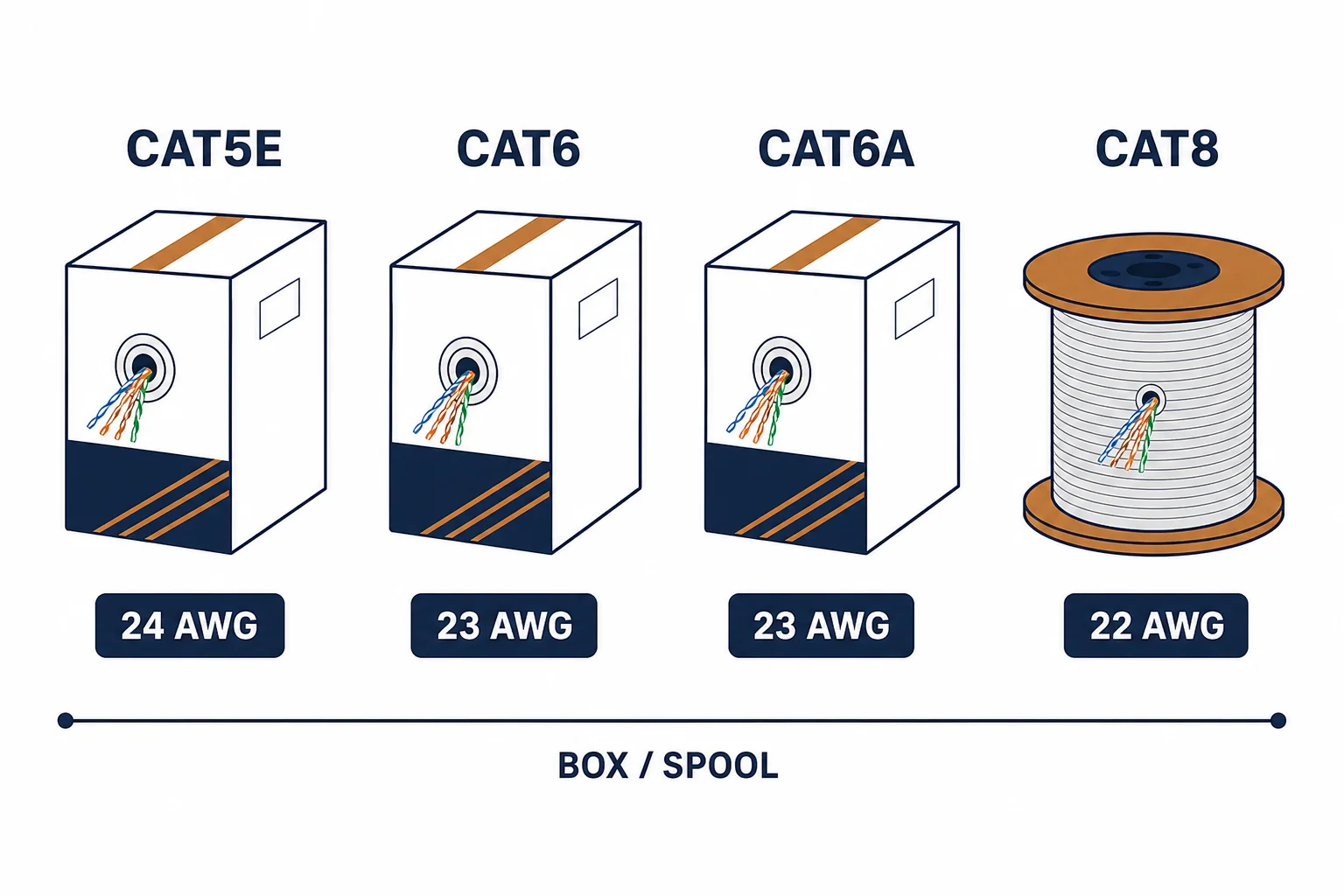
UTP cable is the unshielded twisted-pair line – the default stock of every network installer, sold by category, conductor gauge and box format. Because it is the cheapest cable on the shelf, it is also the one most often bought on price alone, and the differences that matter hide in the print on the jacket.
This is the product-line guide: the specification lines, the box formats, and the quote comparison that keeps a cheap cable from becoming an expensive re-pull.
The Four Lines That Define the SKU
| The line | The options | The effect |
|---|---|---|
| Category | Cat5e, Cat6, Cat6a | The bandwidth and the distance at speed |
| Conductor | Solid bare copper, 23-24 AWG | Attenuation and long-run stability |
| Jacket | CM, CMR, CMP | Where the cable may legally run |
| Box | 305 m, 152 m, shorter | Waste, handling, splice count |
The four lines are independent, which is why a catalogue with four categories still runs to dozens of SKUs. The purchase order should name all four.
What the Print Must Say
- The category and the construction code – U/UTP on an unshielded cable
- The conductor gauge – 23 AWG on most Cat6, 24 AWG on many Cat5e
- The jacket rating – CM, CMR or CMP
- A footage marker, so the remaining length is readable on the reel
The print is the only on-cable evidence of what was bought. A cable without the category printed is a cable without a claim.
Box Versus Reel, and Why It Matters
| The format | The best use | The trade-off |
|---|---|---|
| 305 m box | Larger jobs, fewer splices | Heavier to handle |
| 152 m box | Small jobs, single floors | Less waste on short runs |
| Reel in box | Long pulls with a stand | Needs a stand or a second pair of hands |
Standards and Verification
| The reference | The relevance |
|---|---|
| TIA-568.2-D | Category performance and installation practice |
| ISO/IEC 11801-1 | The equivalent class definitions |
| UL 444 / NEC | The jacket ratings and permitted routes |
| Field test | The channel result at the installed category |
Per-SKU conductor and attenuation data are not provided in the knowledge base. The four-line structure is standard; request the datasheet and a test report per category before committing a pallet.
Real-World Applications
The office fit-out
A floor of desks: Cat6 U/UTP in 305 m boxes, solid 23 AWG, CMR for the riser – one SKU covering the bulk of the run.
The patch-cord bench
Stranded Cat6 in shorter lengths: the flexible conductor for cords that get plugged and unplugged – the solid cable reserved for the permanent run.
The copper-clad surprise
A quote well below the others: the sample cut revealing copper-clad aluminium. The specification restated as bare copper – the quote re-bid.
Related reading: The shielded alternative to this line? Read the FTP primer — blogs/news/what-is-ftp-cat6
Related reading: How the categories stack up? Read the Cat5e versus Cat6a guide — blogs/news/cat5e-vs-cat6a
Frequently Asked Questions
What does UTP mean on a cable?
Unshielded twisted pair – four twisted pairs with no foil or braid, the standard construction for office and home networks.
What should a UTP cable order specify?
Category, conductor (solid bare copper and gauge), jacket rating, and box length. Those four lines define the SKU.
Is solid or stranded UTP better?
Solid for permanent runs – lower loss and stable termination. Stranded for patch cords, which need flexibility.
How do I check the cable is copper?
Read the print and the datasheet, and cut a sample: copper-clad aluminium shows a silver core under the copper skin.
Sourcing cables for a project, a store, or a private-label line? Contact our B2B sales team for specifications, certification evidence, and volume terms – FOB and CIF options available. Request a quote or sample.