
USB Mini-B Cable: Still in Service
Quick answer / TL;DR: Short answer: mini-B is the wider, thicker connector used on older cameras and industrial devices; micro-B is thinner and rated for more mating cycles. They are not interchangeable. Buy a data-rated cable if transfers matter, expect modest charging currents, and check the shell shape in a photograph before ordering.
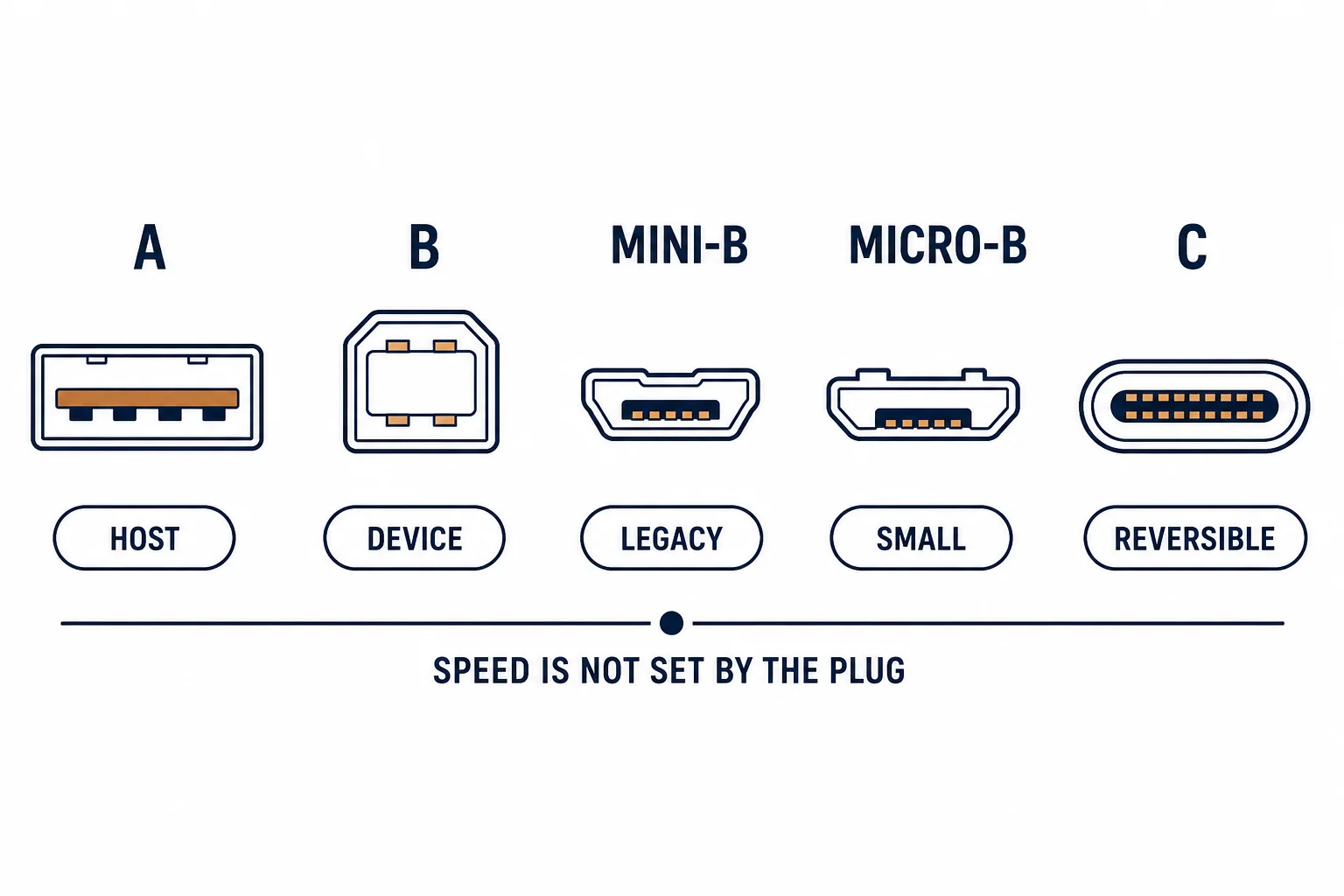
USB mini-B was superseded by micro-B in 2007 and remains in service on equipment with long life cycles: cameras, GPS units, older audio interfaces, industrial controllers and dashcams. Its thicker shell is one reason it survives where micro-B connectors break.
This is the mini-B guide: the devices, the current limits, and how to tell it from micro-B before ordering.
The Devices
| The device | The version | The note |
|---|---|---|
| Older camera | 2.0 | Often charge and data |
| GPS unit | 2.0 | Data transfers |
| Audio interface | 2.0 | Stable in service |
| Industrial controller | 2.0 | Long life cycle |
The connector persists because the devices it serves are still in use, not because it is a good connector.
Mini Against Micro
- Mini-B: wider, thicker shell, 5 pins
- Micro-B: thinner, more mating cycles rated
- Not interchangeable, though both are 5-pin
- Mini is more robust mechanically, micro is rated for more insertions
The trade is robustness against cycle life, which is why industrial equipment kept mini-B.
Current and Charging
| The cable | The typical current | The device |
|---|---|---|
| Standard mini-B | Up to 1-2 A | Older cameras |
| Thin mini-B | Under 1 A | Slow charging |
| Data-rated | Current plus data | Transfers |
Older devices rarely accept high currents, so a basic cable is usually adequate.
Standards and Verification
| The reference | The relevance |
|---|---|
| USB 2.0 | Connector definitions |
| USB Battery Charging | The 5 V conventions |
| Field test | Device charges and transfers |
Per-SKU current ratings are not provided in the knowledge base. The connector definitions are standard; test data transfer as well as charging.
Practical Notes
Mini-B connectors are mechanically stronger but their retention clips wear. A cable that falls out has usually lost its clip, not its contacts – which is why a replacement cable fixes it.
Real-World Applications
The dashcam
A dashcam on a mini-B cable in a hot car: the cable replaced annually as the clip wears – a cheap consumable rather than a device fault.
The audio interface
A studio interface with mini-B: a data-rated cable used, the connection stable – the connector's robustness suiting a fixed installation.
The wrong connector
A micro-B cable ordered for a mini-B device: it did not fit. The shell compared before reordering – the two are visually similar in small photos.
Related reading: Charging limits on mini-B — blogs/news/usb-mini-b-charging
Related reading: The micro-B successor — blogs/news/micro-usb-guide
Frequently Asked Questions
Is mini USB the same as micro USB?
No – different shell sizes, not interchangeable.
Why do old devices use mini USB?
It was the standard before 2007 and is mechanically robust.
Can it fast charge?
Rarely – the devices it serves usually accept modest currents.
What fails first?
The retention clip, which makes the cable fall out.
Sourcing cables for a project, a store, or a private-label line? Contact our B2B sales team for specifications, certification evidence, and volume terms – FOB and CIF options available. Request a quote or sample.