
USB-C Cable OEM: The Rating Discipline
Quick answer / TL;DR: Short answer: build a USB-C line by rating, not by appearance – choose the wattage class (60 W, 100 W, 240 W) and data tier (480 Mbps, 5/10/20 Gbps), add the E-Marker for above 60 W, then specify print, packaging and test. Verify the E-Marker's presence and the cable's conductor count on samples; both are testable.
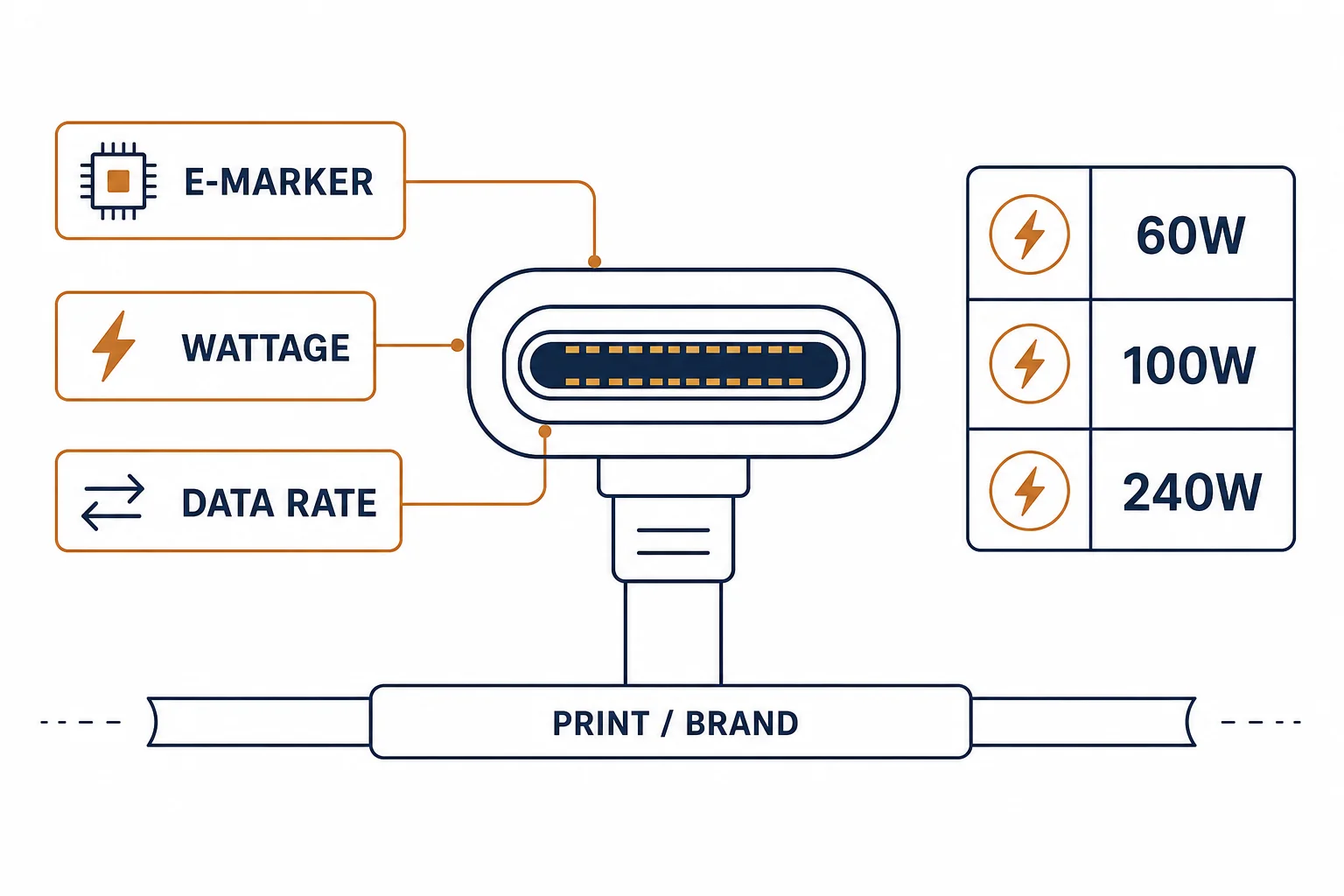
USB-C private label looks easy – one connector shape – and is not: the cable's wattage and data rate depend on internal construction and, above 60 W, on an E-Marker chip. A private-label line that prints 100 W on a 60 W build is a returns problem in waiting. This guide is the OEM discipline.
This is the USB-C OEM guide: the ratings, the E-Marker rule, and the factory checks that keep the label honest.
The Ratings
| The rating | The requirement | The failure |
|---|---|---|
| 60 W | 20 V/3 A class | Under-gauge conductors heat |
| 100 W | 5 A class with E-Marker | No E-Marker – the charger refuses |
| 240 W | Extended power range | Wrong controller – the device caps |
| Data tier | Twisted pairs for SuperSpeed | Untwisted pairs – slow transfers |
The rating table is the product definition: each class is a construction, and the print on the jacket is a promise the build must keep.
The E-Marker Rule
- Above 60 W, the cable must carry an E-Marker chip that declares its rating
- Without it, compliant chargers limit the cable to 60 W or refuse
- The chip also declares the data capability – a second reason to verify
- Counterfeit markers exist – test the declaration, not the print
The E-Marker is the one component that separates a rated cable from a cable-shaped accessory. It is invisible and testable – the OEM's quality gate.
The Factory Checks
| The check | The method |
|---|---|
| Conductor count and gauge | Cross-section on a sample |
| E-Marker declaration | Reader test – what the chip reports |
| Data throughput | Loop test at the claimed tier |
| Bend and pull | Cycle test on the connector |
Standards and Verification
| The reference | The relevance |
|---|---|
| USB Type-C specification | Cable classes and E-Marker requirements |
| USB Power Delivery | The power rules the E-Marker declares |
| USB-IF compliance | The test program behind the label |
Per-SKU construction and certification are not provided in the knowledge base. The rating structure is standard; verify E-Marker declarations with a reader and confirm USB-IF status where claimed.
Real-World Applications
The 100 W laptop line
A brand building 100 W cables: E-Marker verified on samples, conductor gauge confirmed – the label's claim testable in the field.
The data-tier mix-up
A line printed 10 Gbps on untwisted pairs: the loop test showing 480 Mbps – the packaging corrected before launch.
The counterfeit marker
A batch whose E-Marker reported 60 W against a 100 W print: the reader caught it at goods-in – the batch rejected.
Related reading: The data families USB joins? Read the data cable types guide — blogs/news/data-cable-types
Related reading: The custom assembly route? Read the custom cable assembly guide — blogs/news/custom-cable-assembly-supplier
Frequently Asked Questions
What ratings define a USB-C cable?
Wattage class (60 W, 100 W, 240 W), data tier (480 Mbps to 20 Gbps), and the E-Marker requirement above 60 W.
Do all 100 W USB-C cables need an E-Marker?
Yes – above 60 W the cable must declare its rating through the E-Marker, or compliant chargers will limit it.
How do I verify a USB-C OEM cable?
Check conductor count and gauge, read the E-Marker declaration, run a data loop test at the claimed tier, and bend-test the connector.
Can I private-label USB-C cables without USB-IF?
You can manufacture, but the compliance claims require the test program. Verify what the factory can support before printing claims.
Sourcing cables for a project, a store, or a private-label line? Contact our B2B sales team for specifications, certification evidence, and volume terms – FOB and CIF options available. Request a quote or sample.