
TT Patch Cables: Bantam in the Studio
Quick answer / TL;DR: Short answer: TT (bantam) patch cables are balanced, three-conductor cords with a 4.4 mm plug, used for professional patchbays where density matters. They are not interchangeable with 3.5 mm or 1/4 inch plugs. Buy factory-made cables, confirm balanced wiring (tip, ring, sleeve), and label both ends – a dense bay is unusable without a map.
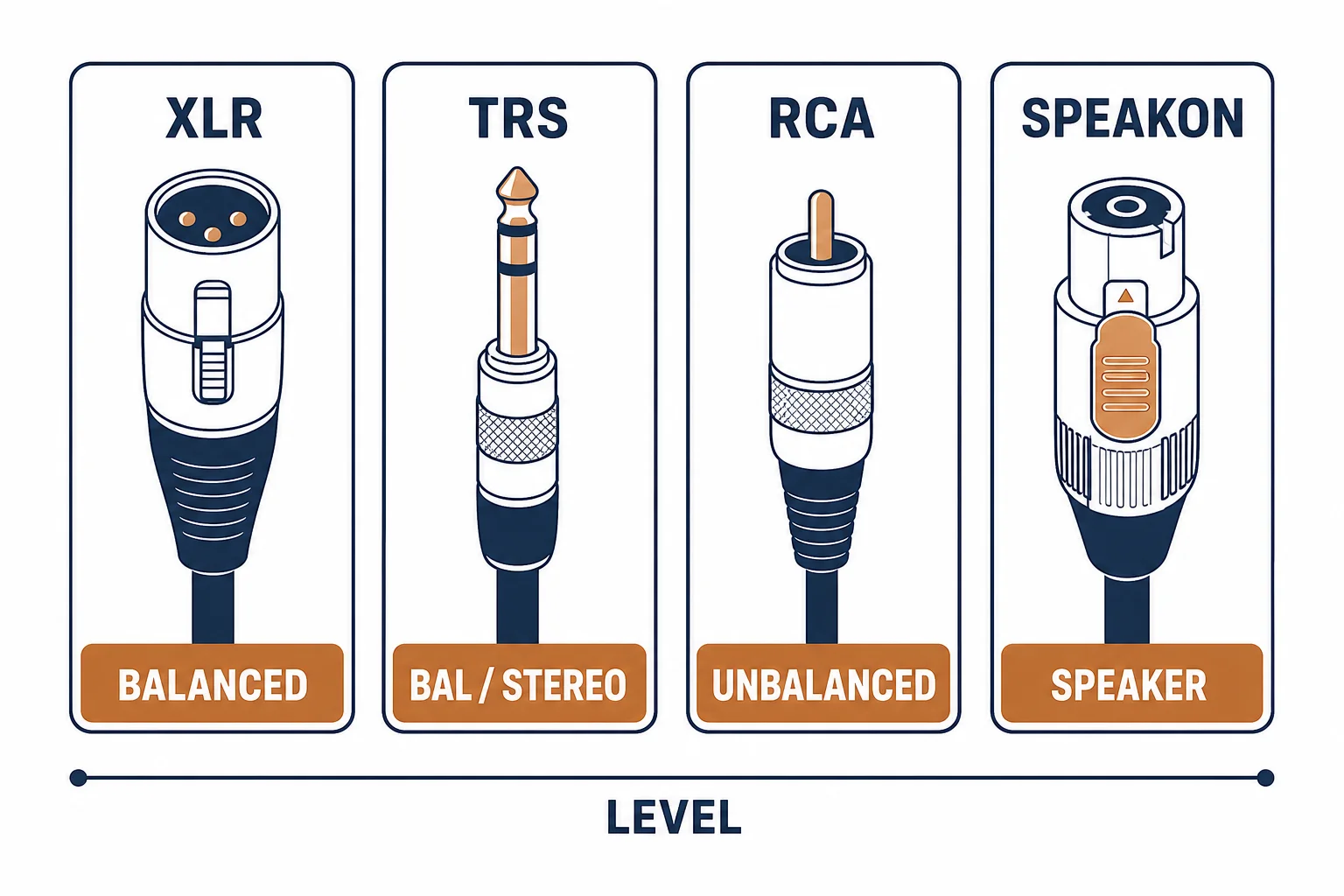
TT patch cables use the bantam (tiny telephone) plug: a 4.4 mm jack that fits twice as many sockets into a patchbay as a quarter-inch. They are the standard in broadcast and professional studios for exactly that reason – density – and they demand more care than a guitar lead because the conductors are small and the sockets are close.
This is the TT guide: what the plug is, the balanced wiring it carries, and the labelling that makes a dense patchbay usable.
The Plug
| The plug | The diameter | The density |
|---|---|---|
| TT / bantam | 4.4 mm | Highest – the broadcast standard |
| 1/4 inch | 6.35 mm | Lower, robust |
| 3.5 mm | 3.5 mm | Consumer, not a patchbay standard |
The diameter is the whole point: smaller plugs mean more circuits in the same rack space, which is what a broadcast bay needs.
The Wiring
- Balanced: tip, ring and sleeve carry hot, cold and shield
- Factory-made: field termination of TT plugs is impractical at this size
- Lengths short: 0.3-1 m for a patchbay
- Colour or labelling: essential at density
The balanced wiring is the same principle as XLR; only the connector scale changes.
Patchbay Discipline
| The practice | The benefit |
|---|---|
| Labelled both ends | Faster patching during a live show |
| Documented normals | Knowing what is half-normalled |
| Spare cables of each length | Recovery without a build |
| Colour by function | Readable at a glance |
Standards and Verification
| The reference | The relevance |
|---|---|
| IEC 60268 | Audio interconnection practice |
| AES14 | Professional audio grounding |
| Continuity test | Tip, ring and sleeve discrete |
Per-SKU conductor data is not provided in the knowledge base. The plug standard is fixed; verify balanced wiring and continuity on delivery rather than trusting the label.
Real-World Applications
The broadcast rack
A station patchbay carrying 96 circuits: TT cables at 0.5 m, labelled at both ends, the normals documented – patching during a live bulletin without opening a manual.
Related reading: The audio cable families behind a patchbay — blogs/news/audio-cable-manufacturers
Related reading: The quarter inch alternative for outboard gear — blogs/news/quarter-inch-patch-cord
Frequently Asked Questions
What is a TT patch cable?
A balanced cord with a 4.4 mm bantam plug, used in professional patchbays for high density.
Is TT the same as 3.5 mm?
No – different diameter and different standard. They are not interchangeable.
Can I make TT cables myself?
It is impractical at this size; factory-made cables are the norm.
Why is labelling critical?
A dense bay has dozens of identical sockets; without a map, patching becomes guesswork.
Sourcing cables for a project, a store, or a private-label line? Contact our B2B sales team for specifications, certification evidence, and volume terms – FOB and CIF options available. Request a quote or sample.