
Toolless Keystone Jack: Termination Without a Tool
Quick answer / TL;DR: Short answer: use toolless jacks where access is tight or the port count is small – the cap seats all conductors at once. Keep the pair untwisting to the minimum the jack allows, close the cap fully until it latches, and test every port: a partly closed cap gives a link that works at low rates and fails at high ones.
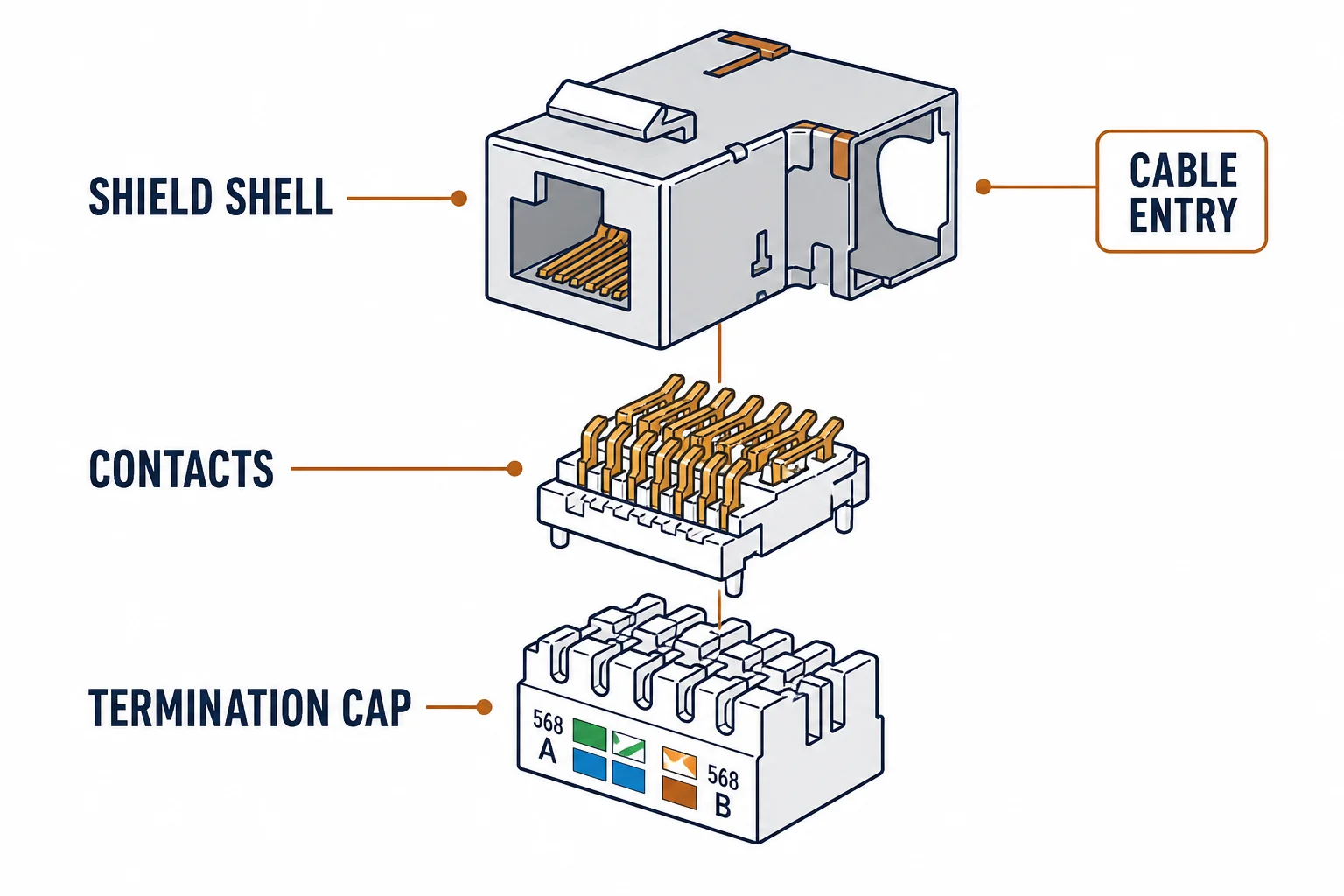
A toolless keystone jack terminates by closing a cap over the conductors rather than punching them into slots. It exists for the installer working in a tight box with no room to swing a tool, and for the small job where buying a punch-down tool cannot be justified.
This is the toolless guide: how the cap makes contact, where the method beats punch-down, and the checks that decide whether the termination holds its category.
How the Cap Makes Contact
| The element | The function | The failure |
|---|---|---|
| Cap | Presses conductors into contacts | Not fully latched |
| Guide slots | Hold pair order | Conductor in the wrong slot |
| Strain relief | Grips the jacket | Jacket not captured |
The mechanism is simple and unforgiving: one cap, eight conductors, and a single closing action that either seats all of them or none reliably.
Where Toolless Wins
- Deep or narrow back boxes where a punch tool will not fit
- Small jobs of two or three outlets
- Field repairs where the tool was left behind
- Installers who terminate occasionally
The advantage is access and tooling, not speed at volume – a punch-down tool still wins on a hundred ports.
The Checks
| The check | The method |
|---|---|
| Cap latch | Audible or tactile click |
| Pair order | Colour sequence against the jack label |
| Untwist | Minimal, measured by eye |
| Test | Pin map per port |
The latch is the whole termination: a cap that closes 'almost' produces the most frustrating class of fault, working at 100 Mbps and failing at gigabit.
Standards and Verification
| The reference | The relevance |
|---|---|
| TIA-568.2-D | Connecting hardware |
| IEC 60603-7 | The jack interface |
| Field test | Permanent link test per outlet |
Per-SKU jack mechanisms are not provided in the knowledge base. The wiring pattern is standard; follow the colour label on the specific jack rather than assuming.
Practical Notes
Toolless jacks are more expensive per unit than punch-down types, and the difference disappears on a small job where the tool would cost more than the jacks. At volume the economics reverse.
Real-World Applications
The deep box
A 35 mm back box behind a kitchen unit: no room for a punch tool. A toolless jack terminated in place, latched and tested – the outlet completed without removing the box.
The unlatched cap
A jack whose cap closed but did not latch: the link ran at 100 Mbps for months and failed when a 2.5G switch was installed. Re-terminated – the fault had been there since day one.
The volume job
Ninety-six ports in a comms room: punch-down used throughout for consistency and speed. Toolless reserved for the twelve tight positions – each method used where it wins.
Related reading: The jack buying guide with punch-down compared — blogs/news/rj45-keystone-jack-buying
Related reading: The shielded jack variant — blogs/news/shielded-keystone-jacks
Frequently Asked Questions
What is a toolless keystone jack?
A jack terminated by closing a cap over the conductors, without a punch-down tool.
Is it as good as punch-down?
Electrically equivalent when fully latched; punch-down is faster at volume.
Why does a toolless jack fail at gigabit?
Usually a cap that was not fully latched, leaving marginal contact.
Can I mix toolless and punch-down?
Yes – the channel does not care, provided each termination is correct.
Sourcing cables for a project, a store, or a private-label line? Contact our B2B sales team for specifications, certification evidence, and volume terms – FOB and CIF options available. Request a quote or sample.