
T568A vs T568B: One Pattern, Both Ends
Quick answer / TL;DR: Short answer: T568A and T568B differ only in the pair order on pins 1-8 – B is the common convention in North America, A in much of Europe and in government specs. Either works for a straight-through cable as long as both ends match. Wiring A at one end and B at the other creates a crossover cable, which will not work between a device and a switch.
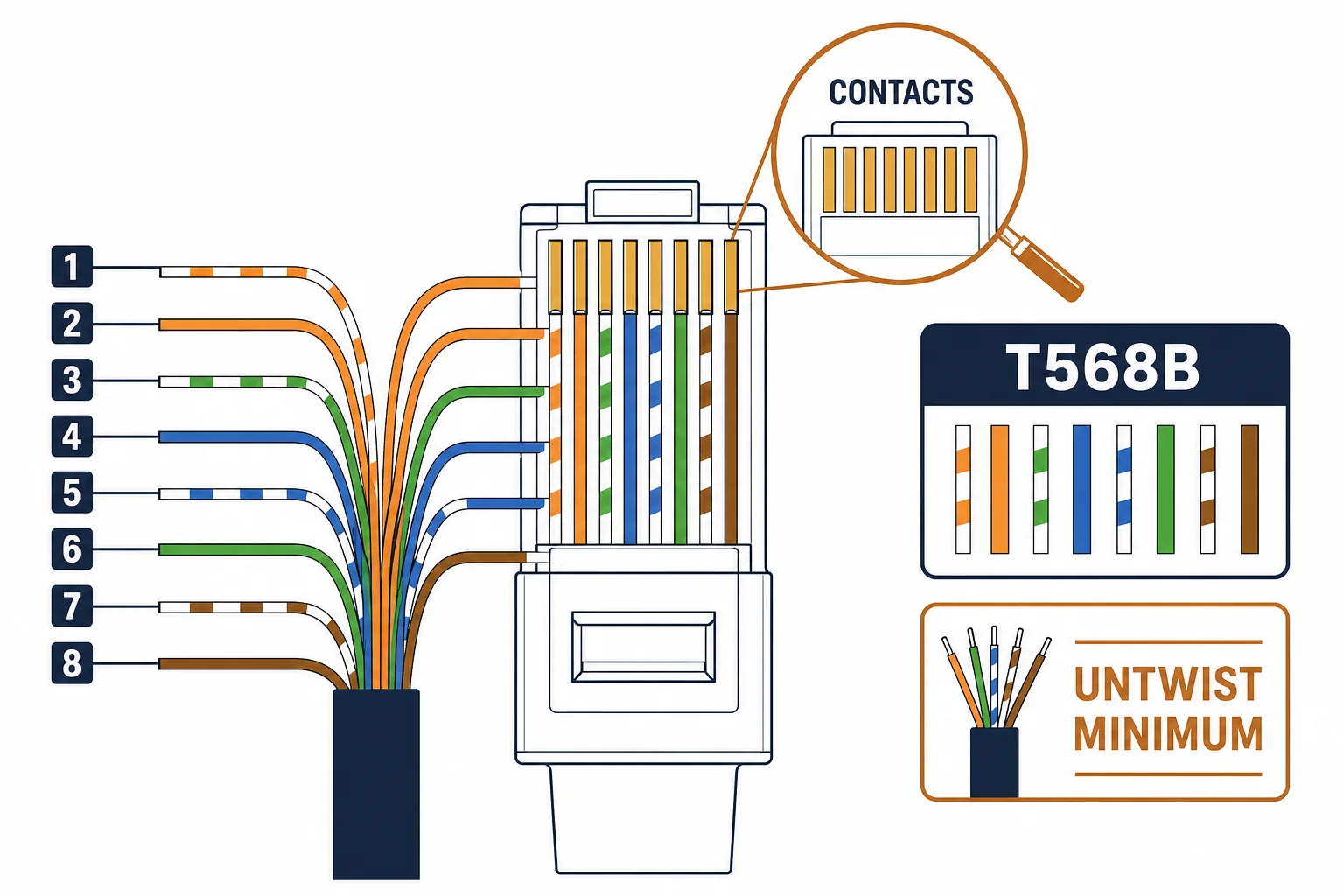
T568A and T568B are two ways to place the four pairs on an RJ45 plug's eight contacts. They differ in which pair occupies positions 2-3 and 6: swap those and the cable is wired to the other pattern. The choice is largely regional – but the rule is absolute: both ends of a cable must use the same one.
This is the wiring-pattern guide: what actually changes, why mixing produces a crossover, and the documentation that keeps a site consistent.
What Actually Changes
| The pattern | Pins 2 and 3 | Pins 6 | The effect |
|---|---|---|---|
| T568B | One pair | Another pair | The common North American order |
| T568A | Swapped with 6 | Swapped with 2 | The alternative order |
The difference is a single swap of two pairs, which is why a mixed cable looks correct and behaves as a crossover.
Why Consistency Beats Preference
- A site wired to one pattern is testable and predictable
- Mixed patterns produce accidental crossovers
- Patch panels and jacks are marked for one pattern – follow the marking
- Document the site's pattern on the panel and in the handover pack
The pattern itself does not affect performance; the inconsistency does.
The Crossover Trap
| The wiring | The result |
|---|---|
| A to A | Straight-through |
| B to B | Straight-through |
| A to B | Crossover – usually a fault in modern networks |
| B to A | Crossover, same fault |
Standards and Verification
| The reference | The relevance |
|---|---|
| TIA-568.2-D | Defines both patterns |
| IEC 60603-7 | Contact numbering |
| Continuity test | Pin-by-pin check catches a mixed cable |
Per-project conventions are not provided in the knowledge base. Both patterns are standard; record which one the site uses before the first cable is made.
Real-World Applications
The mixed batch
A bench batch wired B at one end and A at the other: ten cords behaving as crossovers. The tester caught them pin by pin – the batch re-terminated.
The European fit-out
A site specifying A to match its existing jacks: cords made to A throughout, the pattern printed on the panel label – no crossover surprises at handover.
The inherited site
A site inherited with no documentation: two cords behaving as crossovers and no record of the pattern. All termination re-checked pin by pin and the pattern written on the panel – the ambiguity closed.
Related reading: The connector genders this pattern applies to — blogs/news/rj45-male-female-connectors
Related reading: The plug specification in general — blogs/news/ethernet-plug-buying
Frequently Asked Questions
Does T568A or T568B matter for speed?
No – both carry the same performance. Only consistency matters.
Which is more common?
T568B in North America; T568A in much of Europe and in some government specifications.
What happens if I mix them?
The cable becomes a crossover and usually fails between a device and a switch.
How do I verify the pattern?
Use a pin-by-pin continuity tester; a simple link light will not reveal a crossover.
Sourcing cables for a project, a store, or a private-label line? Contact our B2B sales team for specifications, certification evidence, and volume terms – FOB and CIF options available. Request a quote or sample.