
European wholesalers buy shielded Cat6 in a market where the cable is a commodity but the paperwork is not. Price competition from Chinese and Turkish plants is intense, yet a container that arrives without a construction regulation declaration, a RoHS file and the right reaction-to-fire class can sit in a warehouse unsellable. This guide compares the routes European buyers actually use, from German and Dutch stockists to bonded warehouse imports and factory-direct orders, with indicative price bands, realistic lead times and the documentation set that decides whether a pallet moves.
Quick answer:
Most European wholesalers should buy container volume direct from Chinese or Turkish plants at roughly USD 0.28-0.50 per meter FOB for F/UTP 23 AWG, then hold it in an EU bonded or own warehouse, and top up from a German or Dutch stockist for short SKUs. Caveat: direct orders only pay off above about 5 km per construction, and CPR class plus RoHS/REACH files must be verified before shipment, not after arrival.
Where Do European Buyers Source STP Cat6 Wholesale?
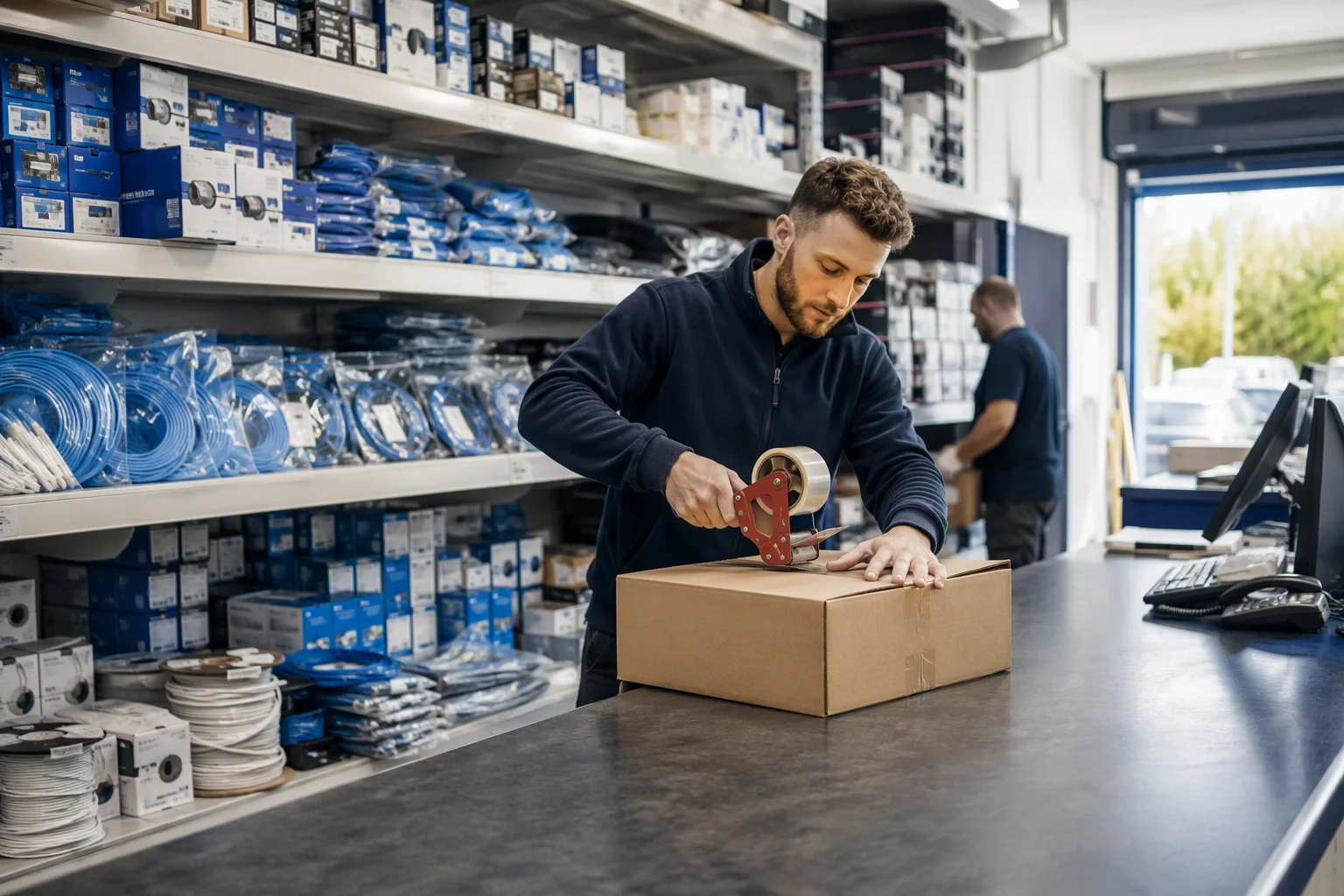
Wholesale sourcing for shielded Cat6 in Europe splits into two decisions that buyers often treat as one: where the cable is made, and where it is held. The manufacturing question is settled quickly, because very little STP Cat6 is extruded inside the EU at competitive cost; the holding question is where margin, service level and cash flow are decided. A wholesaler who imports 20 km a year from a Chinese cluster and keeps it in a rented hall outside Rotterdam runs a different business from one who buys 500 m at a time from a German distributor. Both are valid. The mistake is paying import economics on small volumes, or trade counter economics on container volumes.
What European Wholesale Buyers Are Actually Buying
Shielded Cat6 in Europe is a specification-led purchase. The buyer is usually reselling to installers who work to a consultant’s clause, so the cable has to match a construction (F/UTP or S/FTP), a conductor gauge, a jacket compound and a reaction-to-fire class. That last item is the European variable. PVC cable is common in industrial and outside-plant work, while LSZH dominates inside buildings where national fire regulations or project specifications apply, and the declared class has to be supported by test evidence rather than a datasheet claim.
Volume patterns follow the same logic. A wholesaler’s fastest-moving SKU is typically F/UTP 23 AWG PVC in 305 m boxes, because it covers general commercial work at the lowest cost. S/FTP and LSZH move in smaller quantities but carry better margin and less price pressure, since fewer suppliers can document them properly. Buyers who only chase the commodity SKU end up competing on cents per meter against importers with lower overheads.
Europe’s Sourcing Routes Compared
The table below compares the five routes that supply European wholesalers. Price bands are indicative per meter and vary with copper, shield type, jacket and volume.
| Route | Typical order size | Indicative price band (USD per meter) | Lead time | Documentation strength |
|---|---|---|---|---|
| EU stockist (Germany, Netherlands, Poland) | 100-500 m per SKU | 0.60-1.00 ex-stock | 2-7 days | Strong, local declaration holder |
| EU bonded warehouse import | 5-20 km per construction | 0.38-0.62 landed | 2-4 weeks from call-off | Good if importer holds the file |
| Direct factory order, China clusters | 5-10 km per jacket or print run | 0.28-0.50 FOB | 30-45 days sea to EU | Depends on factory audit |
| Turkish or Eastern European plant | 3-10 km | 0.35-0.58 FOB or delivered | 2-4 weeks road | Good, shorter supply chain |
| Indian or Vietnamese plant | 10 km and up | 0.26-0.46 FOB | 35-50 days sea to EU | Varies widely by plant |
Two patterns stand out. First, the spread between EU stock and factory-direct FOB is large enough to fund a warehouse, which is why mid-sized wholesalers increasingly hold their own import stock rather than buying from distributors. Second, the cheapest FOB origins are not automatically the best landed cost, because freight from South Asia, duty, and the risk of a documentation gap on arrival can absorb the difference in a single shipment.
Indicative Wholesale Price Bands in Europe
For F/UTP 23 AWG PVC, European wholesale prices typically sit between USD 0.30 and 0.55 per meter depending on origin, volume and whether the seller is a stockist or an importer. S/FTP adds roughly 25-40 percent at the same copper weight, and LSZH adds a further 10-20 percent on top of that in most quotations. Outdoor PE jacketing for campus and industrial runs prices close to LSZH because of the compound and the UV stabiliser.
Copper is the largest single swing factor. A move in copper price passes through to cable within weeks, and wholesale contracts that run for twelve months usually carry a copper adjustment clause rather than a fixed number. Buyers who lock a price for a year without one are either paying a risk premium up front or exposing the supplier to a loss that will be recovered through gauge or jacket compromises later. Ask how the adjustment works and what index it references before signing.
CPR, RoHS and the Paperwork That Sells Cable in the EU
Reaction-to-fire classification is the documentation item that most often delays a European sale. A wholesaler needs a declaration that states the class and the test basis, and the class has to match what the project specification demands. A cable declared at a lower class than the clause requires cannot be sold into that project regardless of how well it performs electrically. The same logic applies to RoHS and REACH files: they must be current, name the actual construction, and be available in a form the customer’s compliance team can file.
Practical advice: build a single product file per SKU containing the datasheet with a frequency sweep to 250 MHz, the shield construction drawing, the declaration of performance or class statement, RoHS and REACH declarations, and a test report. Wholesalers who can email that file within an hour win tenders that price alone does not. Those who have to ask the factory and wait three days usually lose the specification before the commercial discussion starts.
Three European Buyer Scenarios
- German trade distributor adding a shielded line. Start with a 5-10 km import of F/UTP PVC and a smaller quantity of S/FTP LSZH, warehouse both, and keep a German stockist as a fallback for urgent single boxes. The margin comes from the imported S/FTP, not the commodity SKU.
- Benelux wholesaler supplying installers across three countries. A bonded warehouse with call-off releases works better than one large import, because duty and VAT timing can be managed and the same lot can serve multiple markets with one documentation set.
- Eastern European contractor buying for its own projects. A Turkish or Polish plant order of 3-10 km by road gives 2-4 weeks delivery, lower freight than sea, and a supplier close enough to visit. For a single project this usually beats a container from Asia.
How to Verify a Wholesale Supplier
Verification for European buyers has a documentation half and a physical half. Run both before the first container, then repeat the physical checks on every shipment.
- Request the datasheet for the exact construction, with electrical values to 250 MHz and the shield type stated in the title, not only in a footnote.
- Ask for a Fluke DSX-8000 or DSX-5000 channel test using shielded adapters, on a reel from the same lot you are buying.
- Confirm the reaction-to-fire class in writing, with the test basis named, and check it against the clause in your customer’s specification.
- Take a sample reel and verify shield continuity and drain-wire termination at both ends, then check jacket print for construction, gauge and lot number.
- Audit the factory or use a third-party audit covering conductor diameter, foil coverage, braid density and jacket wall thickness.
- Book a pre-shipment inspection that includes reel count, length tolerance and a random shield continuity test on at least two reels per pallet.
Reels, Pallets and Warehouse Economics
Reel format drives handling cost more than buyers expect. A 305 m box is easy to pick and ship to an installer but occupies shelf space and generates cardboard waste. A 500 m reel loads efficiently on a pallet but needs a de-reeling stand. A 1,000 m drum cuts per-meter packing cost and suits long pulls, yet requires forklift access and cannot be shipped by parcel carrier. Wholesalers who standardise on one or two formats reduce picking errors, while those who carry five formats for every construction usually find their margin consumed by handling.
Storage also matters for the cable itself. Shielded constructions with foil are more sensitive to crush and tight bend radii than UTP, so drums should be stored upright on their flange edge and boxes should not be stacked beyond the carton rating. A pallet that has sat at the bottom of a stack for six months can show foil creasing that appears as a return loss failure at commissioning, and the argument about who caused it is rarely profitable.
Common Mistakes in European STP Cat6 Tenders
The most frequent error is quoting a UTP price against an STP clause and hoping the substitution is accepted; consultants who specified a shield usually did so for a reason, whether VFD-heavy plant rooms or imaging equipment. The second is importing without confirming the fire class, which turns a cheap container into dead stock. The third is treating a Chinese factory price and a European landed price as comparable numbers, when duty, freight, clearance and financing add a visible percentage that the FOB quote never shows.
Buyers who want a deeper comparison of origin options can read our notes on STP Cat6 wholesalers in China and the country-level view in STP Cat6 suppliers in Germany. Volume planning assumptions, including the step from stocked reels to custom print runs, are set out in our STP Cat6 MOQ guide.
FAQ
1. What is a realistic wholesale price for STP Cat6 in Europe?
Imported F/UTP 23 AWG PVC typically lands at USD 0.38-0.62 per meter for 5-20 km lots, while ex-stock EU distributor prices run USD 0.60-1.00. S/FTP adds 25-40 percent and LSZH adds 10-20 percent. All bands move with copper, freight and volume, so compare landed cost rather than FOB alone.
2. Do I need a CPR declaration to sell STP Cat6 in the EU?
You need documented reaction-to-fire performance, and the declared class must match the project specification. Buyers should request the class statement and its test basis, plus RoHS and REACH files, for the exact construction being supplied. Missing or mismatched declarations are a common cause of stock that cannot be sold into a project.
3. How much STP Cat6 should a first import order be?
A sensible first container is 5-10 km per construction, split between a fast-moving F/UTP PVC SKU and a smaller S/FTP or LSZH line. Below about 3 km, freight and clearance spread over too few meters, and a European stockist is usually cheaper per meter once handling is counted.
4. How long does sea freight take from Asia to Europe for cable?
Allow 30-45 days port to port, plus 15-30 days for production, so roughly seven to ten weeks door to door with clearance. Road delivery from Turkish or Eastern European plants takes 2-4 weeks and avoids sea freight risk, which matters for project deadlines with penalty clauses.
5. Can I mix F/UTP and S/FTP in one wholesale order?
Yes, and most wholesalers do, but each construction carries its own minimum quantity, typically 3,000-10,000 m for a custom jacket or print run. Mixing constructions in one shipment is efficient for freight, provided reel labels and lot numbers stay separated so the documentation for each SKU remains traceable.