
India’s LAN cable market has grown faster than its shielded-cable manufacturing depth, which is why the same construction can be quoted by a genuine extrusion plant, an assembler working from imported drum cable, and a trader with a catalogue. For a buyer, the price difference between those three is small and the quality difference is not. This guide sets out where shielded Cat6 supply sits in India, which supplier types are worth an audit, and the specific tests that expose a supplier who is repackaging rather than producing.
Quick answer:
Direct answer: audit extrusion plants in Pune, Ahmedabad and Chennai first, then Bengaluru and Delhi NCR assemblers if you need small volumes quickly. Expect 90 to 200 USD per 305 m of F/UTP or S/FTP at factory level, with 3 to 5 km as a realistic custom minimum. The caveat: braiding capacity is the constraint in India, so confirm the supplier owns braiding machines rather than buying braided core from a third party.
Which STP Cat6 Suppliers in India Are Worth Auditing?
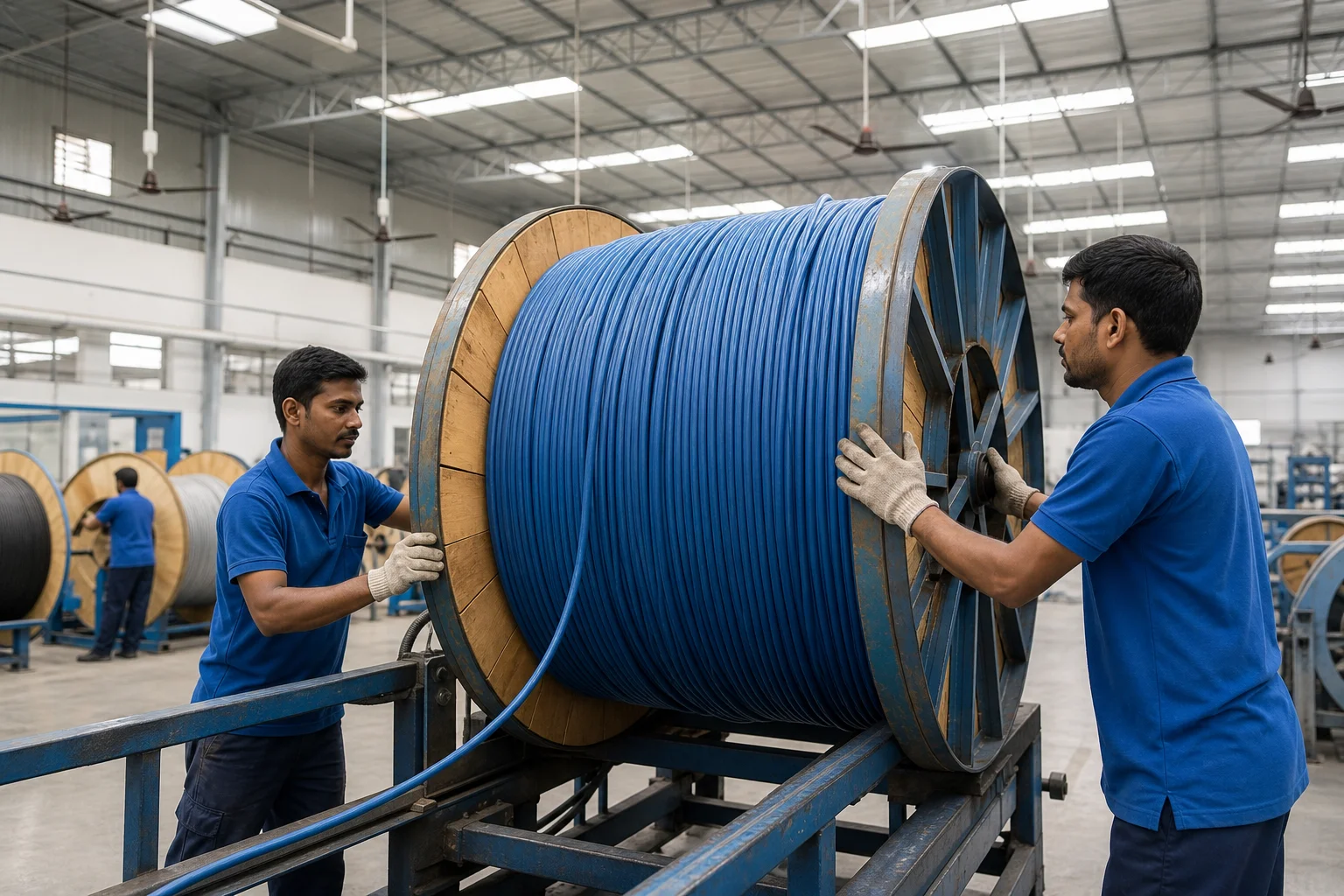
India’s LAN cable market has grown faster than its shielded-cable manufacturing depth, which is why the same construction can be quoted by a genuine extrusion plant, an assembler working from imported drum cable, and a trader with a catalogue. For a buyer, the price difference between those three is small and the quality difference is not. This guide sets out where shielded Cat6 supply sits in India, which supplier types are worth an audit, and the specific tests that expose a supplier who is repackaging rather than producing.
Why shielded Cat6 needs a closer audit in India
Unshielded Cat6 is produced at scale across the country, and a buyer can usually judge a supplier on copper weight, jacket print and a DSX test. Shielded construction is a narrower capability. It needs foil applicators with controlled overlap, braiding machines with consistent tension, drain-wire termination that survives pulling, and test equipment with shielded adapters rather than the unshielded set most labs already own.
That combination is unevenly distributed. Several plants have the extrusion capacity and the copper supply but no braiding line, so they buy shielded core from another factory and add the jacket. The result can pass a basic continuity check while failing on shield transfer impedance, braid coverage or long-run consistency. Auditing is therefore less about quality management systems, which most serious plants have, and more about whether the specific shielded operations happen under the roof you are approving.
Where the supply sits
| Sourcing cluster | Typical supplier type | Realistic MOQ | Indicative price per 305 m (USD) | Audit priority |
|---|---|---|---|---|
| Pune and western Maharashtra | Industrial cable extrusion plants | 3 – 5 km | 105 – 190 | High: braiding line and shield test capability |
| Ahmedabad and Surat | Wire and cable manufacturers | 5 – 10 km | 90 – 165 | High: foil quality and copper weight |
| Chennai and Sri City | Export-oriented cable plants | 5 – 10 km | 100 – 180 | Medium: documentation and lot traceability |
| Bengaluru | Assemblers and kitting houses | 1 – 3 km | 120 – 200 | Medium: source of the drum cable |
| Delhi NCR and Noida | Traders and private-label suppliers | 500 m – 2 km | 110 – 195 | Low unless the plant is named |
The spread in the table is real and it tracks capability rather than geography. A Pune plant with two braiding lines and a calibrated DSX set will quote at the top of its band and deliver a product that behaves like imported cable. A trader in Delhi NCR can quote below that and deliver reels whose construction changes between lots.
The five signals that justify a deeper audit
Most audit decisions can be made from the answers to five questions. If any answer is vague, move to a full plant visit before placing an order.
- The braiding question. How many braiding machines does the plant own, and what braid coverage can it hold on a 23 AWG core? A supplier that quotes S/FTP without owning braiders is sourcing core, and your order depends on a third party’s schedule.
- The adapter question. Which shielded adapters does the lab use with its Fluke tester? Suppliers who test shielded cable with unshielded adapters cannot see the failures that matter.
- The lot question. Can the reel label be traced to an extrusion date, a copper lot and a test file? If the answer is a purchase order number only, traceability stops at the invoice.
- The length question. What is the nominal length and the tolerance per reel? Short-length reels are the oldest trick in the category and are invisible unless you measure.
- The licence question. Does the applicable BIS licence for the product family cover shielded LAN cable in the sizes quoted? Ask for the scope, not just the certificate number.
A buyer question: can an Indian supplier meet EU or US specification?
Yes, at the top of the market, and this is where cluster choice matters. Export-oriented plants in Chennai and Sri City, and the better Pune plants, already produce to EU documentation expectations because their customers require it. They hold RoHS and REACH declarations, run frequency sweeps to 250 MHz, and can supply a shield construction diagram.
The gap appears in two places: CPR classification for EU construction work, which few Indian plants hold because their home market does not require it, and long-run consistency at very high volume. If your project needs a reaction-to-fire class, confirm the test reference before quoting, and expect to pay for third-party testing if the plant does not already hold it.
The audit checklist
Run this sequence before the first purchase order. It takes one plant visit and about ten days of document review.
- Match the factory address on the licence and the GST registration to the address you will visit, and confirm manufacturing is in scope.
- Walk the shielded line: foil applicator, braider, drain-wire lay-in and sheathing, in that order, on the same floor.
- Ask for the calibration record of the test equipment and the model of the shielded adapters in use.
- Take a production sample from the line, not from the showroom, and test it on a Fluke DSX-8000 or DSX-5000 with shielded channel adapters.
- Measure shield continuity and drain-wire bond resistance end to end, then repeat after a pull test that simulates installation.
- Weigh a full reel and compare net copper weight with the figure implied by the datasheet.
- Check jacket print against the datasheet, including construction code, AWG and flame rating.
- Collect RoHS and REACH declarations plus the frequency sweep to 250 MHz, and confirm they name the construction you are buying.
- Book a pre-shipment inspection covering reel count, label and lot code, measured length and random electrical checks.
Three buyer scenarios
- The systems integrator on a factory fit-out. Needs 6 km of F/UTP for drive-adjacent runs in Pune. A local extrusion plant is the right partner because delivery is days rather than weeks and the plant can support a site visit if a run fails. Insist on shielded jacks and panels from the same supplier so the channel bonds properly.
- The distributor importing from China and topping up locally. Needs 2 km of S/FTP to cover a stock-out. Bengaluru assemblers work at this volume, but the buyer should verify which factory produced the drum cable and test the actual reels, since the construction may differ from the imported SKU.
- The export brand using India as a second source. Needs 10 km of S/FTP LSZH with documentation that will pass a European consultant review. Only the export-oriented plants in the table are credible here, and the qualification cycle, including an independent test house, should be budgeted at four to six weeks.
Negotiating with Indian suppliers
Price discussions move fastest when the specification is fixed in writing before the first quote. State the construction, the AWG, the jacket compound, the nominal length and tolerance, the reel type and the test evidence required. Suppliers who quote against a written specification tend to hold the price; suppliers who quote against a description tend to revise it after sampling.
Payment terms are the second lever. Many plants ask for an advance with the balance against documents, which is normal for a first order. The protection is not the payment split but the inspection: a pre-shipment inspection with a defined sampling plan, and a hold point before the balance is released. Buyers who also buy from China should compare the two origins on landed cost rather than FOB, since freight and transit time from India to Europe and the US differ meaningfully from Asian routes.
Finally, treat the audit as an asset. A supplier audited once, with the report and test files on record, becomes a reliable second source for years. That is worth more than the two or three percent that a switch to an unaudited trader appears to save on the invoice.
Use our STP Cat6 manufacturer verification framework as the audit backbone, and compare the resulting price against STP Cat6 price per metre bands before you commit. Buyers specifying for plant and machine environments should also read STP Cat6 industrial suppliers.
FAQ
1. How do I know an Indian supplier actually makes shielded cable?
Ask to see the braiding machines and the foil applicator on the line that will run your order, then take a sample from production and test it with shielded channel adapters. A supplier who owns braiders, extrudes its own core and holds a calibrated DSX set is producing. One who cannot show those three things is sourcing core from elsewhere and adding a jacket.
2. What is a normal MOQ for STP Cat6 from India?
Extrusion plants typically want 3 to 10 km per construction, depending on whether the jacket and print are standard. Assemblers and kitting houses work from 1 to 3 km, and traders may accept 500 m. Below 1 km, local stock is the practical route, and the price per metre rises sharply because setup cost is spread over a small run.
3. Do Indian STP Cat6 suppliers provide CPR documentation for Europe?
Rarely, because the domestic market does not require it. Export-oriented plants usually hold RoHS and REACH declarations and a 250 MHz frequency sweep, but a reaction-to-fire classification is often absent. If your project needs a declared class, budget for third-party testing and confirm the test house is acceptable to your customer before production starts.
4. Is Indian STP Cat6 cheaper than Chinese supply?
Not usually on FOB, where Indian quoted ranges of 90 to 200 USD per 305 m overlap Chinese levels. The difference appears in freight, transit time and duty depending on destination. India is often the better choice for domestic and regional projects where a four-week delivery beats a ten-week import, and China remains stronger for high-volume S/FTP with full EU documentation.
5. What should a pre-shipment inspection cover for shielded cable?
Reel count against the packing list, measured length on a sample of reels, label and lot code matching the production record, jacket print against the datasheet, and an electrical spot check with shielded adapters. Ask the inspector to photograph the drum ends and the test screen, because those images are the evidence you will rely on if a dispute arises later.