
Almost any factory can sell shielded Cat6 that passes a channel test. Far fewer can explain what happens to a 48-cable bundle carrying 60 W per port in a warm ceiling void. PoE sourcing is where a cable supplier’s engineering depth becomes visible, because the questions move from insertion loss to conductor resistance, resistance unbalance and heat accumulation in bundles. This guide sets out what to ask a supplier, which evidence separates a serious plant from a reseller, and what the price bands look like for cable intended for powered devices.
Quick answer:
Choose a supplier who can provide 23 AWG copper data, DC resistance and unbalance values, and a written bundle derating statement for the PoE type you are deploying, not just a Cat6 channel report. Expect F/UTP 23 AWG at roughly USD 0.32-0.58 per meter FOB. Caveat: above 802.3at, bundle size and connector rating matter as much as the cable itself.
Which STP Cat6 Suppliers Handle PoE Loads and Bundles?
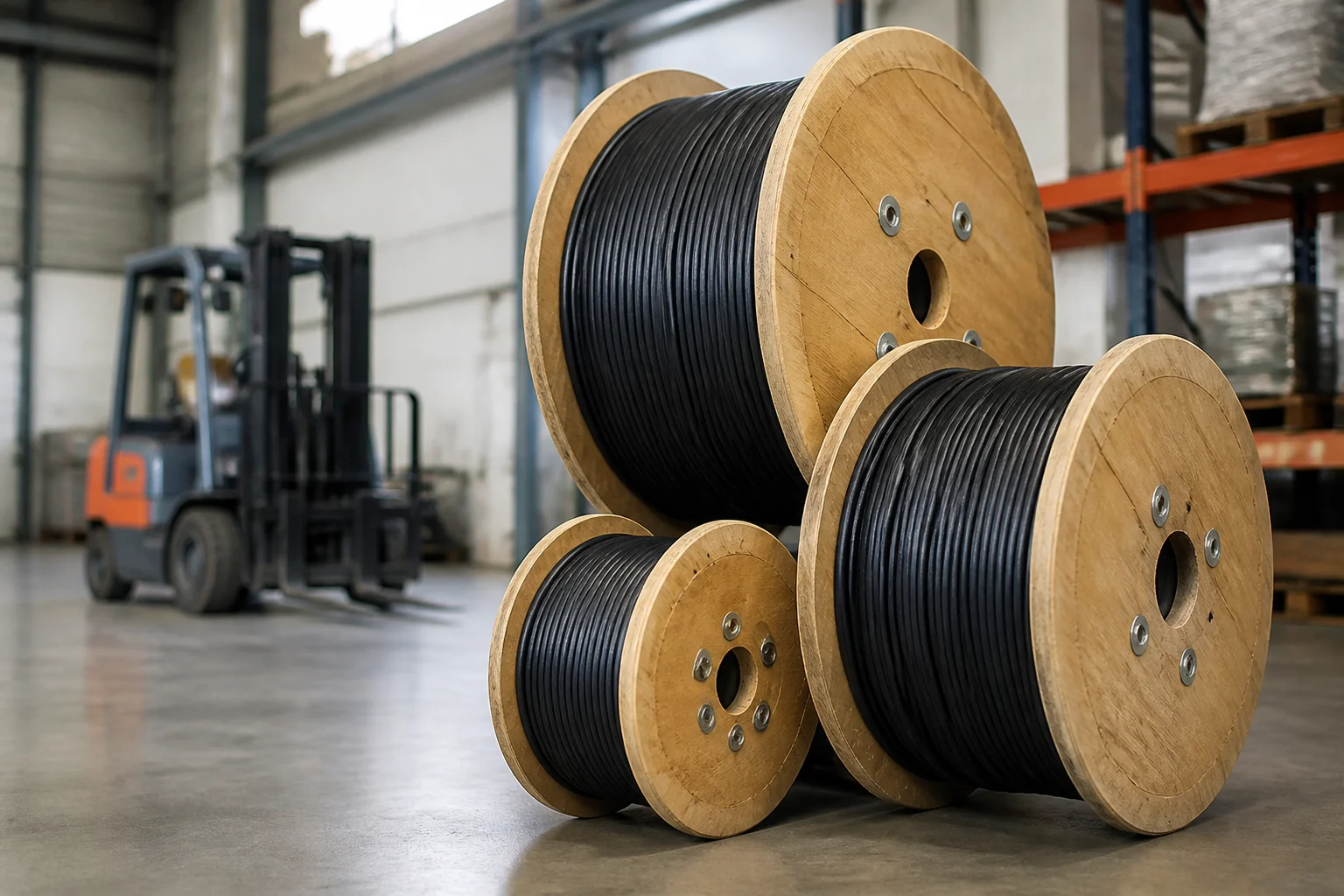
PoE has changed what buyers should ask a cable supplier. A decade ago the question was whether a reel met Cat6 limits at 100 m. Today the same reel may be feeding access points, cameras, LED luminaires or small compute nodes at 60 W or 90 W per port, in bundles of 24 or 48 cables, inside a ceiling void that reaches 40 degrees C in summer. The cable still has to pass Cat6, but the commercial risk sits in conductor resistance and heat, and that is where supplier selection separates.
What PoE Changes in an STP Cat6 Purchase
Power over Ethernet sends DC along the same copper that carries data. The cable does not care about the protocol, only about resistance and temperature. Higher power means higher current, and higher current means more voltage drop over the run and more heat dissipated in the bundle. At 802.3af levels, almost any compliant Cat6 works. At 802.3bt Type 4, conductor gauge, resistance unbalance between pairs and the thermal behaviour of the bundle become the deciding factors.
Shielding adds a specific consideration. The foil and braid are not current-carrying conductors in a PoE circuit, and the shield should be bonded to ground at both ends through the jack and panel. A supplier who cannot explain the grounding path is a supplier who has not thought about shielded PoE installations, which is a useful filter before the technical discussion even starts.
PoE Types and What They Ask of the Cable
The table summarises the four standard power levels and the cable evidence that should accompany each. Figures are the standard port budgets, not measured values from any supplier.
| PoE type | PSE / PD power per port | Cable property that matters most | Bundle sizes to review | Evidence to request |
|---|---|---|---|---|
| 802.3af (Type 1) | 15.4 W / 12.95 W | Basic Cat6 compliance, 23 AWG | 24-48 cables | Channel test to 250 MHz, conductor diameter |
| 802.3at (Type 2) | 30 W / 25.5 W | DC resistance and resistance unbalance | 24-48 cables | Resistance values per pair, unbalance figure |
| 802.3bt Type 3 | 60 W / 51 W | AWG 23 minimum, jacket temperature rise | 12-24 cables | Bundle thermal statement, four-pair test data |
| 802.3bt Type 4 | 90 W / 71.3 W | AWG 22-23, connector and jack current rating | 6-12 cables | Derating table, jack rating, cable tray guidance |
Read the bundle column carefully. The same cable that performs cleanly at 802.3at in a 48-cable bundle may need to be split into two smaller bundles at Type 4, or installed with spacing in the tray. That is an installation decision, but it is a purchasing decision too, because a supplier who provides a derating table lets you plan containment before the cable arrives rather than after the first warm bundle is discovered.
Bundle Heating and Derating: What to Ask Suppliers
Heat in a bundle comes from cumulative current in adjacent conductors, and it is worse where cables are tightly bundled, in insulated voids, or in conduit with no airflow. Standards bodies publish bundle ampacity guidance, and reputable cable makers translate that into a table for their constructions. Ask for it in writing, with the assumptions stated: ambient temperature, number of cables, installation method and whether the figure assumes free air or conduit.
A vague answer is a warning. Suppliers who reply that PoE is fine because the cable is Cat6 have not engaged with the question, and their confidence will not survive a site where 40 cables run through a sealed riser. The stronger suppliers will ask you about bundle size, ambient temperature and the PoE type before quoting, which is exactly the behaviour you want in a partner.
Indicative Price Bands for PoE-Intended STP Cat6
PoE capability is not a separate product category with a certification surcharge. In practice, cable intended for higher PoE levels is priced by construction: F/UTP 23 AWG solid copper in PVC sits around USD 0.32-0.58 per meter FOB, S/FTP adds roughly 25-40 percent, and LSZH adds a further 10-20 percent. An offer significantly below that band usually means copper-coated aluminium, a lighter gauge, or a reduced foil and braid specification, all of which raise resistance and heat at exactly the wrong moment.
Volume changes the picture more than PoE type does. Orders above 10 km per construction move into factory scheduling with better pricing and 15-30 days production, while smaller orders are usually filled from stock at 3-7 days and a higher per-meter cost. Buyers who need several PoE SKUs should consolidate them in one order to reach the production minimum rather than paying stock premiums on each line separately.
Three Buyer Scenarios
- Data centre or campus adding Wi-Fi 6E access points. Loads are typically 802.3at or Type 3, bundles are large and cable trays are crowded. Require a derating table and 23 AWG solid copper, and confirm the jack and panel are rated for the per-port current with shielded termination.
- Industrial site powering cameras and sensors. Runs are often long and electrically noisy, so S/FTP is common and shield bonding at both ends matters. Ask for resistance unbalance data and a bundle statement that reflects a plant ambient temperature rather than an office one.
- Smart building integrator with LED lighting on Type 4. At 90 W per port, conductor gauge and connector rating dominate. A supplier who can show a Type 4 derating table and a jack rated for the current is worth a price premium over one who cannot.
How to Verify a PoE-Capable Supplier
Verification here is a mix of documents and one physical test that most buyers skip.
- Request the construction datasheet with conductor diameter, DC resistance per unit length and resistance unbalance between pairs.
- Ask for a bundle derating statement naming ambient temperature, cable count and installation method.
- Confirm the conductor is solid bare copper, not copper-clad aluminium, and check the jacket print for gauge and construction.
- Test a sample reel with a Fluke DSX-8000 using shielded adapters, and keep the native file with the lot number attached.
- Run a resistance measurement on a known length and compare it against the datasheet value to detect a gauge substitution.
- Confirm the connector and jack current rating for the PoE type you are deploying, and check that shielded termination is available for that hardware.
- Book pre-shipment inspection covering reel count, lot labels and random shield continuity checks.
Documentation and Test Evidence
The document set for a PoE order is only slightly larger than for a standard shielded Cat6 order, but the extra items carry weight: resistance and unbalance values, a bundle thermal statement, and confirmation of the metal in the conductor. Add the usual construction datasheet with a sweep to 250 MHz, the shield construction drawing, RoHS and REACH declarations, and a channel test report tied to a lot number.
Where a project has a commissioning test regime, ask the supplier whether they will support a dispute on a failed bundle with a replacement commitment. Suppliers confident in their derating data will usually accept a clause tied to a documented test; resellers who cannot produce the data will negotiate around it. For larger installations, our guide to STP Cat6 data centre suppliers covers the bundle and pathway questions that come up in dense patching areas, while STP Cat6 industrial suppliers addresses EMI-heavy environments where shielding and PoE combine.
Supplier Selection Shortlist Criteria
A shortlist of three suppliers is usually enough if each is scored on the same five points: documented conductor and resistance data, a written bundle derating statement, a channel test report with shielded adapters and a lot number, a factory audit or verifiable plant, and a stated lead time that distinguishes stock from production. Price enters as the last filter, not the first, because the spread between a compliant and a marginal reel is smaller than the cost of replacing a bundle after commissioning.
Finally, confirm that the supplier understands your bundle plan. A supplier who asks how many cables share a tray and what the ambient temperature is has the experience to flag a derating issue before shipment. One who quotes by the meter and asks nothing is selling copper, not a PoE solution. Price benchmarks by construction are set out in STP Cat6 price per meter if you need a reference before the shortlist conversations start.
FAQ
1. Does STP Cat6 support PoE better than UTP?
Not in power terms; both carry the same current on the same copper. STP is chosen where EMI is a problem, such as industrial drives or imaging rooms, and the shield must be bonded at both ends. PoE performance depends on conductor gauge and resistance, not on shielding.
2. What AWG should PoE Cat6 use?
23 AWG solid bare copper is the practical standard for Cat6 PoE. At 802.3bt Type 4, 22 AWG reduces voltage drop and heat, while 24 AWG increases both and should be treated as a cost-reduced product rather than an equivalent. Confirm gauge on the jacket print and in the datasheet.
3. How many PoE cables can share a bundle?
It depends on the PoE type, ambient temperature and installation method. Above 802.3at, many designs limit bundles to 12-24 cables or require spacing, and Type 4 installations often work with 6-12. Ask the supplier for a written derating table rather than relying on a rule of thumb.
4. Is there a price premium for PoE-rated STP Cat6?
Usually not as a separate category. Price follows construction: F/UTP 23 AWG solid copper runs roughly USD 0.32-0.58 per meter FOB, with S/FTP and LSZH higher. Offers far below that band often indicate copper-clad aluminium or a lighter gauge, which is the wrong trade for PoE.
5. What evidence should a PoE cable supplier provide?
Conductor diameter and DC resistance per unit length, resistance unbalance between pairs, a bundle derating statement with stated assumptions, a 250 MHz channel report from a Fluke DSX with shielded adapters and a lot number, plus RoHS and REACH declarations. Missing resistance data is the most common gap.