
Vietnam has become a genuine alternative for buyers who want shielded Cat6 outside China without paying European prices. Northern industrial parks near Hanoi handle most export-oriented cable work, while southern plants around Ho Chi Minh City serve both domestic construction and regional export. The capability is real, but it is younger than the Chinese clusters, and material dependency shapes what a plant can promise. This guide profiles the five factory types worth visiting and the checks that decide whether a quote is deliverable.
Quick answer:
Direct answer: prioritise foreign-invested plants in Bac Ninh and Hai Phong for export documentation, then Dong Nai and Binh Duong plants for volume F/UTP. Expect 100 to 185 USD per 305 m at 5 to 10 km, with 20 to 35 days of production. The caveat: foil, braid wire and LSZH compound are largely imported, so confirm material lead time separately from cable lead time.
Top 5 STP Cat6 Factories in Vietnam
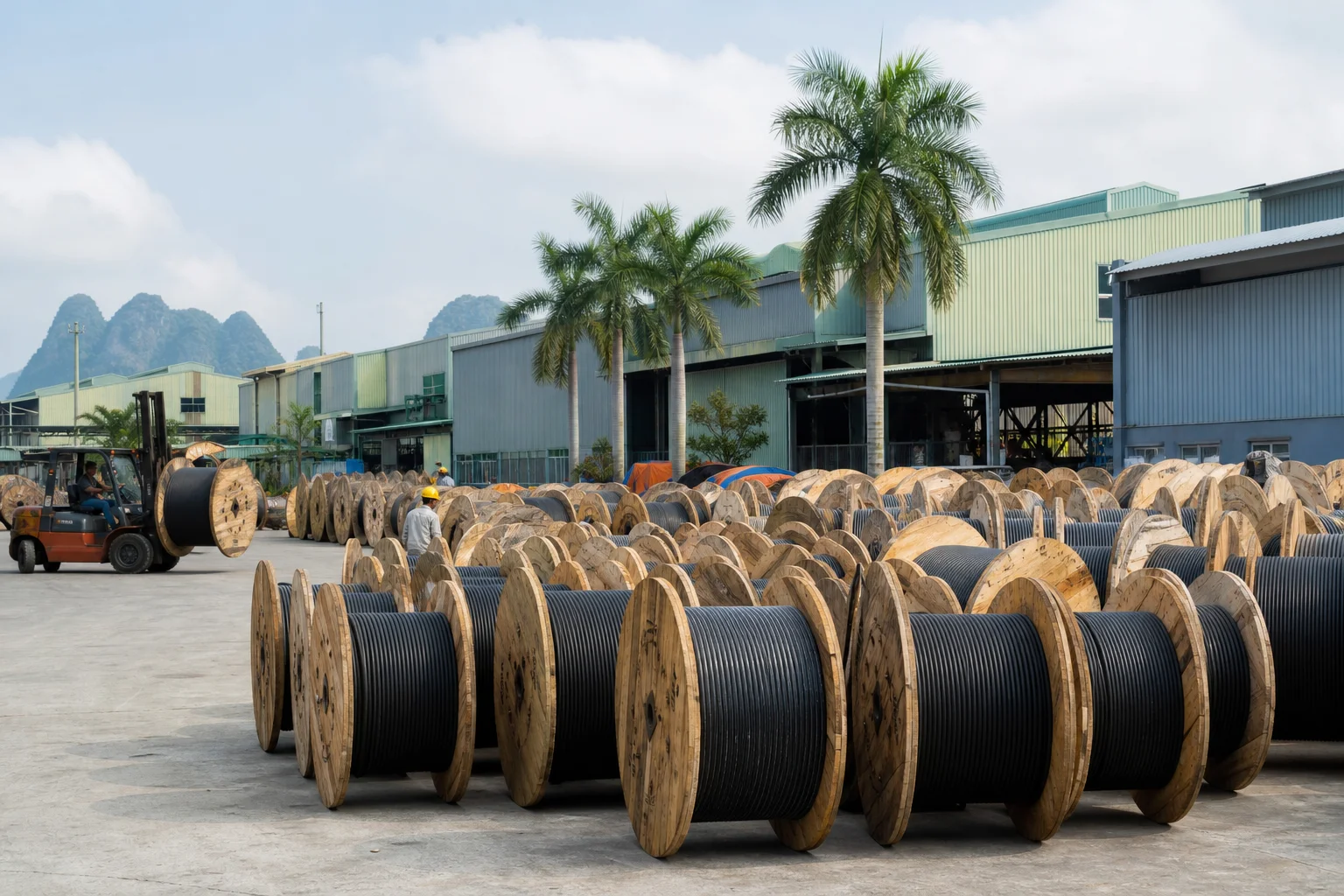
Vietnam has become a genuine alternative for buyers who want shielded Cat6 outside China without paying European prices. Northern industrial parks near Hanoi handle most export-oriented cable work, while southern plants around Ho Chi Minh City serve both domestic construction and regional export. The capability is real, but it is younger than the Chinese clusters, and material dependency shapes what a plant can promise. This guide profiles the five factory types worth visiting and the checks that decide whether a quote is deliverable.
Why buyers are looking at Vietnam at all
Three forces moved Vietnam onto sourcing shortlists. Supply diversification programmes at distributor level made a second Asian origin commercially desirable. Tariff treatment into the EU under the trade agreement between Vietnam and the EU changed the landed-cost calculation for European buyers. And a wave of foreign-invested cable and electronics plants brought extrusion, braiding and testing capability into industrial parks that already had reliable power and port access.
The result is not a copy of the Chinese cluster. Vietnamese plants tend to be newer, better laid out and more likely to be managed to a single customer’s specification, which suits buyers who need consistency. What they lack is depth in raw materials: the foil, braid wire, LSZH compound and even some copper rod come from outside the country, and that dependency is the single most important thing to understand before signing.
The five factory profiles
| Factory profile | Region | Realistic MOQ | Production lead time | Indicative FOB per 305 m (USD) | Best fit |
|---|---|---|---|---|---|
| Foreign-invested LAN cable plant | Bac Ninh and Bac Giang | 5 – 10 km | 20 – 30 days | 110 – 185 | Export documentation and consistency |
| Port-adjacent export plant | Hai Phong | 10 – 20 km | 25 – 35 days | 100 – 170 | Container volume with short inland haul |
| Industrial park cable manufacturer | Dong Nai and Binh Duong | 5 – 15 km | 22 – 32 days | 105 – 175 | F/UTP volume and PVC constructions |
| Southern specialist with braiding | Ho Chi Minh City | 3 – 8 km | 20 – 30 days | 120 – 190 | S/FTP with tighter braid coverage |
| Small converter and assembler | Da Nang and central provinces | 1 – 3 km | 15 – 25 days | 125 – 195 | Short runs and private-label packing |
Read the table as a map of capability rather than a price list. The northern plants were largely built to serve export customers and carry the documentation habits those customers demand. The southern plants grew out of domestic construction supply, which means strong volume capability in PVC constructions and thinner experience with LSZH and CPR-class work.
Profile 1 and 2: the northern export plants
Bac Ninh and Bac Giang host the densest concentration of foreign-invested cable and electronics manufacturing in the country, with plants that were designed around export orders from the start. Buyers here usually find a complete technical file: frequency sweep to 250 MHz, shield construction drawing, RoHS and REACH declarations, and a lot traceability format that survives an audit. English-language documentation is normal rather than exceptional.
Hai Phong plants sit close to the port, which removes a day or two of inland haulage and, more importantly, removes the risk of a truck missing a vessel. For container-scale orders of 10 km or more, that proximity is worth a small price premium. Ask whether the plant loads at its own dock or trucks to a consolidation yard, because the answer affects both cost and damage risk on heavy drums.
Profile 3, 4 and 5: southern volume and smaller runs
Dong Nai and Binh Duong form the southern manufacturing belt, and the cable plants there are comfortable with PVC F/UTP at volume. They are price-competitive with Chinese second-tier plants and considerably better organised on delivery scheduling than small Chinese workshops. LSZH remains the weak point: compound availability is limited and often imported, so a large LSZH order can stall on material rather than on machine time.
The Ho Chi Minh City specialists who own braiding equipment are the best option for S/FTP in Vietnam. There are fewer of them, so capacity tightens quickly in the second half of the year, and a buyer planning a Q4 delivery should book a slot by mid-year. Central Vietnam converters in Da Nang handle small private-label runs competently but generally buy core cable rather than producing it, so the plant behind the brand still needs approval.
A buyer question: is Vietnam actually cheaper than China?
On FOB, usually not. Vietnamese quoted ranges overlap Chinese ranges closely, and for high-coverage S/FTP the Chinese clusters are often five to ten percent cheaper because material supply is local and braiding capacity is abundant. Vietnam wins on landed cost in specific situations: EU destinations where the trade agreement reduces duty, buyers who need a second origin for supply-security reasons, and orders where a shorter ocean transit to Europe matters.
The honest comparison includes material risk. A Vietnamese plant importing foil and braid wire carries a longer critical path than its machine schedule suggests, and that risk surfaces as a delay rather than a price. Ask for the material on-hand quantity for your construction, not just the production slot.
Verification before the first container
Run this sequence in order and keep the records with the supplier file:
- Confirm the investment licence and business registration cover cable manufacturing at the address you will visit.
- Ask which shielding materials are imported and what quantity is on hand for your construction.
- Inspect the braiding line and foil applicator, and check braid coverage against the datasheet claim.
- Take a production sample and test it on a Fluke DSX-8000 or DSX-5000 with shielded channel adapters.
- Verify shield continuity and drain-wire bond resistance end to end, then repeat after a pull test.
- Collect RoHS and REACH declarations and the frequency sweep to 250 MHz, confirming the construction is named.
- For EU-bound goods, confirm whether a CPR reaction-to-fire declaration exists, and budget third-party testing if not.
- Book a pre-shipment inspection covering reel count, measured length, jacket print and a random electrical check.
Three buyer scenarios
- The European distributor adding a second origin. Needs 12 km of S/FTP LSZH with documentation a consultant will accept. The northern foreign-invested plants are the only realistic shortlist, and the qualification should include an independent test house because local CPR experience is thin.
- The contractor buying for a domestic Vietnamese project. Needs 4 km of F/UTP quickly at a competitive price. A southern industrial park plant delivers in three weeks, and the buyer should focus on copper weight and measured length rather than export paperwork that the project does not require.
- The brand testing a small private-label run. Needs 2 km of F/UTP with printed cartons. A central Vietnam converter will take the order at low volume, but the buyer must approve the underlying cable plant and test the actual reels rather than a sample from a different lot.
Getting the commercial terms right
Vietnamese suppliers generally quote FOB Hai Phong or Cat Lai, with payment by deposit and balance against documents. Two clauses are worth negotiating before the first order. The first is a material-sourcing clause that names the foil and braid specification, so a substitution cannot be made quietly when supply is tight. The second is a length tolerance clause tied to a measured sample at inspection, because reel-length shortfalls are the most common silent cost in this category.
Shipping schedules deserve attention too. Direct sailings from Hai Phong to Northern Europe are less frequent than from Chinese hubs, so transhipment is common and adds transit variability. Buyers planning a fixed installation date should add a week compared with an equivalent Chinese booking, and should confirm the routing rather than accepting a generic transit time.
Compare the resulting offer against STP Cat6 lead times from Asia before you commit to a date, and set volume expectations with the STP Cat6 MOQ guide. If Vietnam turns out to be a second source rather than a replacement, run the manufacturer verification routine on both plants and keep the test files for each.
FAQ
1. Can Vietnamese factories produce S/FTP Cat6 or only F/UTP?
Both, but the capability is concentrated. F/UTP is widely available across the northern and southern belts. S/FTP requires braiding machines with consistent tension, and only a limited number of plants own them, mostly in Bac Ninh, Hai Phong and Ho Chi Minh City. Confirm the braider exists on the line that will run your order rather than elsewhere in the group.
2. What is a realistic MOQ for STP Cat6 from Vietnam?
Expect 5 to 10 km per construction from export-oriented plants, 10 to 20 km at port-adjacent volume plants, and 1 to 3 km from smaller converters. Custom jacket print and packaging usually sits at the upper end of those bands. Below 1 km, buying from stock elsewhere is more practical than opening a production order.
3. Is Vietnam subject to the same anti-dumping exposure as China?
Not for LAN cable in the same way, which is one reason buyers moved. Duty treatment depends on origin rules, and a product assembled in Vietnam from imported core may not qualify for preferential origin. If duty savings are part of your business case, ask the supplier for the origin documentation and confirm the rules with a customs broker before ordering.
4. How long does shipping take from Vietnam to Europe or the US?
Typically 30 to 40 days from Hai Phong or Cat Lai to Northern European ports, with transhipment common, and 25 to 35 days to US West Coast ports. Add one week of buffer compared with a Chinese booking because direct sailings are less frequent. Production of 20 to 35 days sits in front of that, so plan eight to twelve weeks door to door.
5. Do Vietnamese plants provide CPR declarations for EU construction work?
Seldom, because domestic demand does not require it. Most export plants hold RoHS and REACH declarations and a 250 MHz sweep, but a reaction-to-fire classification is usually absent. If your customer needs a declared class, arrange testing with an accepted laboratory and add four to six weeks to the qualification schedule rather than assuming the plant can supply it.