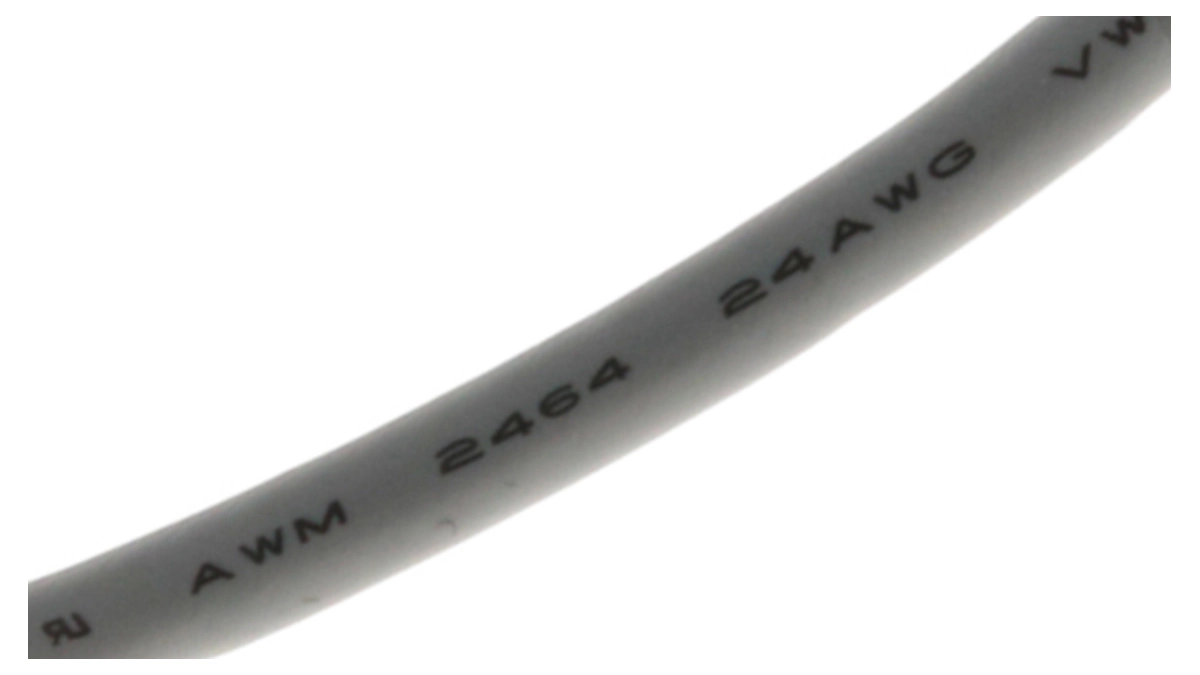
Quick answer: Speaker cables red and black are one pair with two identities, and the colours exist so you can repeat the same connection at both ends. Red is a convention, not a voltage. Polarity goes wrong when one conductor is swapped relative to the other, so the rule is simple: whatever colour leaves the red or positive terminal must arrive at the positive terminal of the speaker.
Half of all polarity problems start with a sensible decision: the installer runs one reel to both speakers, cuts it at the wall, and loses track of which strand went where. The amplifier end looks correct. The speaker end was assembled from memory. The result is a stereo image that seems to lean, or bass that never quite arrives. Nothing failed. A colour simply stopped being read.

What the two colours are actually for
Twin cable carries the outgoing and returning current on two insulated conductors inside one jacket. The colours give each conductor a name you can follow through a long run. That is their entire function. They do not indicate voltage, they do not indicate which conductor is electrically superior, and they carry no signal of their own.
Polarity is a relationship, not an absolute
One channel reversed
If a single speaker is wired with its pair swapped, that channel moves in the opposite direction to the other one at the same instant. Low frequencies from the two cabinets then partly cancel in the room. This is the case people notice, and it usually gets described as weak bass or a vague centre image.
Both channels reversed
Swap both speakers the same way and the system stays consistent with itself, because both cones still move together. The relationship between channels is intact, so the audible result is normal. This is why the technical rule is about consistency at both ends rather than about which colour touches which binding post.
Where the marking disappears mid run
Printed stripes fade, molded ribs become hard to feel through a glove, and translucent jackets make both conductors look identical under a work light. On long pulls the marking matters most at the two ends, so leave a service loop with extra slack and mark both conductors with tape before the cable goes into a wall. A continuity check with a meter settles any doubt faster than guesswork.
What the colours do not guarantee
A red and black pair tells you nothing about gauge, conductor metal or jacket rating. Two reels can share the same colour scheme and differ completely in resistance per metre. Colour also fails as a standard across products: some cables use a stripe rather than a solid red, some use a rib on the negative side, and a few use two identical conductors with only a faint print. Reading the jacket is the only reliable approach.
| Cable type | Conductor marking | Where it fails | How to confirm |
|---|
| Twin zip, red and black | Solid colour on each | Jacket peels back past the colour | Tape both ends before the pull |
| Clear jacket, one stripe | Printed line on one side | Print rubs off in a conduit | Meter check, end to end |
| Figure eight, molded rib | Rib on the negative leg | Rib hard to feel at low light | Compare both ends side by side |
| Four conductor | Two colours plus two stripes | Pairs mixed between channels | Label each pair at the cut |
Practical scenarios
- Cable cut from a bulk reel: Both halves lose their factory end markings, so label each conductor the moment the cut is made.
- Speaker terminals hidden behind a cabinet: Photograph the terminal block before pushing the cabinet back, since the colours will be the only reference next time.
- Repair after a moved room: Reversed polarity often appears after a move, when cables are reconnected from memory rather than from labels.
- Four conductor cable split into two pairs: Decide which pair is positive before stripping, or the two channels will disagree with each other.
FAQ
Does red have to go to the positive terminal?
By convention yes, and following it keeps the system predictable. Electrically what matters is that the same conductor reaches the same polarity at both ends of that channel.
How can I test polarity without tools?
A small battery touched across the cable at one end makes the cone move one way or the other, which shows the direction of the pair. A meter on continuity is quicker and safer.
Can wrong polarity damage a speaker?
No. Swapping the pair only changes the direction of cone travel relative to the other channel, so the risk is acoustic cancellation rather than damage.
Next step
If your run needs four conductors or a split pair, read up before ordering: bi-wiring speaker cable explains the two pair layout, 12 4 speaker cable covers the heavier version, and 16 4 speaker wire suits shorter routes.
See the matching cables and adapters