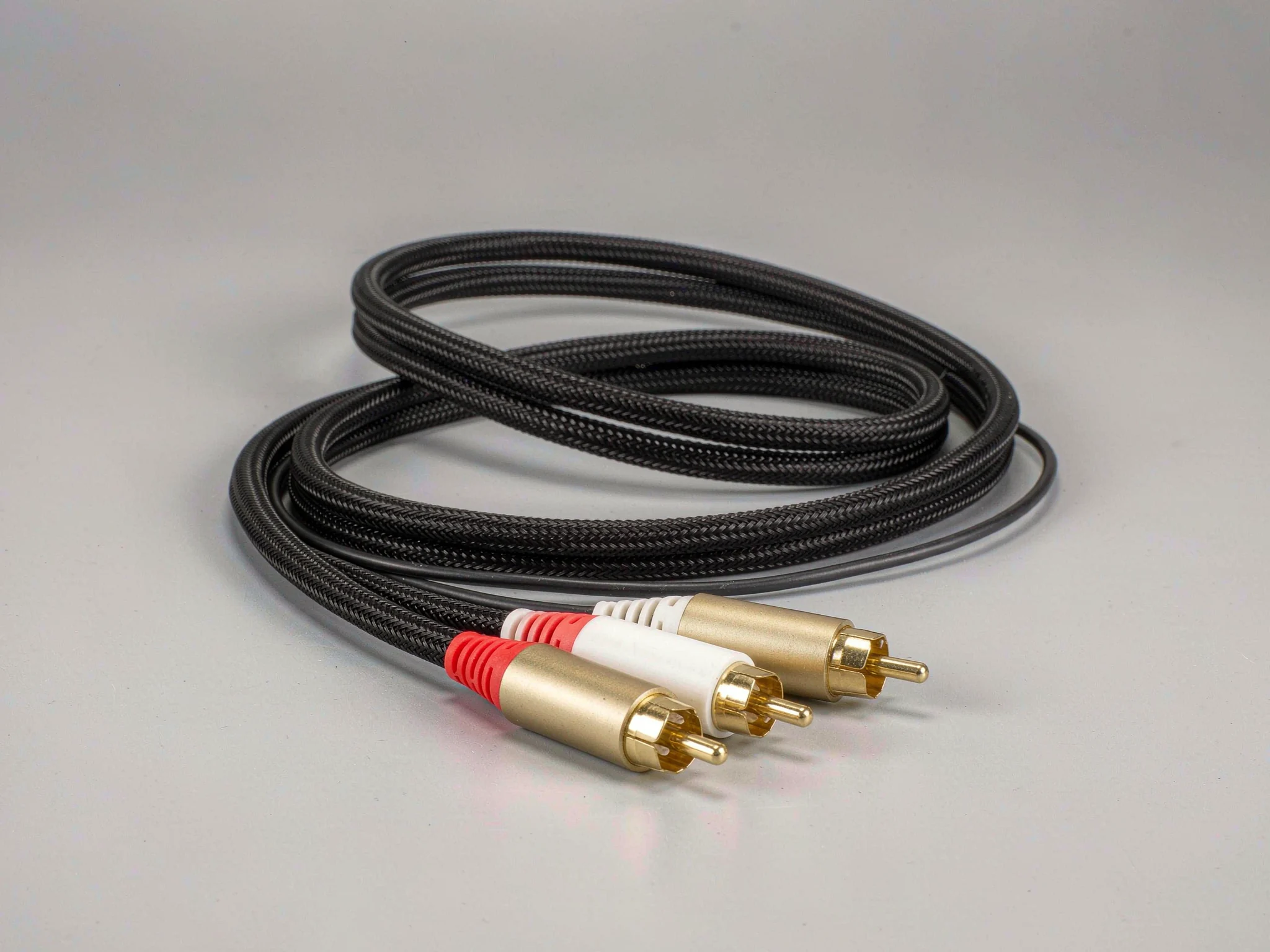
Quick answer: A speaker cable adapter is safe at speaker level when both of its contacts are solid metal and sized for the current. Banana to spade, quarter inch to banana, and locking plug to screw terminal all qualify. RCA to bare wire does not, because the centre pin is slim and the outer contact is a thin shield. When in doubt, trace the current path before plugging in.
The wall plate has spring terminals, the cable ends in banana plugs, and a small adapter from a parts drawer seems to solve it. Sometimes it does. Other times the adapter is a signal part with a hair thin centre pin, and it becomes the hottest, least reliable joint in the chain. The plug shapes look interchangeable; the metal behind them is not.

What makes an adapter safe at speaker level
Speaker level means several amps of current changing direction many times a second. An adapter has to carry that through both of its contacts without heating. Two solid, broad contacts can do it. A single slim pin and a foil shield cannot, no matter how well the plug fits.
Trace the current path
Follow the metal from the first connector to the second. If either side narrows to a pin, a spring wire or a braided screen, the adapter is a signal part. If both sides are plates or tubes of similar size, it is a speaker part.
Adapters that pass the test
These are the shapes that keep a wide path from end to end. Each still has to be tight, clean and mechanically supported.
| Adapter | What it joins | Current path | Safe at speaker level | Note |
|---|
| Banana to spade | Banana jack to screw post | Solid barrel to flat lug | Yes | Check the spade fits the collar |
| Quarter inch to banana | Jack socket to banana jack | Tip and sleeve to barrel and spring | Yes | Tip contact carries the whole signal |
| Locking plug to screw terminal | Panel socket to bare wire post | Two pins to two clamps | Yes | Match pin count to the socket |
| RCA to bare wire | Phono socket to speaker terminal | Centre pin plus thin shield | No | Signal level only, never speaker output |
Adapters that belong on signal only
RCA, 3.5 mm and other small connectors are built for a volt or two at almost no current. Their contact area is a fraction of a banana plug, and the return path is often a shield braid rather than a conductor. They belong between a source and an amplifier input, not between an amplifier and a speaker.
Why a phono plug is not a speaker connector
The centre pin is the only wide metal in the plug, and the outer ring touches a foil or braid. Passing several amps through that joint heats it, and heat loosens it further.
The two extra joints
Every adapter adds two connections: cable to adapter and adapter to terminal. Each one has its own contact resistance and its own chance of working loose. On a short run at 8 ohm this is usually invisible. At 4 ohm, where the cable resistance is already a larger share of the load, a marginal adapter can make the difference between a solid channel and one that fades.
Length, gauge and the adapter share
Size the cable first, then treat the adapter as a fixed penalty. A long thin run with an adapter at each end stacks three resistances in series. Shortening the run or going up one gauge step does more for the channel than buying a heavier adapter.
Testing a new adapter before trusting it
Connect it, play at a normal level for half an hour, then touch the adapter body. It should be no warmer than the cable beside it. A joint that is noticeably warm is losing power, and it will not improve with age. Re seat it once, and if it warms again, replace it.
Practical scenarios
- Plate with spring clips: banana to spade at the plate, bare wire at the speaker, so the adapter never moves.
- Old cabinet with a quarter inch socket: quarter inch to banana adapter, cable tied to the cabinet handle for strain relief.
- Rack of small amplifiers: locking plug to screw terminal, one adapter per channel, labelled.
- Television to a soundbar: RCA to bare wire is acceptable here only because the soundbar input is signal level, not a speaker terminal.
FAQ
Can I use an RCA adapter on a speaker output?
No. The centre pin and shield are too small for speaker current and the joint will heat. Use it only on a line level input.
Do adapters reduce sound quality?
They add resistance and two joints. Whether that matters depends on the load and the length; a clean, tight adapter on a short run is not a problem.
Are adapters safe for a 4 ohm speaker?
They are safe if both contacts are solid, but the margin is smaller than at 8 ohm. Keep the run short and check the adapter temperature after an hour.
Next step
Work out which end of the chain needs adapting before you buy. A banana jack speaker cable removes one adapter entirely, the banana jack guide shows which plug fits a recessed post, and a spare banana connector is a better fix than stacking two adapters.
See the matching cables and adapters