
Snagless Patch Cable: Protecting the Latch
Quick answer / TL;DR: Short answer: choose snagless boots in dense patch fields, cabinets and anywhere cords are pulled through bundles – the hood stops the latch catching. At a desk, a standard moulded boot is easier to release and costs less. Either way, buy stranded cords with moulded plugs, and never use a cord as permanent cabling.
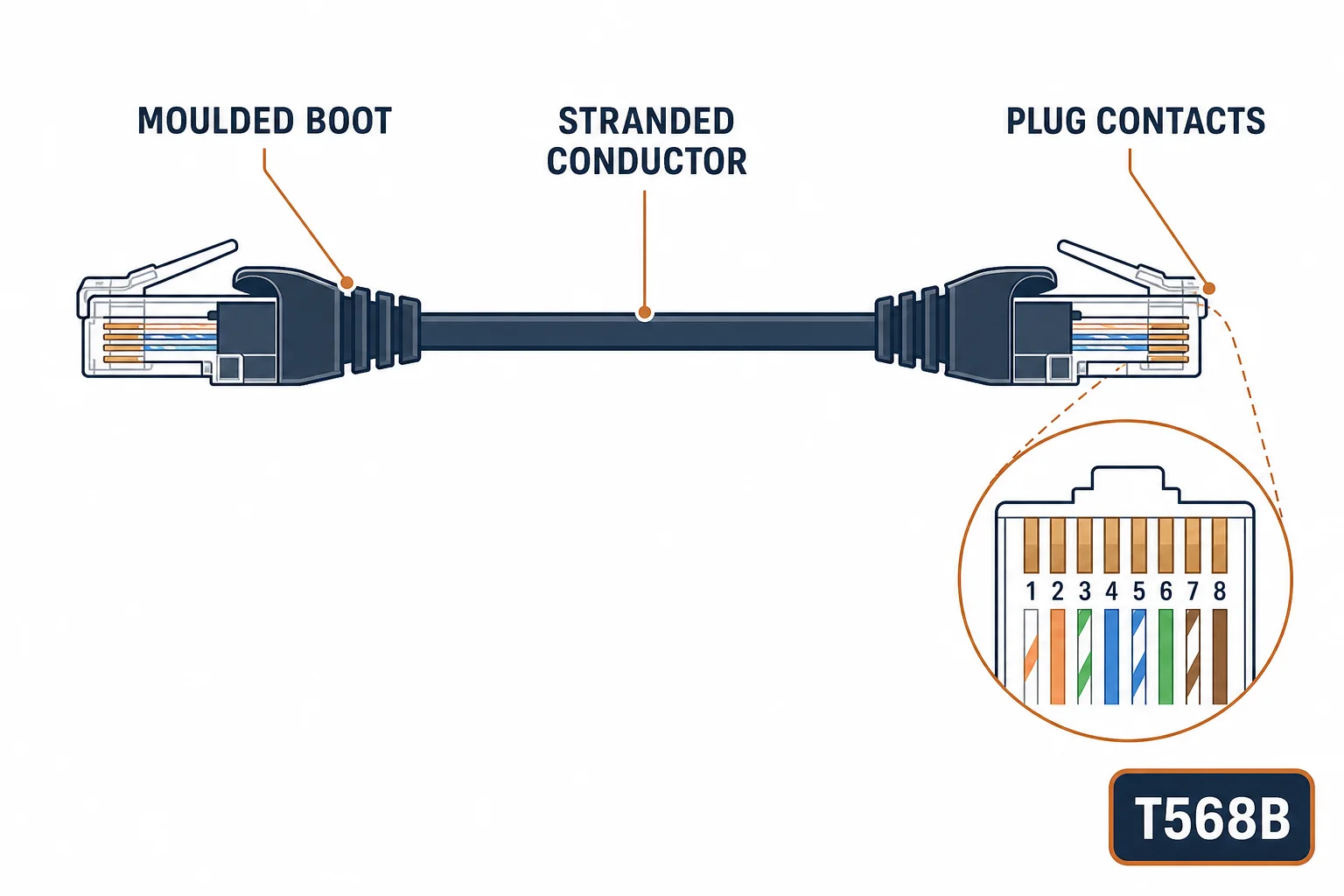
A snagless patch cable has a moulded hood over the release latch, so the clip cannot catch on an adjacent cord or a cable bundle when the lead is pulled. The part it protects is small, cheap and decisive: a snapped latch leaves a cord that will not stay seated and a port that looks faulty.
This is the boot guide: what the hood changes, where snagless earns its small premium, and the cases where a standard boot is the better choice.
What the Hood Changes
| The boot | The protection | The trade-off |
|---|---|---|
| Standard moulded | Strain relief only | Latch exposed to snagging |
| Snagless | Hood over the latch | Slightly harder to release |
| Slim | Reduced body | Less mechanical protection |
The hood is a mechanical guard: it does not change the electrical performance, only how long the plug survives handling.
Where Snagless Belongs
- Dense 48-port panels where cords touch each other
- Cabinets with cable managers and tight bends
- Leads pulled through bundles during changes
- Anywhere a cord is removed by tugging the cable rather than the plug
The pattern is handling density: the more cords are moved and the closer they sit, the more the hood earns its cost.
Where It Does Not
| The position | The boot |
|---|---|
| Desk to wall outlet | Standard moulded |
| Occasional equipment swap | Standard |
| Documented rack patching | Snagless |
| High-density panel | Snagless, short lengths |
At a desk the cord is released often and rarely dragged; the hood adds friction without adding life.
Standards and Verification
| The reference | The relevance |
|---|---|
| TIA-568.2-D | Cord requirements |
| IEC 60603-7 | The plug interface |
| Continuity test | Per cord on receipt |
Per-SKU boot dimensions are not provided in the knowledge base. The mechanical function is standard; confirm the boot type on the product rather than the listing title.
Real-World Applications
The dense panel
A 48-port panel patched with snagless cords in two lengths: three moves in a week and no broken latches – the hood doing the work the technician did not have time for.
The snapped clip
A standard cord dragged through a bundle: the latch snapped off and the link dropped whenever the cabinet door closed. Replaced with a snagless cord – the fault was mechanical, not electrical.
The desk friction
Snagless cords at every desk in a hot-desking office: users struggling to release them. Standard boots specified for desk positions – the hood kept where density needs it.
Related reading: The cord construction behind the boot — blogs/news/patch-cord-buying
Related reading: Choosing cord lengths for a cabinet — blogs/news/ethernet-patch-cable-line
Frequently Asked Questions
What is a snagless patch cable?
A cord with a moulded hood over the release latch so it cannot catch on adjacent cables.
Does snagless affect performance?
No – it is a mechanical guard. Electrical performance is set by the category.
Are snagless boots harder to remove?
Slightly, which is why they suit rack patching more than desk use.
Should every cord be snagless?
No – use them where density and handling demand it, and standard boots elsewhere.
Sourcing cables for a project, a store, or a private-label line? Contact our B2B sales team for specifications, certification evidence, and volume terms – FOB and CIF options available. Request a quote or sample.