
Single Mode Fiber Patch Cable: OS2 and the Budget
Quick answer / TL;DR: Short answer: specify OS2 single-mode cable (9/125 micron), the connector your ports use (LC is the data-centre default, SC in many PON plants), and the polish that matches the existing plant – UPC (blue) or APC (green), never mixed. Keep runs within the loss budget and clean every end-face before testing.
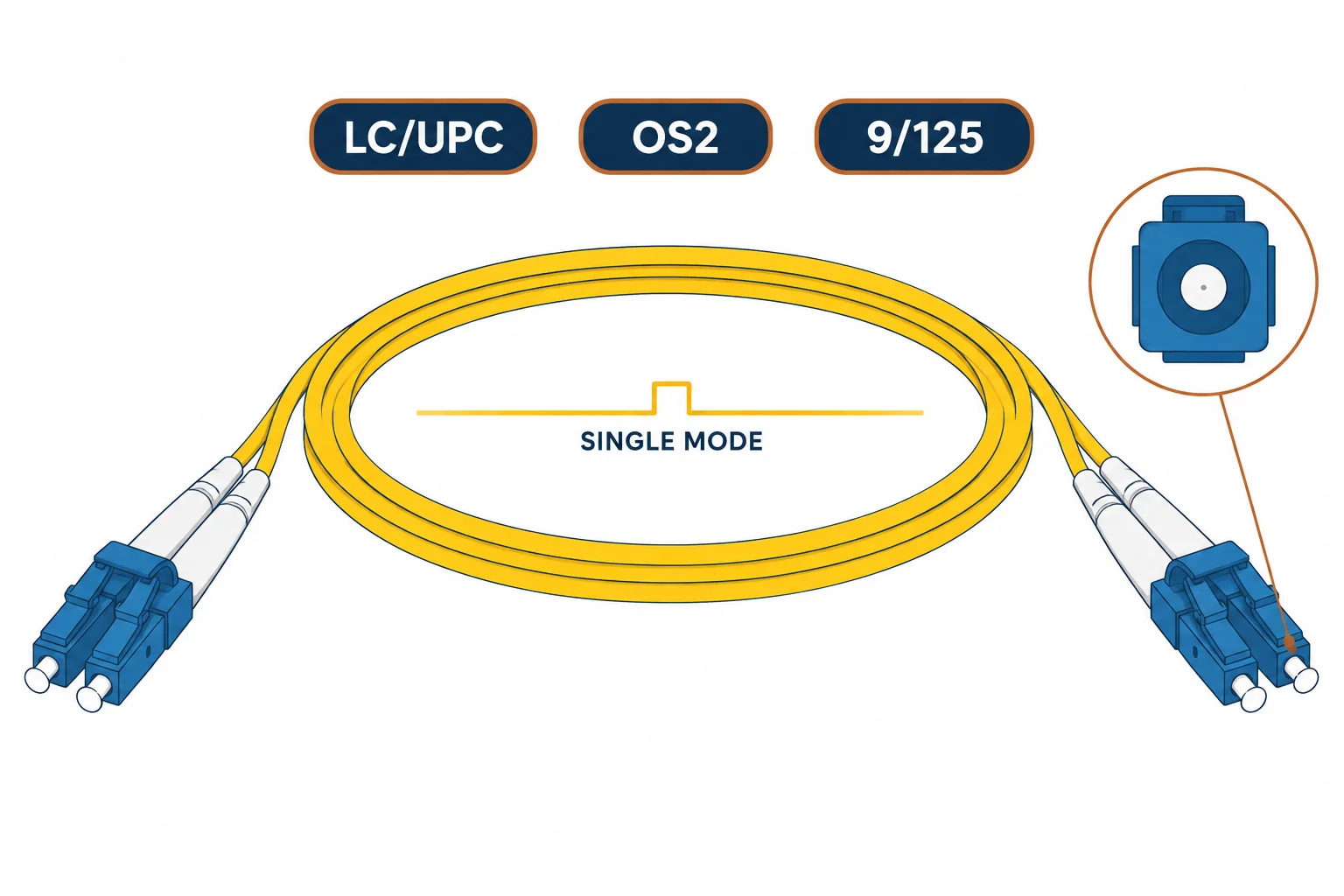
A single mode patch cable is the cheapest way to move a lot of data a long way, and the easiest to get wrong: the polish must match the plant, the connector must match the port, and the loss budget must be calculated rather than assumed. At single-mode distances there is usually margin – until a mismatched polish eats it.
This is the single-mode guide: OS2 construction, the connector and polish decisions, and the budget arithmetic that proves the link.
The Specification Lines
| The line | The options | The consequence |
|---|---|---|
| Fiber type | OS2 single-mode | Long reach, narrow core |
| Connector | LC, SC | Must match the port |
| Polish | UPC (blue), APC (green) | Mismatch loses signal |
| Length | Stock or custom | Tidiness versus lead time |
Four lines, and three of them are compatibility rather than performance – only the length is a free choice.
The Polish Rule
- UPC: flat end-face, typically blue boots and housings
- APC: angled end-face, typically green – lower reflection for PON and RF
- Never mate APC to UPC: the air gap costs loss and reflection
- Read the plant before ordering – the existing connectors set the rule
The polish rule is the single most common field error in fiber: the connectors mate, the light does not.
The Budget Arithmetic
| The element | The typical allowance |
|---|---|
| Connector pairs | A small loss per mated pair |
| Splice | A small loss per splice |
| Fiber loss | Per kilometre, from the datasheet |
| Margin | Keep a reserve for ageing and repairs |
Standards and Verification
| The reference | The relevance |
|---|---|
| ITU-T G.652 | Single-mode fiber characteristics |
| IEC 61300 | Connector test methods |
| TIA-568.3 | Fiber cabling practice |
| OTDR / power meter | The measurement that proves the link |
Per-SKU loss figures are not provided in the knowledge base. The budget method is standard; request test reports and measure the installed link.
Real-World Applications
The building link
Two buildings 400 m apart: OS2 LC/UPC patch cords at each end of the backbone – the loss budget comfortably met at that distance.
The PON drop
An FTTH drop on an APC plant: SC/APC cords with green housings throughout – the reflection budget respected.
The mixed-polish link
An APC cord mated to a UPC adaptor in a PON cabinet: the link loss climbing without any visible fault. The green-to-blue mismatch found – the cord replaced, the budget restored.
Related reading: The fiber cord supply lines? Read the patch cord suppliers guide — blogs/news/fiber-patch-cord-suppliers
Related reading: When fiber is the right answer over copper? Read the crossover guide — blogs/news/fiber-vs-copper-buying
Frequently Asked Questions
What is a single mode fiber patch cable?
A narrow-core (9/125) fiber cord for long-reach links, typically OS2 grade with LC or SC connectors.
UPC or APC – how do I choose?
Match the existing plant. APC (green) has lower reflection; mixing APC with UPC costs loss.
How far can single mode run?
Kilometres, limited by the optics and the loss budget rather than the fiber itself.
Do fiber cords need cleaning?
Yes – every end-face before mating. Contamination is the most common cause of a failed link.
Sourcing cables for a project, a store, or a private-label line? Contact our B2B sales team for specifications, certification evidence, and volume terms – FOB and CIF options available. Request a quote or sample.