
Shielded Cat6 Grounding: The Path to Earth
Quick answer / TL;DR: Short answer: ground shielded Cat6 by bonding the drain wire to the patch panel, bonding the panel to the rack, and ensuring the rack reaches the building's earth. Ground at one end to avoid ground loops, keep the path short and low-impedance, and verify continuity from the jack's shield to earth before the channel test.
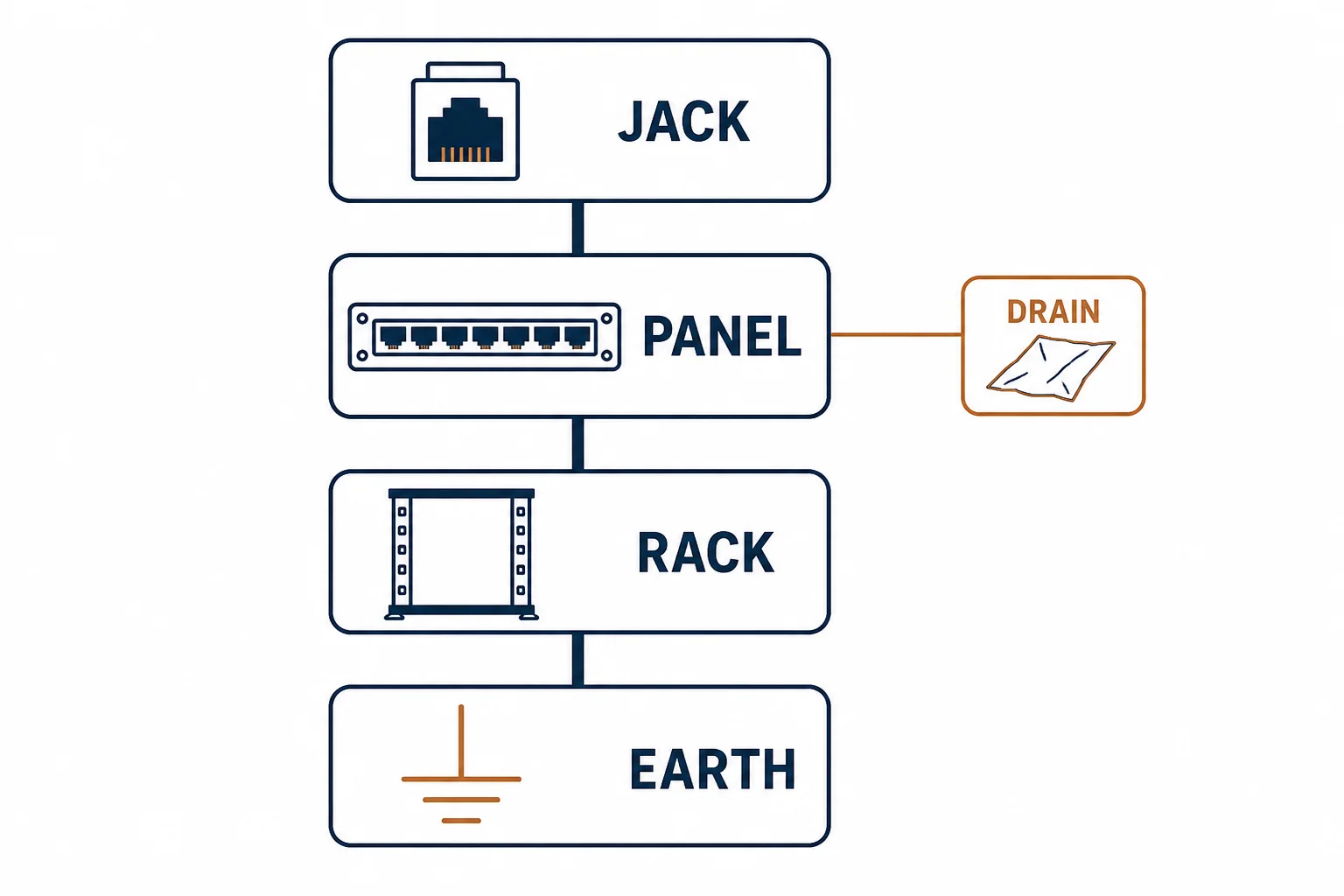
A shielded cable without grounding is a floating conductor – it collects noise and delivers none of the rejection the foil promises. Grounding is the completion step: the drain bonds at the panel, the panel bonds to the rack, and the rack reaches the building's earth. This guide walks the path and the checks.
This is the grounding guide: the chain, the single-point principle, and the tests that prove it.
The Grounding Chain
| The link | The connection |
|---|---|
| Drain wire | Bonded to the panel's shield bar or the jack's shell |
| Jack | Shielded jack bonds to the panel |
| Panel | Bonded to the rack frame |
| Rack | Bonded to the building's earthing point |
The chain is only as good as its weakest link: a bonded panel on an unbonded rack leaves the shield floating at the far end.
The Single-Point Principle
- Bond at one end where the design allows – multiple bonds invite ground loops
- Where both ends are bonded, the building's equipotential bonding must be sound
- Keep the bond conductors short and thick – the impedance matters at high frequency
- Never use the cable's drain as a safety earth – it is a signal shield
The principle prevents the classic mistake: an enthusiastic installer bonding everywhere and creating a loop that hums.
The Checks
| The check | The method |
|---|---|
| Drain to panel | Continuity at the termination |
| Panel to rack | Continuity across the bond |
| Rack to earth | Continuity to the earthing point |
| Loop check | No unintended second path |
Standards and Verification
| The reference | The relevance |
|---|---|
| TIA-568.2-D | Shielded cabling grounding practice |
| ISO/IEC 11801-1 | Screening and bonding requirements |
| Local electrical code | The earthing rules the building follows |
Per-site earthing arrangements are not provided in the knowledge base. The chain and the checks are standard; confirm the building's earthing with the site's electrical documentation.
Real-World Applications
The new comms room
A comms room fit-out: the panel bonded to the rack, the rack to the earth bar – the continuity recorded in the handover file.
The humming link
A link with both ends bonded into a loop: the hum traced to the second path – one bond removed, the noise gone.
The floating floor
A shielded install on an unbonded rack: the shield's benefit absent until the rack bond was added – the chain completed.
Related reading: The termination that starts the path? Read shielded termination — blogs/news/terminate-shielded-cat6
Related reading: The component chain? Read shielded system supply — blogs/news/shielded-system-supply
Frequently Asked Questions
Does shielded Cat6 need grounding?
Yes – the drain must bond to the panel and the path must reach earth. Without it the shield floats and delivers nothing.
Should shielded cable be grounded at both ends?
One end is the simpler default; both ends require sound equipotential bonding to avoid ground loops.
How do I test the grounding?
Continuity from the drain to the panel, panel to rack, and rack to earth – plus a check that no unintended loop exists.
Can the drain wire serve as a safety ground?
No – it is a signal shield conductor, not a protective earth. Safety earthing follows the electrical code.
Sourcing FTP (F/UTP) Cat6 for a project, a store, or a shielded system? Contact our B2B sales team for shield construction data, category reports, and volume terms – FOB and CIF options available. Request a quote or sample.