
Shielded Cable Next to Power: Separation First
Quick answer / TL;DR: Short answer: keep shielded data cable separated from power runs wherever possible – parallel runs at close spacing couple noise regardless of shielding, and many codes require separation. Shielding reduces what remains after separation; it does not license co-routing. Where crossing is unavoidable, cross at right angles and keep the parallel length short.
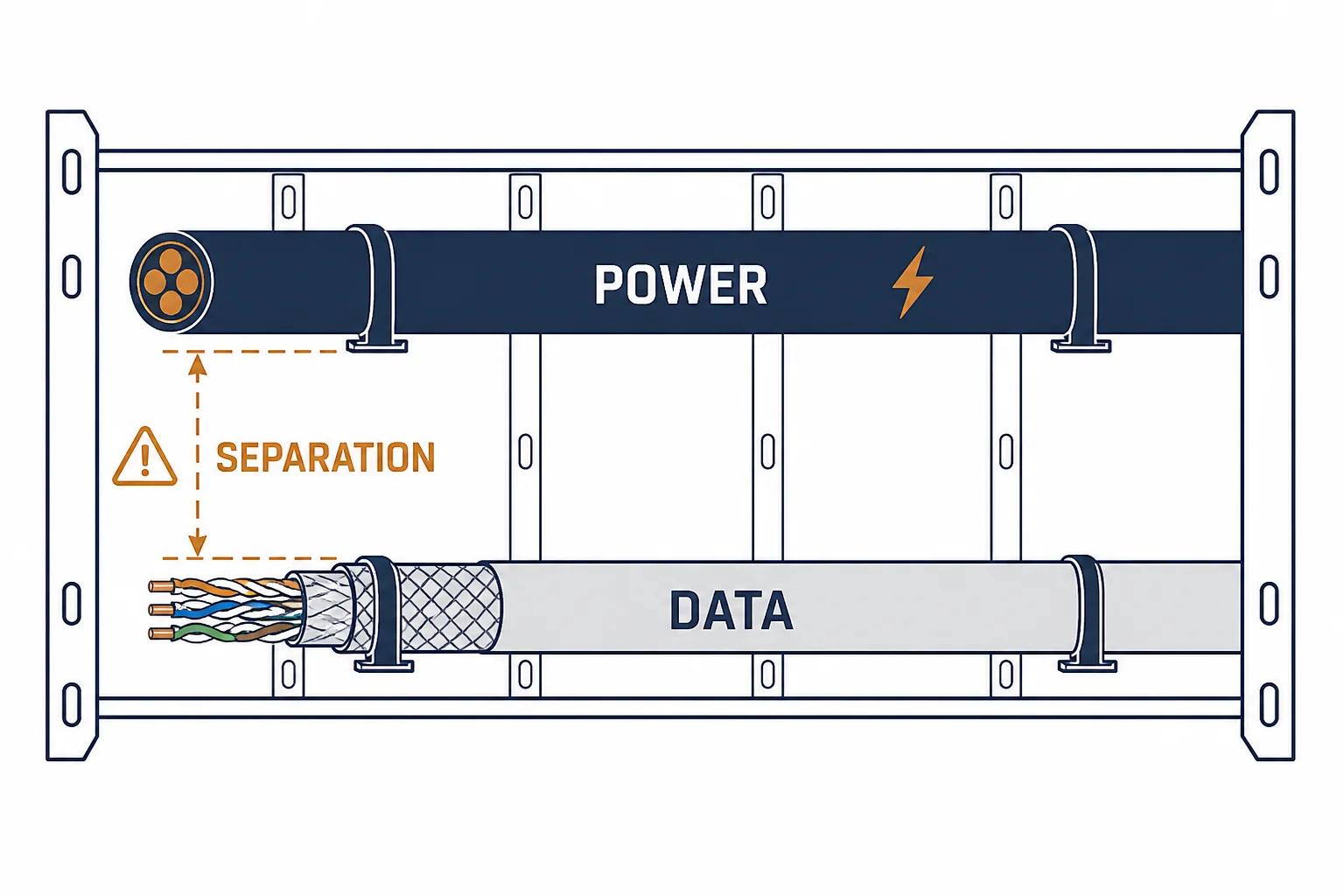
Running data cable beside power is a separation question before it is a shielding question: distance reduces coupling far more effectively than foil at close range, and codes often require separation regardless of the cable's construction. Shielding is the second line, not the first.
This is the shared-tray guide: the separation principle, what shielding adds, and the checks that keep a run quiet.
Why Separation Comes First
| The factor | The effect | The control |
|---|---|---|
| Distance | Coupling falls sharply with spacing | Separation per code |
| Parallel length | Longer parallel runs couple more | Shorten or cross at right angles |
| Shield | Reduces residual coupling | Bonded foil or braid |
| Power current | Higher current, stronger field | Route power away from data |
The table ranks the controls by effectiveness: distance first, geometry second, shielding third. Buying shielding to compensate for co-routing is the expensive order.
What the Shield Adds
- Rejection of the residual field that separation leaves
- Protection against external sources the route cannot avoid
- A grounding obligation – the drain bonds at the panel
- Nothing if the shield is not bonded
The shield's contribution is real but second-order: it cleans up the margin, not the main coupling.
The Installation Checks
| The check | The practice |
|---|---|
| Separation | Per code – commonly a few centimeters minimum in trays |
| Crossings | Right angles, short parallel sections |
| Tray dividers | A physical barrier where runs share a tray |
| Bonding | Drain grounded at the panel |
Standards and Verification
| The reference | The relevance |
|---|---|
| TIA-568.2-D | Separation and installation guidance |
| Local electrical code | The separation distances that apply |
| Shielded practice | Bonding requirements |
Per-market separation distances are not provided in the knowledge base. The principle is standard; confirm the distances in the local electrical code.
Real-World Applications
The shared tray
Data and power in one tray with a divider: the separation maintained, shielded cable for the residual – both controls in place.
The parallel run along a wall
A long parallel stretch beside a feeder: the run re-routed to cross at right angles – the coupling reduced before any cable was changed.
The shield-only fix
Co-routed shielded cable that still failed: separation added – the foil alone had not been enough.
Related reading: The identification checks in the field? Read the shielding check — blogs/news/shielded-cable-identification
Related reading: What the foil adds? Read the FTP primer — blogs/news/what-is-ftp-cat6
Frequently Asked Questions
Can shielded ethernet run next to power?
With separation, yes. Distance and geometry reduce coupling most; the shield handles the residual. Codes often require separation regardless of shielding.
How far should data cable be from power?
Local code sets the distance – commonly a few centimeters minimum in shared trays. Confirm the figure for the site.
Does shielding allow co-routing with power?
No – shielding reduces residual noise; it does not replace separation.
What about crossings?
Cross at right angles and keep parallel sections short – geometry matters as much as distance.
Sourcing FTP (F/UTP) Cat6 for a project, a store, or a shielded system? Contact our B2B sales team for shield construction data, category reports, and volume terms – FOB and CIF options available. Request a quote or sample.