
RJ45 Male and Female: Plug and Jack
Quick answer / TL;DR: Short answer: a male RJ45 is a plug on the end of a cable; a female RJ45 is a jack in a wall plate, patch panel or coupler. A male-to-male assembly is an ordinary patch cord, female-to-female is a coupler, and male-to-female adapters exist for tight spaces. Match the gender to what it must plug into – and remember a coupler adds a joint to the channel.
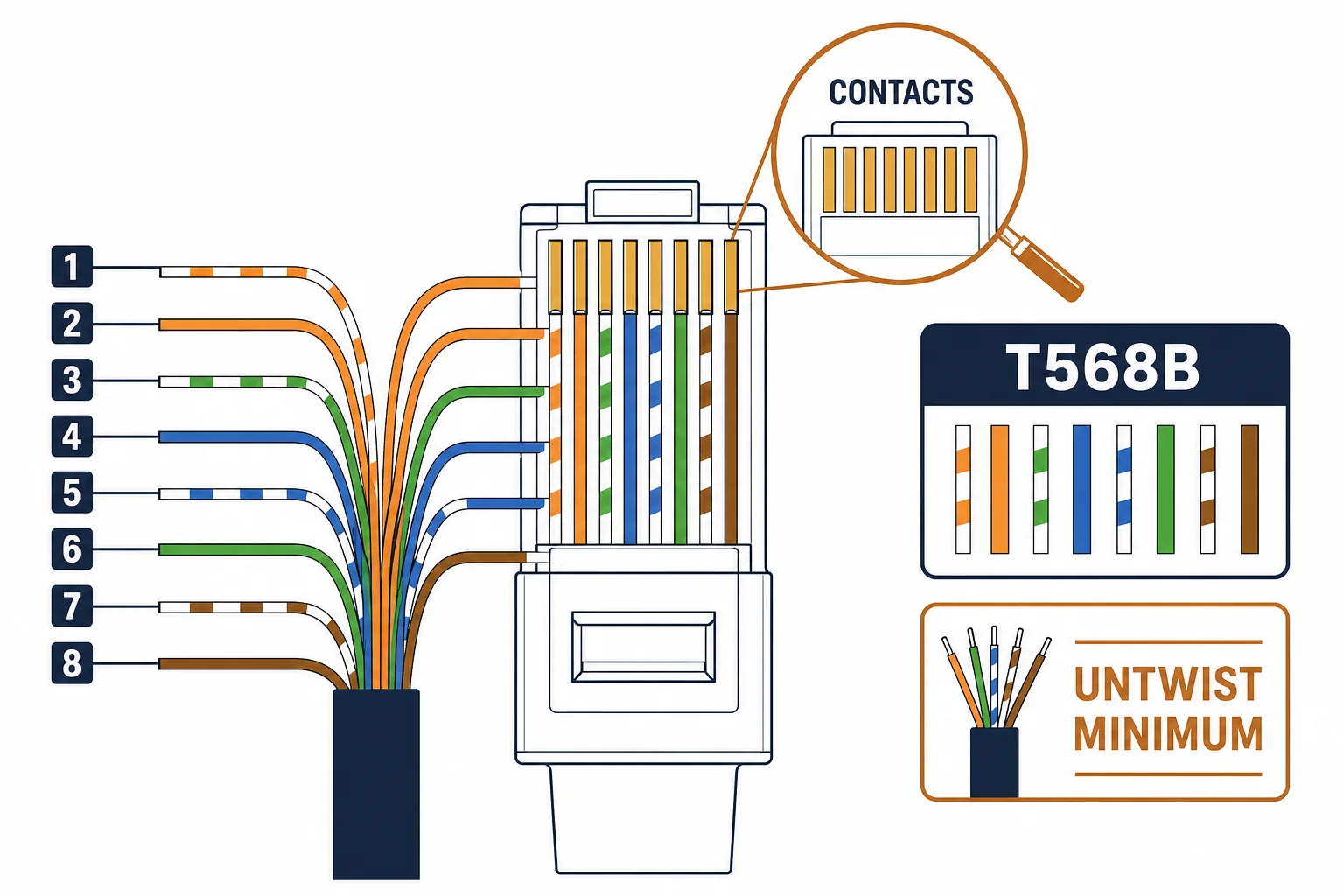
RJ45 'male' and 'female' are informal terms for a plug and a jack: the plug has the contacts and the latch, the jack has the cavity. The confusion appears in couplers and gender changers, where a product may present two jacks, two plugs, or one of each – and the wrong one cannot be used.
This is the connector guide: what the terms mean in practice, the four combinations sold, and the checks that stop a wrong-gender purchase.
The Terms in Practice
| The term | The physical part | Where it appears |
|---|---|---|
| Male | Plug with contacts and latch | Ends of patch cords |
| Female | Jack with a cavity | Wall plates, panels, couplers |
| Male to male | Plug at both ends | A normal patch cord |
| Female to female | Jack at both ends | A coupler |
The vocabulary is borrowed from plumbing and only approximately useful; the physical part is what matters at the counter.
The Four Combinations
- Male to male: the standard cord – device to outlet, or panel to switch
- Female to female: a coupler joining two cords – a joint in the channel
- Male to female: an adapter for a fixed socket that needs relocating
- Bare end: cable for field termination, not a connector
Most purchases are male-to-male, which is why the other three cause confusion when they arrive.
The Checks
| The check | The question |
|---|---|
| What it plugs into | Jack or plug? |
| Category | Does the connector carry the cable's category? |
| Shield | Shielded shell where the cable is shielded? |
| Joint count | Is a coupler adding a failure point? |
Standards and Verification
| The reference | The relevance |
|---|---|
| IEC 60603-7 | The RJ45 interface |
| TIA-568.2-D | Connector and channel requirements |
| Field test | Continuity and channel test after assembly |
Per-SKU connector gender and wiring are not provided in the knowledge base. The interface is standard; confirm the physical part in the product photograph before ordering.
Real-World Applications
The coupler purchase
A buyer ordering 'male to male' to join two cords: the coupler that arrived was female to female, which was correct – the naming had been the confusion, not the product.
The tight cabinet
A recessed socket behind a fixed panel: a short male-to-female adapter brought the connection forward – no re-termination, no new cable.
The coupler chain
Three couplers used to reach a far desk: the channel tested marginal. Replaced by one correctly sized cable – the joints removed, the margin restored.
Related reading: The wiring pattern inside the plug? Read T568A versus T568B — blogs/news/t568a-vs-t568b
Related reading: The couplers that join two cords? Read the coupler guide — blogs/news/ethernet-coupler-junction-box
Frequently Asked Questions
Is a patch cord male to male?
Yes – a plug at each end is a male-to-male assembly, which is what most cords are.
What is a female RJ45?
A jack: the socket in a wall plate, patch panel or coupler that a plug inserts into.
Do I need a male-to-female adapter?
Only when a fixed socket must be extended to a reachable position – for example behind a panel.
Does a coupler affect performance?
It adds insertion loss and a failure point. Keep total channel length within 100 m and test after joining.
Sourcing cables for a project, a store, or a private-label line? Contact our B2B sales team for specifications, certification evidence, and volume terms – FOB and CIF options available. Request a quote or sample.