
Right Angle RJ45: Clearance and Cost
Quick answer / TL;DR: Short answer: use right angle RJ45 connectors where a straight plug will not fit – shallow enclosures, wall-mounted displays, tight skirting. Choose the angle direction deliberately (down, up, left or right), keep the cable supported within a few centimetres of the plug, and prefer factory-moulded assemblies over field-terminated right-angle plugs, which are harder to crimp correctly.
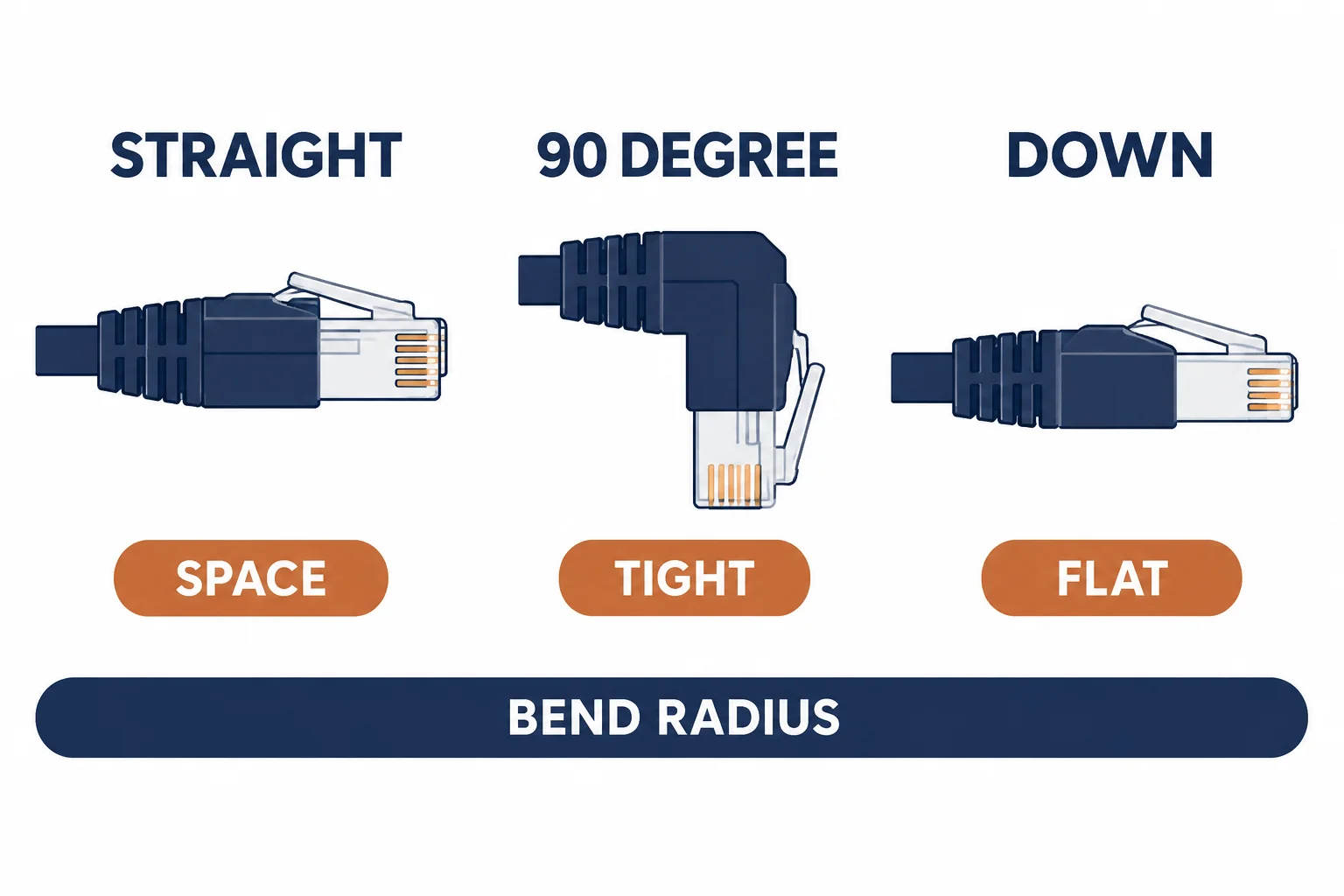
A right angle RJ45 connector turns the cable ninety degrees at the plug, which buys clearance in a shallow cabinet, behind a wall-mounted screen, or against a skirting board. The clearance is real and so is the cost: the cable bends immediately behind the plug, where strain relief is weakest.
This is the right-angle guide: the profiles available, the situations where the angle is the only answer, and the handling rules that keep the bend from becoming a fault.
The Profiles
| The profile | The direction | The best use |
|---|---|---|
| Straight | Out from the port | Default, best strain relief |
| 90 degree down | Downward | Wall-mounted screens, low clearance |
| 90 degree up | Upward | Under-desk positions |
| Left or right | Sideways | Narrow cabinets |
| Flat pancake | Inline | Very shallow voids |
The direction must be chosen against the installation, not against the catalogue: the wrong angle is as unusable as a straight plug.
What the Angle Costs
- Bend radius: the cable turns immediately at the plug's exit
- Strain: the jacket takes the load at a point with little relief
- Field termination: right-angle plugs are harder to crimp consistently
- Replacement: less common in stock, so spares matter
The angle trades mechanical convenience for a tighter bend, which is why support close to the plug is not optional.
Where It Is the Only Answer
| The situation | The reason |
|---|---|
| TV mounted flat to a wall | No depth behind the panel |
| Shallow floor box | Lid will not close over a straight plug |
| Cabinet against a wall | Clearance measured in centimetres |
| Skirting-level outlet | Cable must run along the wall |
Standards and Verification
| The reference | The relevance |
|---|---|
| IEC 60603-7 | The plug interface |
| TIA-568.2-D | Cord and bend-radius practice |
| Continuity test | After field termination, pin by pin |
Per-SKU angle and depth dimensions are not provided in the knowledge base. Measure the available clearance before ordering; the plug body depth varies by product.
Real-World Applications
The wall-mounted TV
A screen hung 25 mm from the wall: a down-angled RJ45 cord, clipped to the bracket – the connector fitting where a straight plug could not.
The floor box
A recessed floor box with a flush lid: right-angle plugs on both ports, the lid closing cleanly – the alternative was a new, deeper box.
The field-terminated failure
A right-angle plug crimped in the field: two contacts marginal and the link intermittent when the cable was touched. Replaced with a moulded assembly – the termination difficulty made visible.
Related reading: The outlet the angled plug reaches — blogs/news/ethernet-wall-plate-buying
Related reading: The slim cords used in dense panels — blogs/news/cat6a-slim-patch-cable
Frequently Asked Questions
When should I use a right angle RJ45?
When a straight plug will not fit – shallow cabinets, wall-mounted screens, tight skirting.
Does the angle affect performance?
The connector does not change the category, but the tighter bend can damage the cable if unsupported.
Are field-terminated right-angle plugs reliable?
They are harder to crimp correctly; factory-moulded assemblies are the safer choice.
How do I choose the direction?
Measure the installation: which way the cable must leave the port determines down, up or sideways.
Sourcing cables for a project, a store, or a private-label line? Contact our B2B sales team for specifications, certification evidence, and volume terms – FOB and CIF options available. Request a quote or sample.