
RCA to 3.5mm: The Adapter Cable
Quick answer / TL;DR: Short answer: a 3.5 mm TRS to dual RCA cable carries stereo in one direction – 3.5 mm to RCA for feeding an amplifier, RCA to 3.5 mm for feeding a recorder or powered speakers. Start with the source volume low when the source is a headphone output, and check whether the jack is TRS or TRRS before assuming the microphone path.
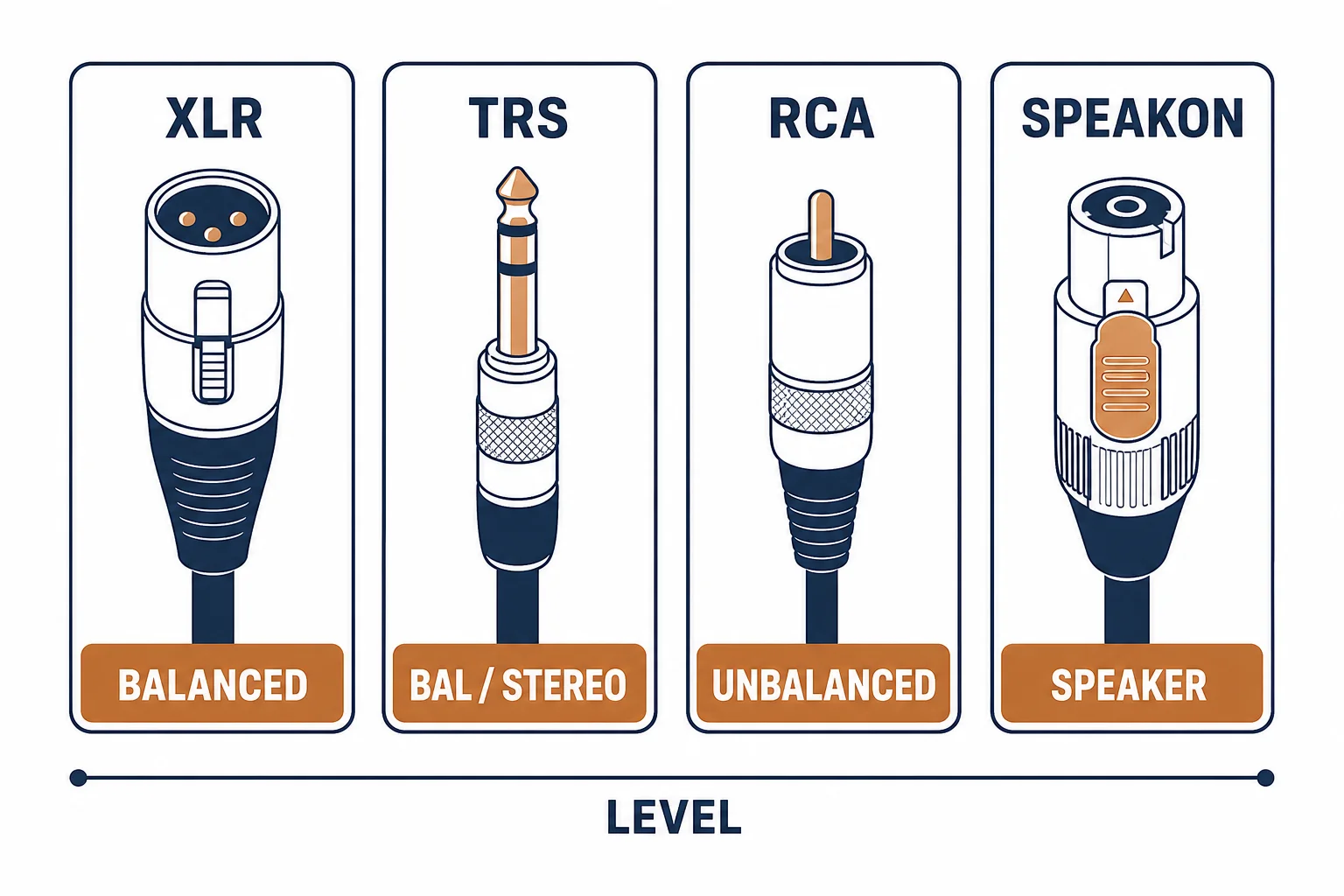
An RCA to 3.5 mm cable connects a consumer jack to a component with RCA inputs or outputs: a phone to an amplifier, a mixer to a portable recorder. The wiring is simple and the level question is not – a headphone output and a line output behave very differently.
This is the adapter-cable guide: the wiring variants, the level mismatch that causes distortion or silence, and the direction that decides which end goes where.
The Wiring
| The end | The conductors | The signal |
|---|---|---|
| 3.5 mm TRS | Tip, ring, sleeve | Left, right, ground |
| Dual RCA | Two centre pins plus rings | Left and right |
| Direction | One way | Source to destination |
The cable is two coaxial leads joined to one TRS plug; there is no electronics in it.
The Level Question
- Headphone output: variable, can overload a line input
- Line output: fixed, correct for line inputs
- Microphone input: far too sensitive for either
- Set the source low, raise until just before distortion
The level mismatch produces either a harsh, clipped sound or a signal too quiet to use – both are cured at the source, not the cable.
The Direction
| The use | The cable |
|---|---|
| Phone to amplifier | 3.5 mm to dual RCA |
| Mixer to recorder | Dual RCA to 3.5 mm |
| Laptop to powered speakers | 3.5 mm to 3.5 mm |
| Turntable to preamp | RCA plus a separate earth |
The direction decides which plug is at the source; the signal path is otherwise symmetric.
Standards and Verification
| The reference | The relevance |
|---|---|
| IEC 60268 | Audio interconnection |
| CTIA / OMTP | TRRS conventions |
| Continuity test | Tip, ring and sleeve discrete |
Per-device output levels are not provided in the knowledge base. The level rules are general; check the device manual for its output type.
Practical Notes
A TRRS jack used with a TRS cable can mute or misroute a channel on some devices. If one channel is missing, check the jack type before condemning the cable.
Real-World Applications
The phone to hi-fi
A phone feeding an amplifier's aux input: a 3.5 mm to dual RCA cable, source at 70 percent – loud and clean without clipping the input.
The missing channel
A laptop with a TRRS jack and a TRS cable: the right channel silent. A TRS-compatible output setting used, or a TRRS-aware cable – the wiring, not the cable's quality, was the cause.
The recorder feed
A mixer's RCA outputs to a portable recorder's 3.5 mm input: dual RCA to 3.5 mm, levels set at the mixer – a clean recording without touching the cable again.
Related reading: The RCA cable guide — blogs/news/rca-cable-guide
Related reading: The 3.5 mm jack variants — blogs/news/3-5mm-audio-cable
Frequently Asked Questions
Does an RCA to 3.5mm cable work in both directions?
Electrically yes, but the level and impedance suit one direction better.
Why is the sound distorted?
The source is a headphone output turned up into a line input.
Why is one channel missing?
Often a TRRS jack with a TRS plug, or a faulty plug.
Is a cheap cable adequate?
For short runs at line level, generally yes; the plugs are the weak point.
Sourcing cables for a project, a store, or a private-label line? Contact our B2B sales team for specifications, certification evidence, and volume terms – FOB and CIF options available. Request a quote or sample.