
RCA Splitter: One Output, Two Loads
Quick answer / TL;DR: Short answer: a passive RCA splitter is fine for feeding two line-level inputs a metre or two away, at the cost of a small level drop. For long runs, three or more destinations, or where hum appears, use a powered distribution amplifier. Never use a splitter backwards to combine two outputs into one input.
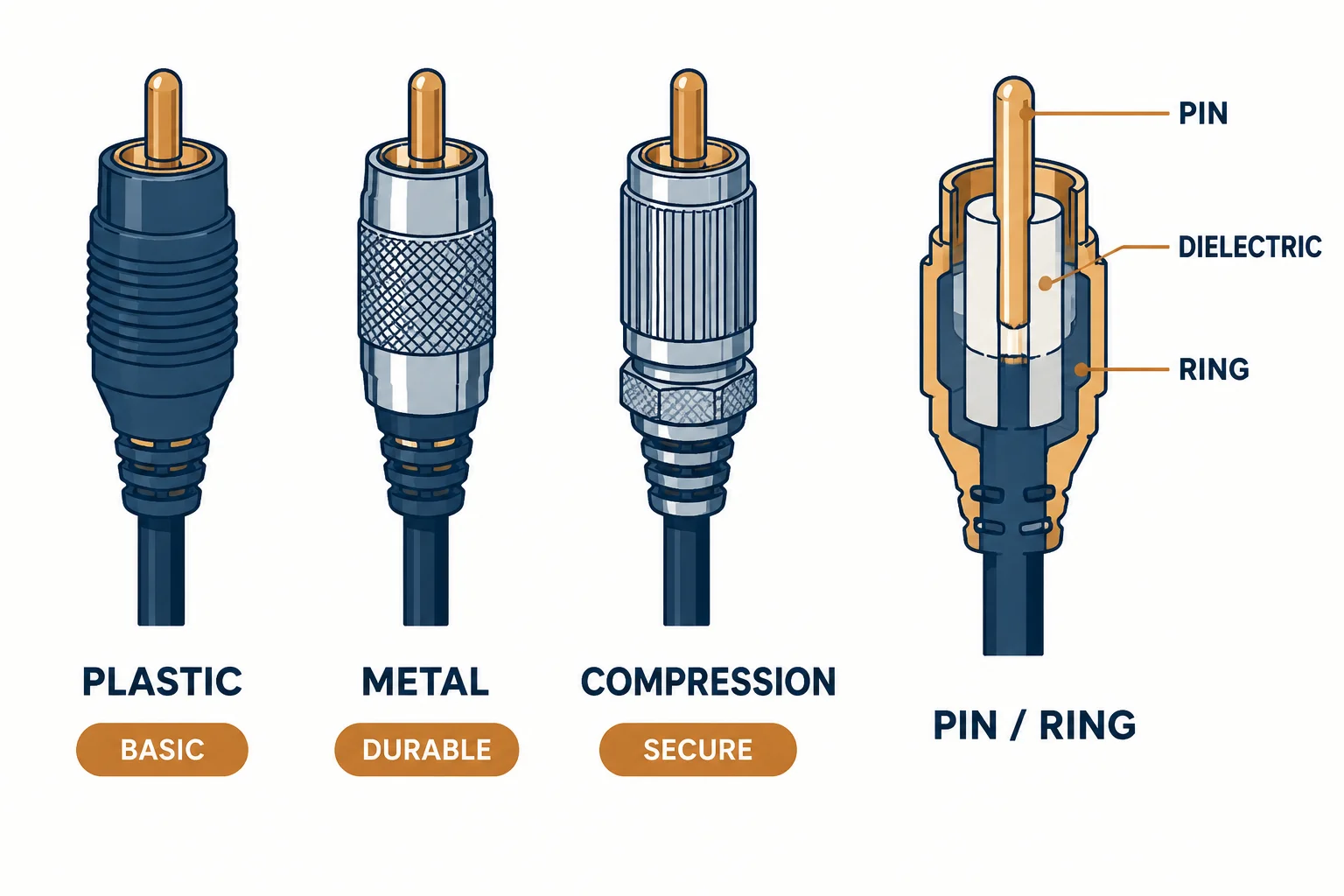
An RCA splitter is a passive Y-joint that feeds one output to two inputs. It works because line-level outputs are low impedance and inputs are high impedance, so the load barely changes – but it also halves the signal to each destination and can create ground loops between two devices.
This is the splitter guide: what the Y-joint does electrically, the symptoms of a bad split, and the cases where an active distribution amplifier is the correct product.
What the Y-Joint Does
| The arrangement | The effect | The symptom |
|---|---|---|
| One output, two inputs | Signal shared | Slight level drop |
| Two outputs, one input | Outputs fight each other | Distortion, possible damage |
| Long cable runs | Capacitance adds | High-frequency loss |
The passive split is a shared connection: each destination sees the same source through a slightly heavier load.
Where It Works
- Two inputs within a couple of metres
- Similar input impedances
- Line level, not phono or microphone
- No ground-loop hum in the installation
The conditions are modest: short, similar and quiet. Outside them the splitter's simplicity becomes the problem.
When to Use a Distribution Amplifier
| The situation | The answer |
|---|---|
| Three or more destinations | Distribution amplifier |
| Runs over a few metres | Amplifier or balanced conversion |
| Hum after splitting | Isolation transformer |
| Critical listening | Amplifier with separate outputs |
The amplifier provides isolated outputs, which solves both the level drop and the ground-loop problem at once.
Standards and Verification
| The reference | The relevance |
|---|---|
| IEC 60268 | Audio interconnection |
| Line level | Nominal levels the split assumes |
| Continuity test | Tip and sleeve through the split |
Per-SKU splitter construction is not provided in the knowledge base. The passive principle is standard; test for hum after installation rather than assuming.
Practical Notes
The most common misuse is combining: two sources into one input through a Y-joint. The outputs drive each other, distortion rises, and in some equipment the output stage is damaged. A small mixer is the correct tool.
Real-World Applications
The two-room feed
A streamer feeding a living-room amplifier and a kitchen input: a passive splitter with 1 m cables – level adequate on both, no hum.
The hum that appeared
The same feed after a third device was added: hum on both outputs. An isolation transformer on one leg removed it – the ground loop, not the splitter, was the problem.
The reversed splitter
Two sources combined into one input: distortion at every level. A small mixer substituted – the outputs had been driving each other.
Related reading: Audio sharing at line level — blogs/news/audio-output-cable
Related reading: The 3.5 mm equivalent — blogs/news/headphone-splitter
Frequently Asked Questions
Does an RCA splitter reduce quality?
It shares the signal and adds a small level drop; at short distances the effect is minor.
Can I use one backwards?
No – combining two outputs can distort and damage equipment.
Why is there hum after splitting?
A ground loop between the two destinations; an isolation transformer fixes it.
When do I need an amplifier?
Three or more destinations, long runs, or where hum and level loss matter.
Sourcing cables for a project, a store, or a private-label line? Contact our B2B sales team for specifications, certification evidence, and volume terms – FOB and CIF options available. Request a quote or sample.