
RCA Patch Cables: Colour and Impedance
Quick answer / TL;DR: Short answer: RCA patch cables carry unbalanced audio in pairs (white left, red right) and composite video on yellow. For digital S/PDIF or video, use a 75-ohm coaxial RCA cable rather than an audio lead. Keep unbalanced runs short – a few metres – and expect hum on long runs near power.
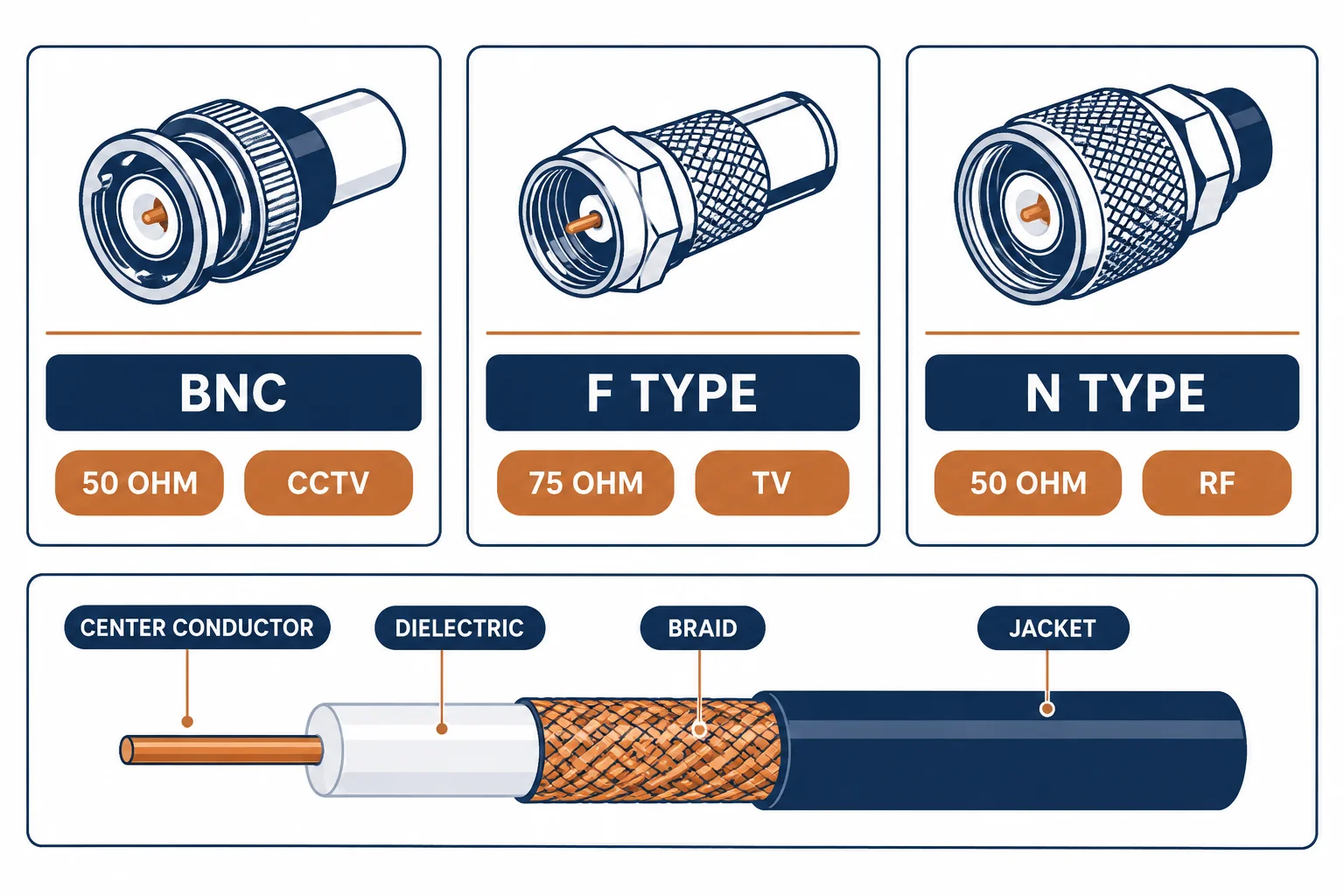
An RCA patch cable is a single-conductor coaxial lead with a centre pin and an outer ring: simple, cheap, and asked to do two different jobs. For line-level audio it carries an unbalanced signal; for composite video or digital S/PDIF it must be a 75-ohm coaxial cable. The same plug, two specifications.
This is the RCA patch guide: the colour conventions, the impedance distinction, and the lengths where an unbalanced lead starts to pick up noise.
The Colour Conventions
| The colour | The signal | The note |
|---|---|---|
| White | Left audio | Convention, not a standard |
| Red | Right audio | Convention, not a standard |
| Yellow | Composite video | Analogue video |
| Orange | Digital coaxial | S/PDIF often uses orange or black |
The colours are conventions inherited from consumer equipment; the plug is identical and the cable behind it may not be.
The Impedance Question
- Audio lead: flexible coaxial, impedance unspecified, fine for line level
- 75-ohm coaxial: required for video and S/PDIF to avoid reflections
- Using an audio lead for digital: usually works short, fails unpredictably long
- Using a video cable for audio: harmless but unnecessary
The distinction matters because a digital signal punishes impedance mismatch in ways an analogue audio signal does not.
Length and Noise
| The use | The practical length |
|---|---|
| Line-level audio | Up to a few metres |
| Turntable to preamp | Keep short, earth carefully |
| Composite video | Moderate lengths with 75-ohm cable |
| S/PDIF coaxial | Within the 75-ohm spec, moderate length |
Standards and Verification
| The reference | The relevance |
|---|---|
| IEC 60958 | The S/PDIF digital audio interface |
| IEC 60268 | Audio interconnection practice |
| Continuity test | Centre to centre, shell to shell, no short |
Per-SKU impedance and conductor data are not provided in the knowledge base. The 75-ohm requirement for digital and video is standard; confirm the cable type before using an audio lead for S/PDIF.
Real-World Applications
The turntable
A record player to a preamp: a short RCA pair with a separate earth lead – hum eliminated by keeping the run short and the earth solid.
The S/PDIF substitution
An audio RCA lead used for digital coax: working for a metre, dropping out at four. Replaced with 75-ohm cable – the impedance mismatch found by length.
The colour mix-up
A system wired red-to-white at one end: the stereo image inverted. Re-plugged by colour and labelled – the convention earning its keep.
Related reading: The digital coax variant in detail? Read the digital coaxial RCA guide — blogs/news/digital-coaxial-rca-buying
Related reading: The cords named by their colours? Read what the yellow red and white cords are — blogs/news/rca-cord-naming
Frequently Asked Questions
Are all RCA cables the same?
No – audio leads and 75-ohm coaxial video/digital cables share the plug but differ in construction.
Can I use an audio RCA cable for S/PDIF?
It often works at short lengths but is outside the 75-ohm specification and can fail unpredictably.
What do the colours mean?
White left, red right, yellow composite video – conventions, not standards.
How long can an RCA run be?
Keep unbalanced audio to a few metres; digital and video need 75-ohm cable for longer runs.
Sourcing cables for a project, a store, or a private-label line? Contact our B2B sales team for specifications, certification evidence, and volume terms – FOB and CIF options available. Request a quote or sample.