
Car Audio RCA Cable — 99.99% OFC, Double-Shielded, 2/4/6-Channel
Factory-direct low-level interconnect for head units, DSPs and amplifiers.
Twisted-pair OFC conductors, foil-plus-braid shielding and gold-plated split-pin
RCA plugs, built in 1 m to 6 m runs with your jacket, colour code and
packaging.
Get a Factory Quote
See Specifications
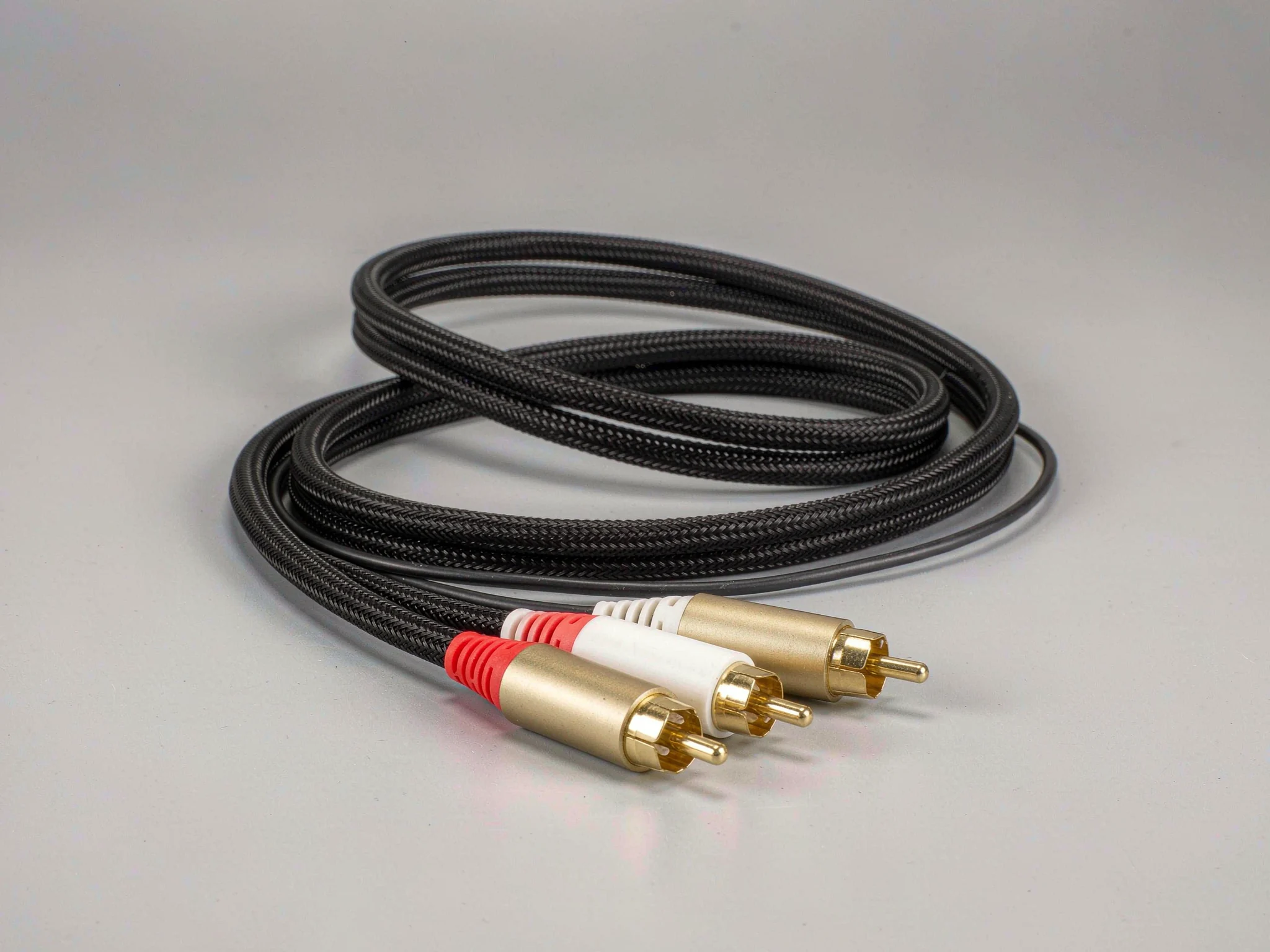
A car audio RCA cable carries the low-level, un-amplified audio signal from the head unit,
DSP or line output converter to the amplifier — typically 1–2 V at low impedance.
For a noise-free install, specify four things: 99.99% oxygen-free copper conductors, a twisted pair,
foil-plus-braid double shielding, and gold-plated split-pin plugs. Keep the run as short as the
routing allows. The ZOGUO ZG-CAR02 series covers 2-, 4- and 6-channel configurations from
1 m to 6 m, with OEM jacket, colour and packaging options.
Alternator whine rarely starts at the amplifier. It arrives on the RCA cable — a
low-level signal of a volt or two, sharing a steel chassis with a 14.4 V charging system, an
ignition coil, a fuel pump and a class-D output stage switching at hundreds of kilohertz.
Rockford Fosgate’s signal-integration guide draws the line clearly: low-level audio is an
un-amplified signal, usually 4 V and below, and a good-quality RCA source should sit around
1–2 V with low impedance. Anything below roughly 100 mV, or above about
500 Ω of source impedance, is a candidate for a line driver rather than a better cable.
At that signal level, a few tens of millivolts of induced noise is already audible against a
quiet passage. The cable is the least expensive part of the system, and it is the part that
decides whether that noise ever reaches the speakers.
This page covers what the ZG-CAR02 is built from, why each layer exists, how to pick the
channel count and length, and where the cable is specified in real installs.
What a Car Audio RCA Cable Actually Does
The cable carries two channels of unbalanced line-level audio from a source to an amplifier.
Each channel needs a centre conductor to carry the signal and a return path for ground. Because
the interface is unbalanced, any voltage difference between the head unit’s ground and the
amplifier’s ground appears in series with the audio itself. That single mechanism explains most
of the “my amp has alternator whine” complaints that get blamed on the amplifier.
The signal is small; the electrical environment is not
A moving-coil pickup in a turntable and a head unit pre-out live in the same millivolt-to-volt
territory, but only one of them is installed next to a 100 A alternator. Under the dash you
have rectified alternator ripple, ignition noise, PWM dimming for interior lighting, and the
switching carrier of every class-D amplifier in the vehicle. All of it couples into nearby
conductors capacitively and inductively. The cable’s job is to keep that coupling out of the
audio band.
Twisted pair versus coax
Coax puts the return current on a braided sleeve wrapped around the centre conductor. A twisted
pair gives both conductors the same exposure to an interfering field, so the induced voltage
appears almost equally on each leg and cancels at a differential input. Most modern car
amplifiers use differential RCA inputs, which makes a twisted pair the better match. Twisting
alone does not stop electric-field coupling, so a foil-and-braid shield sits over the pair to
handle that part of the problem.
Why the shield should not be your signal ground
When a shield is tied to signal ground at both ends, it becomes a parallel path for ground
current between the head unit and the amplifier. Any potential difference between those two
chassis points then drives current through the shield, and the audio rides on top of it. ZOGUO
terminates the shield at the source end only, and keeps the signal return on its own dedicated
drain wire, so the shield does its job without becoming a ground loop.
Construction, Layer by Layer
Six layers decide how a car audio RCA cable behaves. Each one has a measurable specification
and a failure mode when it is skipped.
| Layer | Material | Function | What to check |
|---|---|---|---|
| Conductor | 99.99% OFC, 22 AWG (20 AWG option) | Carries the audio signal | OFC, not CCA — scrape a strand |
| Dielectric | Foamed polyethylene | Holds geometry, keeps capacitance low | pF per metre on the datasheet |
| Pair | Two insulated conductors, twisted | Common-mode noise rejection | Consistent twist pitch end to end |
| Shield 1 | Aluminium foil, bonded to dielectric | 100% electrostatic coverage | Foil bonded, not loose |
| Shield 2 | Tinned copper braid, ≥95% coverage | RF rejection plus flex life | Coverage percentage, braid density |
| Jacket | Nylon braid or PVC, −20 °C to 80 °C | Abrasion, heat and chafe protection | Braid adhesion, bend radius |
| Connector | Gold-plated brass, split centre pin | Contact resistance and retention | Plating thickness, spring tension |
Conductor: oxygen-free copper, not CCA
Copper-clad aluminium is cheaper and shows up in low-cost car audio RCA cables because the
current is small and the voltage drop is easy to hide. It also work-hardens and fractures at the
point where the cable exits the connector — exactly where a door loom or a seat rail flexes
it. ZG-CAR02 uses 99.99% OFC strands throughout, at 22 AWG as standard and 20 AWG on
request for longer runs.
Shielding: foil plus braid, not one or the other
Foil handles electric fields across the full audio band and beyond; braid handles the higher
frequencies and survives repeated flexing. A cable with foil only becomes brittle at the fold
points behind a dashboard. A cable with braid only leaves gaps that a switching amplifier can
exploit. Running both, with the foil bonded to the dielectric, gives coverage that stays stable
after installation.
Connectors: split pin, gold plate, tight barrel
The RCA interface has no locking mechanism. Retention comes entirely from the spring of the
outer ring and the split in the centre pin. A four-segment split pin keeps tension after
repeated insertion; a single slit relaxes. Gold plating over nickel keeps contact resistance
stable in the humidity and temperature swings of a vehicle interior. The connector is also where
most cheap cables fail mechanically, so ZOGUO moulds a strain relief that overlaps the jacket by
at least 8 mm.
Specifications — ZG-CAR02 Series
The table below is the standard build. Length, conductor gauge, jacket material, colour code
and printing are all made to order, so treat these as the baseline for your own specification
sheet rather than a fixed catalogue.
| Model | ZG-CAR02 (2-ch) / ZG-CAR04 (4-ch) / ZG-CAR06 (6-ch) |
| Connector type | RCA male to RCA male, 8.3 mm barrel, 3.2 mm centre pin |
| Channels | 2, 4 or 6 (one to three twisted pairs) |
| Conductor | 99.99% oxygen-free copper, 22 AWG standard / 20 AWG option |
| Shielding | Aluminium foil (100%) + tinned copper braid (≥95% coverage) |
| Nominal impedance | 75 Ω |
| Capacitance | ≤60 pF/m conductor to shield |
| Jacket | Nylon braid, PVC or cotton sleeve; −20 °C to 80 °C |
| Lengths | 1, 2, 3, 5, 6 m (custom lengths to 10 m) |
| Colour coding | Red = right, white or black = left; custom colours on request |
| Remote lead | Optional 20 AWG remote turn-on conductor in the same jacket |
| Packing | Polybag, foil bag, colour box, gift box or full OEM packaging |
| Production time | 30–40 days after sample approval |
| Quality system | ISO 9001 factory; CE and RoHS documentation per shipment |
2-Channel vs 4-Channel vs 6-Channel
Channel count is not a quality decision, it is a system-topology decision. Buy the number of
pairs the amplifier actually needs and no more — unused channels add cost, bulk behind the
dash and another connector to work loose.
| Configuration | Pairs | Typical system | Best for |
|---|---|---|---|
| 2-channel | 1 | Mono subwoofer amplifier, or a single 2-channel amp on front speakers | Entry upgrades, powered subwoofers, spare-wheel sub builds |
| 4-channel | 2 | One 4-channel amp driving front and rear, or a DSP with four inputs | The most common retail package; component fronts plus coaxial rears |
| 6-channel | 3 | DSP front / rear / sub, or a 5-channel amp plus a sub feed | Active three-way fronts, competition builds, OEM integration with a DSP |
One practical note: if the plan is to add a DSP later, run the 6-channel cable now. Pulling a
second cable through a finished door loom or under a carpet is a two-hour job, and the cable
itself costs a fraction of that labour.
Choosing the Length: Measure the Route, Not the Distance
The most common length mistake is measuring the straight-line distance from the dash to the
amplifier and then subtracting for slack. The cable has to follow the actual route: down the
centre console, along the sill, behind the rear quarter panel, then forward to the amp. That
path is typically 1.4 to 1.8 times the straight-line distance.
Go the other way: run a length of string along the intended route, then add 0.5 m at each
end for service loops and connector access. Two rules follow from that:
- Do not coil the excess. A tight coil of unused cable behaves like a choke
and can pick up the very field you paid to shield against. Fold the slack loosely and tie it
away from the power run. - Do not stretch the run. A cable under tension pulls on the connector
barrel, and the centre pin loses spring tension over a heating and cooling cycle.
Real Installation Scenarios
Four builds where the specification above makes a measurable difference. These sit alongside
the rest of our car electronics range, which
covers charging, USB-C data and in-vehicle power accessories.
Hatchback with a powered subwoofer
A factory head unit feeds a line output converter, which feeds an under-seat powered sub
through a 5 m 2-channel run. The converter output is often below 500 mV, so the
shield and the twisted pair do most of the work. Route down the opposite sill from the
amplifier power lead and cross at 90° if they must meet.
Four-channel amp, front components plus rears
A 3 m 4-channel cable from the dash to an amplifier in the boot, with two pairs
carrying front and rear. The shorter front pair is the one that matters: it runs closest to
the vehicle’s main harness and the climate-control blower, which is a strong noise source.
Active three-way front stage with a DSP
A 6-channel cable feeds the DSP’s inputs, and the DSP’s outputs run to a multi-channel
amplifier. Keep the input run on the opposite side of the vehicle from the amplifier power
cable and from any class-D output wiring, which radiates far more than the DC feed.
UTV, ATV and centre-console marine
Vibration and water are the constraints here, not noise. The braided jacket and the moulded
strain relief take the abrasion; specify tinned copper and a UV-stable jacket if the cable
will sit in an open cockpit. Add dielectric grease to the connector shells at assembly.
Installation Practices That Protect the Signal
No cable recovers a signal that was compromised at installation. These five points cover
almost every noise complaint we see come back through a distributor.
- Separate signal from power. Run the RCA down one side of the vehicle and
the amplifier’s +12 V feed down the other. Where they must cross, cross at 90° so the
coupling area is minimised. - Ground the amplifier to bare chassis metal. Scrape the paint back to steel,
use a star washer, and keep the ground lead under 1 m. A long ground lead raises the
resistance that turns a small potential difference into audible noise. - Use the remote turn-on wire, not a switched accessory tap. The head unit’s
remote output is designed to sequence the amplifier with the source. Tapping an ignition circuit
adds switching transients straight into the amplifier’s trigger. - Test with the engine running. A system that is silent with the ignition off
and noisy at idle has a grounding or routing problem, not a cable problem — but you only
find that out if you test in the right condition. - Do not daisy-chain more than two amplifiers on one shield. Each additional
ground reference adds another path for current. Use a distribution block or a line driver with
isolated outputs instead.
OEM and ODM Options
ZOGUO has manufactured cable assemblies in Guangdong since 2000. For a car audio RCA programme,
the customisable variables are:
- Length and gauge — any length from 0.5 m to 10 m, 22 or
20 AWG, with or without a remote conductor. - Jacket and colour — nylon braid, PVC, cotton sleeve; moulded or
machined connector shells in your colourway. - Branding — laser-etched or pad-printed logo on the connector barrel,
printed heat-shrink, and retail-ready packaging with your own artwork. - Compliance package — CE and RoHS declarations, plus a batch test
report covering continuity, insulation resistance and shield coverage. - Packaging — polybag, foil bag, colour box, gift box, or a
customer-supplied design.
Send a drawing or a competitor sample and we will return a matched specification with a
quotation. Existing RCA programmes on this site include the
ZG-AVR02
general-purpose audio RCA cable, if your requirement is home or pro audio rather than
in-vehicle, inside the wider
audio and video cable range. Every order
ships with a batch test report covering
continuity, insulation resistance and shield coverage.
Frequently Asked Questions
What gauge is a car audio RCA cable, and does it matter?
Most car audio RCA cables use 22 AWG centre conductors; 20 AWG
is used for longer runs or lower-loss builds. At line level the current is tiny, so gauge affects
resistance far less than shielding and capacitance do. A 22 AWG OFC twisted pair will
outperform a 20 AWG CCA cable with poor shielding in every real installation.
Will a more expensive RCA cable really remove alternator whine?
It removes the part of the noise that couples into the cable, which is
usually most of it. It will not fix a ground loop created by a poor amplifier ground, a
daisy-chained ground, or a head unit with a damaged ground trace. Diagnose first: unplug the
RCA at the amplifier end and listen. If the noise stops, the cable or its routing is the
problem. If it continues, look at grounding.
Can I use one car audio RCA cable for a subwoofer only?
Yes. A mono subwoofer amplifier needs one channel, so a 2-channel cable
gives you a spare leg for a second amp later, or a Y-split feed. Use a proper splitter rather
than twisting two centre pins together, and keep both legs the same length if you split.
What is the difference between 2-channel and 4-channel RCA cables?
A 2-channel cable contains one twisted pair and carries left and right.
A 4-channel cable contains two pairs and carries front left/right plus rear left/right, or four
DSP inputs. The conductors are identical; only the number of pairs and the overall diameter
change.
Why does my RCA cable pick up noise only when the engine is running?
Because the alternator is the source. Rectified ripple on the charging
system couples into the signal path, and a ground potential difference between the head unit and
the amplifier turns that ripple into current through the shield. Move the RCA away from the
power feed, shorten the amplifier ground, and confirm the shield is terminated at one end
only.
Do I need a remote turn-on wire inside the RCA cable?
It is convenient rather than mandatory. Many head units provide a separate
remote output that you can run alongside. Bundling a 20 AWG remote conductor inside the
RCA jacket simplifies the install and keeps the trigger away from power wiring, which is why we
offer it as an option on the ZG-CAR02 series.
What length RCA cable do I need for a car?
Measure the route with string, not the straight-line distance, then add
0.5 m at each end. A dash-to-boot run in a sedan is usually 5 m; a dash-to-under-seat
run is usually 3 m; a hatchback with a rear-quarter amplifier is usually 5 m. Never
coil the excess tightly.
Request a Free Sample or a Factory Quote
Tell us the channel count, length and jacket you need, and whether a remote turn-on conductor
is required. We will return a matched specification and a quotation, usually within one working
day, and ship a sample before you commit to volume.
Send Your Requirement
OEM / ODM Support
Sources
- Rockford Fosgate, How To: Audio Signal Integration (Technical Volume 5, 2013),
pp. 1–2 — defines low-level RCA audio as an un-amplified signal of roughly
4 V and below, cites 1–2 V with low impedance as the target for a good RCA
source, and describes the remote turn-on conductor.
rockfordfosgate.com (PDF) - Wikipedia, RCA connector — origin in the 1930s, 8.3 mm shell and
3.2 mm centre pin dimensions, unbalanced hot-and-ground topology, 75 Ω cable
convention, and the red-right / white-left colour code.
en.wikipedia.org - Crutchfield, Processors & Line Output Converters: How-To, FAQ and Buying Guide
— reference for line output conversion and pre-amp signal handling in vehicles.
crutchfield.com
Specifications in Tables 1 and 2 describe the ZG-CAR02 standard build and are
supplied for evaluation. Confirm the final bill of materials against your approved sample before
release.